
Product
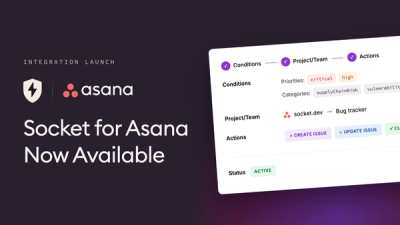
Socket for Asana Is Now Available
Create and manage Asana tasks directly from Socket alerts, with manual task creation, automated ticketing rules, and two-way sync.
By Jeppe Hasseriis - Aug 25, 2026
memory-vault
Advanced tools
Claude-style memory over a local folder, served via MCP — per-project spaces plus a shared org layer. Harness-neutral, customer-owned.
An organizational memory layer that works with any harness, any model. Customer-owned, permission-first, harness-neutral.
Thesis: the harness is temporary, the model is temporary, the memory is the org. The vault holds the one asset that survives every model swap and every vendor switch.
Local-only, zero dependencies, one file (server.mjs). The store is a plain directory (memory/) of markdown files with MEMORY.md indexes — the same shape Claude Code keeps its own memory in. The server exposes exactly Claude's core memory commands over MCP — view, create, str_replace, insert, delete, rename — sandboxed to the requesting project's slice of that folder. No search engine, no database, no auth: the model maintains the index, checks for duplicates, and decides what to keep, guided by the server's instructions. Files are the source of truth — edit them by hand, grep them, sync the folder with git.
memory/
  MEMORY.md               # vault index: one line per space
  shared/                 # org-wide memory, read-write from every project scope
    MEMORY.md
  <project>/              # one space per project, isolated from the others
    MEMORY.md
    *.md
    skills/<name>/        # whole skill folders scraped into the vault
The scope is carried in the URL: POST /mcp/<project> sandboxes a session to memory/<project>/ plus shared/; bare POST /mcp is the unscoped whole-vault view — the org "gardener" scope for pruning across projects and promoting facts into shared/.
npm start # serves ./memory at http://localhost:8787 (127.0.0.1 only)
Env knobs: MEMORY_DIR (store location), VAULT_PORT.
Per repo (recorded in the repo's .mcp.json):
claude mcp add --transport http --scope project vault http://localhost:8787/mcp/<project>
Optionally also at user scope for the whole-vault gardener view — the project-scope entry of the same name wins inside a repo:
claude mcp add --transport http --scope user vault http://localhost:8787/mcp
New sessions get the memory tools; the server must be running.
DSH loads MCP servers as Cordis plugin instances via @deepseek-ai/dsh-mcp-client. A ready-to-use patch is in dsh-cordis.patch.yml:
# Per-session (workspace-local)
dsh --profile headless --patch ./dsh-cordis.patch.yml "your task"

# Or make it permanent by copying the entry into:
#   ~/.dsh/profiles/headless/cordis.patch.yml
#   ~/.dsh/profiles/web/cordis.patch.yml
The patch connects to the local vault at http://localhost:8787/mcp/memory-vault; tools appear as mcp__vault__view, mcp__vault__create, etc. The server must be running.
Copy markdown files into memory/<project>/ (or memory/shared/) — the store is the folder. Give each name: and description: frontmatter and an index line in that space's MEMORY.md (or let the model tidy that up next session).
First time connecting the vault on a repo that already has harness memory? Scrape it in:
node scripts/scrape.mjs <repo-path> [--dry-run] # writes into memory/<project>/
Per-harness adapters, each stamping its own source (scrape:<adapter>) and origin path:
| Adapter | Scrapes |
|---|---|
claude-memory | ~/.claude/projects/<repo-slug>/memory/*.md (Claude Code auto-memory) |
claude-instructions | CLAUDE.md, CLAUDE.local.md, .claude/CLAUDE.md |
claude-skills | .claude/skills/* (whole folders, into skills/<name>/; add --include-user-skills for ~/.claude/skills/*), .claude/commands/*.md, .claude/agents/*.md |
codex | AGENTS.md |
cursor | .cursorrules, .cursor/rules/* |
Everything lands in memory/<project>/ (project = repo dir name, override with --project) and only that project's MEMORY.md is rebuilt. Names are stable, so re-running is an idempotent refresh. --only <a,b> runs a subset of adapters (skills = claude-skills). User-level files (~/.claude/CLAUDE.md, ~/.claude/skills/) are personal, not org memory — opt in with --include-user / --include-user-skills. --dry-run previews without storing; --claude-home overrides ~/.claude (mainly for tests). Adding a harness = adding one adapter block in scripts/scrape.mjs.
MVP above is the read/write pipe. Write governance (extraction, dedup, contradiction handling, review) comes next. Strategy notes live outside this repo; see docs/ for the architecture sketch.
FAQs
Claude-style memory over a local folder, served via MCP — per-project spaces plus a shared org layer. Harness-neutral, customer-owned.
The npm package memory-vault receives a total of 488 weekly downloads. As such, memory-vault popularity was classified as not popular.
We found that memory-vault demonstrated a healthy version release cadence and project activity because the last version was released less than a year ago. It has 1 open source maintainer collaborating on the project.
Product
Create and manage Asana tasks directly from Socket alerts, with manual task creation, automated ticketing rules, and two-way sync.

Security News
Open VSX has removed three extension IDs from its malicious-extension list as the legitimate publishers they impersonated move to claim the names for themselves.

Product
Socket’s PHP and Composer support is now in Beta for all customers, with PHP reachability analysis generally available.