

Product
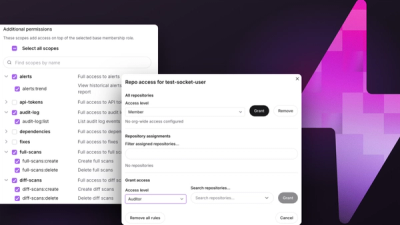
Introducing Repository Access Permissions and Custom Roles
Socket now supports Custom Roles and Repository Access Permissions so organizations can control who can access specific repositories and actions.
By Joe Werle - Jun 19, 2026
message-tag
Advanced tools


A template literal tag to format arbitrary values in a string template. Useful for error messages, logs, etc.
import msg from 'message-tag';
const time = new Date();
const user = { name: 'John' };
const message = msg`[${time}] Found user: ${user}`;
// Result: '[2018-04-22T22:19:39Z] Found user: `{"name": "John"}`'
When constructing (plain text) messages, we often want to include other JS objects, dates, etc. These need to be converted to string first, in order to interpolate them into the message template.
const log = `Current user: '${formatUserAsString(user)}'`;
Converting a JS value to a string is in general not straightforward. The toString() method only exists for objects, and even then is often useless as it just prints the type of the value (e.g. the well-known [object Object]). JSON.stringify often does the job, but includes tons of edge cases. Because JSON.stringify only prints valid JSON, it won't work as expected for values like undefined, NaN, or Infinity. For custom types, this approach also won't work unless they've implemented toJSON.
If you always know the type of the input, then these can be dealt with by using the correct formatting procedure, but getting it right is often cumbersome and error-prone.
In addition, sometimes we do not have any knowledge of the type of the input at all. This is common in the case of error handling, where we may want to construct error messages such as:
if (!(input instanceof Foo)) {
    throw new TypeError(`Expected instance of Foo, but given '${JSON.stringify(input)}' instead`);
}
Since we do not know the type of input, using JSON.stringify is optimistic here. It will produce suboptimal or cryptic results for values like NaN, functions, or custom types that don't implement toJSON().
First, import or require the msg tag:
import msg from 'message-tag';
//const msg = require('message-tag'); // CommonJS version
Values of any known, built-in type can be formatted:
msg`Message: ${undefined}`; // 'Message: `undefined`'
msg`Message: ${null}`; // 'Message: `null`'
msg`Message: ${42}`; // 'Message: 42'
msg`Message: ${[1, 2, 3]}`; // 'Message: `[1,2,3]`'
msg`Message: ${{ name: 'John' }}`; // 'Message: `{"name": "John"}`'

// Dates are formatted as ISO strings:
msg`Message: ${new Date()}`; // 'Message: 2018-04-22T22:19:39Z'

// Also works for functions:
msg`Message: ${x => x + 1}`; // 'Message: `x => x + 1`'
Instances of custom types will be printed with the name of the type, and with the contents serialized through toJSON(). If toJSON is not implemented, all enumerable properties of the instance are used instead.
class MyType {
    value = 42;

    toJSON() {
        return { value: this.value };
    }
}

msg`Custom type: ${new MyType()}`; // 'Custom type: [MyType] `{"value": 42}`'
If you want to disable formatting for a specific input, use msg.raw:
msg`Will not be formatted: ${msg.raw('foo')}`; // 'Will not be formatted: foo'
You can customize the formatting using msg.custom. For example:
msg`The date is: ${msg.custom({ dateFormat: 'mmmm dS, yyyy' }, new Date('2018-01-01'))}`;
// Result: 'The date is: January 1st, 2018'
You can also change the defaults by creating your own customized tag:
import { msgTag } from 'message-tag';

const msg = msgTag({ dateFormat: 'mmmm dS, yyyy' });
msg`The date is: ${new Date('2018-01-01')}`;
// Result: 'The date is: January 1st, 2018'
Supported options:
dateFormat: Custom format for Date objects. See the dateformat package for a complete overview of the format options.format: Formatting for JS objects. Can use any option supported by pretty-format.This package includes definitions for TypeScript.
FAQs
ES6 template literal tag to format message strings
We found that message-tag demonstrated a not healthy version release cadence and project activity because the last version was released a year ago. It has 1 open source maintainer collaborating on the project.
Did you know?

Socket for GitHub automatically highlights issues in each pull request and monitors the health of all your open source dependencies. Discover the contents of your packages and block harmful activity before you install or update your dependencies.
Product
Socket now supports Custom Roles and Repository Access Permissions so organizations can control who can access specific repositories and actions.
Product
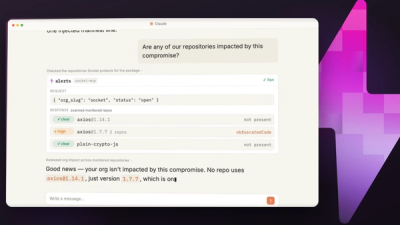
Socket MCP now lets AI assistants review org alerts, investigate threats using the Socket threat feed, and inspect package files in addition to dependency scoring.
Product
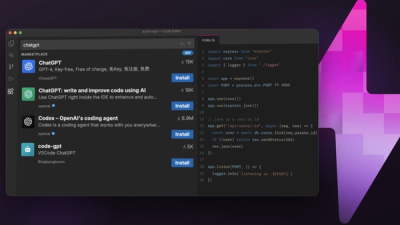
Socket Firewall blocks malicious VS Code and Open VSX extensions before install, protecting developers from compromised editor marketplaces.