
Product
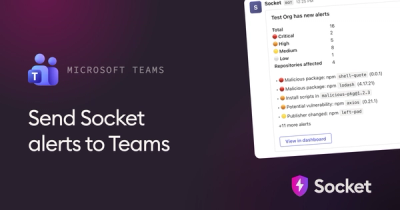
Microsoft Teams Notifications Are Now Available in Socket
Socket can now send alerts and supply chain attack notifications to Microsoft Teams, with filters that route the right updates to each channel.
By Jeppe Hasseriis - Sep 01, 2026


Composable, framework-neutral Open Graph image tooling for TypeScript.
Metaplate turns one branded JSX plate into a consistent image system: SVG and PNG rendering, Fetch API responses, predictable image URLs, matching Open Graph and Twitter metadata, package-based font loading, and PNG verification. It works with plain Node, Astro, SvelteKit, Remix, Express, static build scripts, and Next.js.
For framework-neutral Node rendering:
npm install metaplate react
For Next.js, next and react are peers already supplied by the application:
npm install metaplate
Define the design once with createNodeOg. The component is Satori-compatible
JSX, not browser DOM, so containers with multiple children should use flex.
// src/lib/og.tsx
import { packageFontLoader } from "metaplate/fonts";
import { createNodeOg } from "metaplate/node";

export const og = createNodeOg<{ title: string; alt: string }>({
  alt: (copy) => copy.alt,
  fonts: packageFontLoader([
    {
      name: "Inter",
      package: "@fontsource/inter",
      file: "files/inter-latin-700-normal.woff",
      weight: 700,
    },
  ]),
  headers: { "Cache-Control": "public, max-age=86400" },
  component: (copy) => (
    <div
      style={{
        width: "100%",
        height: "100%",
        display: "flex",
        alignItems: "center",
        background: "#111",
        color: "#fff",
        fontFamily: "Inter",
        fontSize: 72,
        padding: 72,
      }}
    >
      {copy.title}
    </div>
  ),
});
The resulting plate supports three output forms:
const png: Uint8Array = await og.render(copy);
const svg: string = await og.renderSvg(copy);
const response: Response = await og.response(copy);
handler returns a standard Fetch API handler. For an Astro endpoint:
// src/pages/og-image.png.ts
import { og } from "../lib/og";

export const prerender = true;
export const GET = og.handler({ title: "An Astro site", alt: "Astro card" });
The same handler shape works in SvelteKit and other route systems that return a
Web Response.
Express can send the raw PNG returned by render. Static generators can write
the same bytes into public/ during a build:
import { writeFile } from "node:fs/promises";
import { og } from "./og.js";

await writeFile("public/og.png", await og.render(copy));
Use createSvgOg from metaplate/render when the consumer only needs SVG and
should not load Resvg's native Node binding.
Next applications can use the native next/og pipeline while keeping the same
route and metadata pattern:
// src/lib/og.tsx
import { packageFontLoader } from "metaplate/fonts";
import { createNextOg } from "metaplate/next";

export type OgCopy = {
  eyebrow: string;
  title: string;
  description: string;
  alt: string;
};

export const og = createNextOg<OgCopy>({
  alt: (copy) => copy.alt,
  fonts: packageFontLoader([
    {
      name: "Inter",
      package: "@fontsource/inter",
      file: "files/inter-latin-700-normal.woff",
      weight: 700,
    },
  ]),
  component: (copy) => (
    <div style={{ width: "100%", height: "100%", display: "flex" }}>
      {copy.title}
    </div>
  ),
});
Keep the copy next to the page metadata:
// src/app/roadmap/page.tsx
import { og } from "@/lib/og";

export const copy = {
  eyebrow: "What comes next",
  title: "Roadmap",
  description: "A dependency-ordered view of the work ahead.",
  alt: "Project roadmap",
};

export const metadata = {
  title: copy.title,
  description: copy.description,
  ...og.metadata("/roadmap", copy),
};
Then expose the predictable route:
// src/app/roadmap/og-image/route.tsx
import { og } from "@/lib/og";
import { copy } from "../page";

export const dynamic = "force-static";
export const GET = og.handler(copy);
For Next's opengraph-image.tsx convention, call og.render(copy) from the
default export and re-export og.size and og.contentType as its constants.
The root metaplate entry has no framework dependency. It can describe a
hand-authored or pre-rendered image, like a conventional public/og.png:
import { socialImageMetadata } from "metaplate";

const metadata = socialImageMetadata("/", "Project home card", {
  imagePath: "og.png",
  size: { width: 1200, height: 630 },
});
basePathFor a branded image generated during next build, use Next's special
app/opengraph-image.tsx file shown above and set dynamic = "force-static".
Next can prerender that ImageResponse when output: "export" is enabled.
If the image is generated outside Next and lives in public, use the
framework-neutral metadata helper instead:
// app/layout.tsx
import type { Metadata } from "next";
import { socialImageMetadata } from "metaplate";

const social = socialImageMetadata("/", "Project home card", {
  basePath: "/project",
  imagePath: "og-image.png",
});

export const metadata: Metadata = {
  metadataBase: new URL("https://example.github.io"),
  openGraph: social.openGraph,
  twitter: social.twitter,
};
This emits /project/og-image.png; Next resolves it against metadataBase.
Verify both public/og-image.png and the copied out/og-image.png, and inspect
the exported HTML to confirm its social tags contain the deployment prefix.
Satori needs real font bytes and accepts TTF, OTF, and WOFF, but not WOFF2.
packageFontLoader reads faces from installed packages and walks upward through
node_modules, so hoisted workspace dependencies work. It memoizes the bytes
for repeated development requests.
Extension-free route-handler output may be served as a generic download by a
static host. Set Content-Type: image/png explicitly for /og-image and
/*/og-image. For Netlify:
[[headers]]
for = "/og-image"
  [headers.values]
  Content-Type = "image/png"

[[headers]]
for = "/*/og-image"
  [headers.values]
  Content-Type = "image/png"
Metaplate checks the PNG signature, IHDR chunk, and dimensions without decoding the entire image:
npx metaplate verify --size 1200x630 public/og.png
Files of different sizes can be checked in one invocation by repeating the size group:
npx metaplate verify \
  --size 1200x630 public/og.png public/about.png \
  --size 512x512 public/icon-512.png
Or import verifyPng from metaplate/png in a test.
metaplate — framework-free paths, dimensions, and metadata.metaplate/render — Satori-based SVG generation.metaplate/node — SVG and PNG generation plus Fetch API responses.metaplate/next — native Next.js ImageResponse adapter.metaplate/fonts — hoist-safe package font loading and memoization.metaplate/png — PNG header inspection and dimension verification.Metaplate extracts the production patterns used by the GOLC and Cinnabar sites and the pre-rendered static-image pattern used by the AntikytheraOS showcase.
MIT
FAQs
Composable, framework-neutral Open Graph image tooling for TypeScript.
The npm package metaplate receives a total of 42 weekly downloads. As such, metaplate popularity was classified as not popular.
We found that metaplate demonstrated a healthy version release cadence and project activity because the last version was released less than a year ago. It has 1 open source maintainer collaborating on the project.
Product
Socket can now send alerts and supply chain attack notifications to Microsoft Teams, with filters that route the right updates to each channel.

Security News
pnpm 12 rewrites the package manager in Rust, cutting install times by up to 90% while preserving pnpm 11 workflows and lockfiles.
Security News
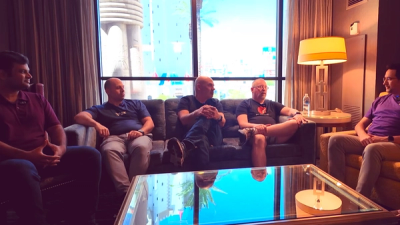
Socket CTO Ahmad Nassri joins AppSec leaders at Black Hat to discuss active malware, package manager risks, and software supply chain defense.