
Product
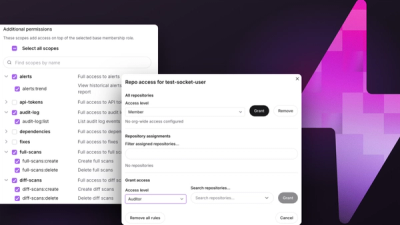
Introducing Repository Access Permissions and Custom Roles
Socket now supports Custom Roles and Repository Access Permissions so organizations can control who can access specific repositories and actions.
By Joe Werle - Jun 19, 2026
mustard-connect-node
Advanced tools
Connect is a family of libraries for building and consuming APIs on different languages and platforms, and [@bufbuild/connect](https://www.npmjs.com/package/@bufbuild/connect) brings type-safe APIs with Protobuf to TypeScript.
Connect is a family of libraries for building and consuming APIs on different languages and platforms, and @bufbuild/connect brings type-safe APIs with Protobuf to TypeScript.
@bufbuild/connect-node provides the following adapters for Node.js:
Lets your clients running on Node.js talk to a server with the Connect protocol:
import { createPromiseClient } from "@bufbuild/connect";
+ import { createConnectTransport } from "@bufbuild/connect-node";
import { ElizaService } from "./gen/eliza_connect.js";

+ // A transport for clients using the Connect protocol with Node.js `http` module
+ const transport = createConnectTransport({
+   baseUrl: "https://demo.connect.build",
+   httpVersion: "1.1"
+ });

const client = createPromiseClient(ElizaService, transport);
const { sentence } = await client.say({ sentence: "I feel happy." });
console.log(sentence) // you said: I feel happy.
Lets your clients running on Node.js talk to a server with the gRPC protocol:
import { createPromiseClient } from "@bufbuild/connect";
+ import { createGrpcTransport } from "@bufbuild/connect-node";
import { ElizaService } from "./gen/eliza_connect.js";

+ // A transport for clients using the gRPC protocol with Node.js `http2` module
+ const transport = createGrpcTransport({
+   baseUrl: "https://demo.connect.build",
+   httpVersion: "2"
+ });

const client = createPromiseClient(ElizaService, transport);
const { sentence } = await client.say({ sentence: "I feel happy." });
console.log(sentence) // you said: I feel happy.
Lets your clients running on Node.js talk to a server with the gRPC-web protocol:
import { createPromiseClient } from "@bufbuild/connect";
+ import { createGrpcWebTransport } from "@bufbuild/connect-node";
import { ElizaService } from "./gen/eliza_connect.js";

+ // A transport for clients using the Connect protocol with Node.js `http` module
+ const transport = createGrpcWebTransport({
+   baseUrl: "https://demo.connect.build",
+   httpVersion: "1.1"
+ });

const client = createPromiseClient(ElizaService, transport);
const { sentence } = await client.say({ sentence: "I feel happy." });
console.log(sentence) // you said: I feel happy.
Run your Connect RPCs on the Node.js http, https, or http2 modules.
// connect.ts
import { ConnectRouter } from "@bufbuild/connect";

export default function(router: ConnectRouter) {
  // implement rpc Say(SayRequest) returns (SayResponse)
  router.rpc(ElizaService, ElizaService.methods.say, async (req) => ({
    sentence: `you said: ${req.sentence}`,
  }));
}
// server.ts
import * as http2 from "http2";
+ import routes from "connect";
+ import { connectNodeAdapter } from "@bufbuild/connect-node";

http2.createServer(
+ connectNodeAdapter({ routes }) // responds with 404 for other requests
).listen(8080);
With that server running, you can make requests with any gRPC, gRPC-Web, or Connect client.
buf curl with the gRPC protocol:
buf curl --schema buf.build/bufbuild/eliza \
  --protocol grpc --http2-prior-knowledge \
  -d '{"sentence": "I feel happy."}' \
  http://localhost:8080/buf.connect.demo.eliza.v1.ElizaService/Say
curl with the Connect protocol:
curl \
    --header "Content-Type: application/json" \
    --data '{"sentence": "I feel happy."}' \
     --http2-prior-knowledge \
    http://localhost:8080/buf.connect.demo.eliza.v1.ElizaService/Say
Node.js with the gRPC protocol:
import { createPromiseClient } from "@bufbuild/connect";
import { createGrpcTransport } from "@bufbuild/connect-node";
import { ElizaService } from "./gen/eliza_connect.js";

const transport = createGrpcTransport({
  baseUrl: "http://localhost:8080",
  httpVersion: "2",
});

const client = createPromiseClient(ElizaService, transport);
const { sentence } = await client.say({ sentence: "I feel happy." });
console.log(sentence) // you said: I feel happy.
A client for the web browser actually looks identical to this example - it would
simply use createConnectTransport from @bufbuild/connect-web
instead.
To get started with Connect, head over to the docs for a tutorial, or take a look at our example.
FAQs
Connect is a family of libraries for building and consuming APIs on different languages and platforms, and [@bufbuild/connect](https://www.npmjs.com/package/@bufbuild/connect) brings type-safe APIs with Protobuf to TypeScript.
We found that mustard-connect-node demonstrated a not healthy version release cadence and project activity because the last version was released a year ago. It has 1 open source maintainer collaborating on the project.
Did you know?

Socket for GitHub automatically highlights issues in each pull request and monitors the health of all your open source dependencies. Discover the contents of your packages and block harmful activity before you install or update your dependencies.
Product
Socket now supports Custom Roles and Repository Access Permissions so organizations can control who can access specific repositories and actions.
Product
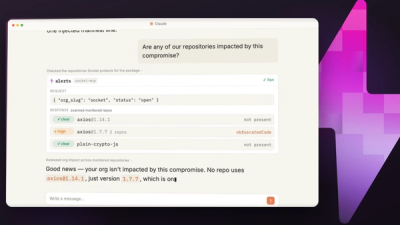
Socket MCP now lets AI assistants review org alerts, investigate threats using the Socket threat feed, and inspect package files in addition to dependency scoring.
Product
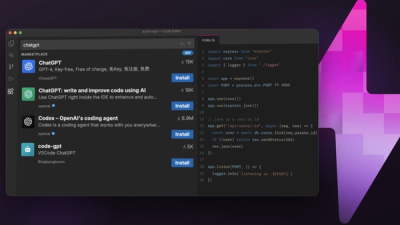
Socket Firewall blocks malicious VS Code and Open VSX extensions before install, protecting developers from compromised editor marketplaces.