

Product
PHP and Composer Support Is Now in Beta
Socket’s PHP and Composer support is now in Beta for all customers, with PHP reachability analysis generally available.
By Trevor Norris, Benjamin Barslev - Aug 21, 2026

English | Русский | 简体中文 | Bahasa Indonesia
A tiny, secure, URL-friendly, unique string ID generator for JavaScript.
“An amazing level of senseless perfectionism, which is simply impossible not to respect.”
A-Za-z0-9_-).
So ID size was reduced from 36 to 21 symbols.import { nanoid } from 'nanoid'
model.id = nanoid() //=> "V1StGXR8_Z5jdHi6B-myT"
Supports modern browsers, IE with Babel, Node.js and React Native.
Read full docs here.
The uuid package can generate RFC-compliant UUIDs. It offers different versions of UUIDs, such as v1 (timestamp-based), v4 (random), and others. Compared to nanoid, uuid provides more standardized and structured IDs, but they are not as compact as nanoid's IDs.
Shortid is another package for generating short non-sequential url-friendly unique ids. However, it is no longer recommended for use as it has been deprecated in favor of nanoid, which is more secure and maintains a smaller size.
Uniqid is a package that generates unique IDs based on the current time and an optional prefix or suffix. It is less feature-rich compared to nanoid and does not provide the same level of customization or security.
FAQs
A tiny (118 bytes), secure URL-friendly unique string ID generator
The npm package nanoid receives a total of 180,137,540 weekly downloads. As such, nanoid popularity was classified as popular.
We found that nanoid demonstrated a healthy version release cadence and project activity because the last version was released less than a year ago. It has 1 open source maintainer collaborating on the project.
Product
Socket’s PHP and Composer support is now in Beta for all customers, with PHP reachability analysis generally available.

Product
Socket is bringing experimental protection to Firefox, scanning 97,000+ extensions in Mozilla's official directory for malware and risky updates.
Research
/Security News
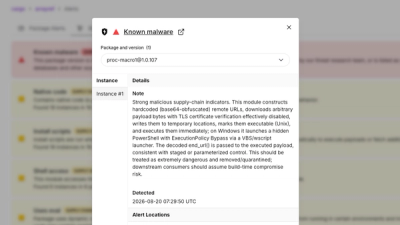
Three compromised Rust crates pulled in a malicious dependency that downloaded and executed cross-platform malware during Cargo builds.