

Company News
AWS Security Hub Adds Socket for Supply Chain Security
Socket is now in the AWS Security Hub Extended plan. Adopt it through AWS, apply committed spend, and block malicious open source packages.
By Feross Aboukhadijeh - Aug 04, 2026
nanoodle-mcp
Advanced tools
MCP stdio server that turns saved nanoodle workflow graphs into callable tools — BYOK or accountless x402 (pay per call in Nano), runs on the NanoGPT API
Build a multi-model media pipeline visually at nanoodle.com — then hand the whole pipeline to your agent as ONE typed tool.
Skill or MCP? Running (or designing) a single workflow? The nanoodle skill is one command and no setup. This server is for when you've built up a folder of saved graphs and want each one exposed to your agent as its own tool.
Point this MCP stdio server at a folder of noodle-graph.json saves from the
nanoodle editor and every graph becomes a callable tool with a derived input
schema — in Claude Code, Claude Desktop, Cursor, VS Code, Windsurf, or anything
else that speaks the Model Context Protocol.
No middleman server, no telemetry — and with wallet mode,
no account either. The MCP implementation here is hand-rolled (stdio, JSON-RPC
2.0 — small enough to read). Two runtime dependencies:
nanoodle, the zero-dep workflow
executor that does all the heavy lifting, and
nanocurrency for signing
Nano blocks in wallet mode. Your NanoGPT API key goes straight from your
machine to nano-gpt.com; it is never logged and never
appears on stdout.
You need: Node 20+, a folder of saved graphs (say ~/noodles — see
Making graphs), and a nano-gpt.com
API key in NANOGPT_API_KEY (or passed via --key / --env-file) — or no
key at all with a Nano wallet, see
wallet mode.
claude mcp add nanoodle --env NANOGPT_API_KEY=your-key-here -- npx -y nanoodle-mcp --graphs ~/noodles
Or install it as a plugin — Claude Code prompts for your noodles folder and API key, and also learns what a noodle is (this repo doubles as a plugin marketplace):
/plugin marketplace add nanoodlecom/nanoodle-mcp
/plugin install nanoodle@nanoodle
Install in Cursor
(then edit the graphs path and key), or add to .cursor/mcp.json yourself:
{
  "mcpServers": {
    "nanoodle": {
      "command": "npx",
      "args": ["-y", "nanoodle-mcp", "--graphs", "/absolute/path/to/noodles"],
      "env": { "NANOGPT_API_KEY": "your-key-here" }
    }
  }
}
.vscode/mcp.json — note VS Code's root key is servers, not mcpServers:
{
  "servers": {
    "nanoodle": {
      "type": "stdio",
      "command": "npx",
      "args": ["-y", "nanoodle-mcp", "--graphs", "/absolute/path/to/noodles"],
      "env": { "NANOGPT_API_KEY": "your-key-here" }
    }
  }
}
~/.codeium/windsurf/mcp_config.json:
{
  "mcpServers": {
    "nanoodle": {
      "command": "npx",
      "args": ["-y", "nanoodle-mcp", "--graphs", "/absolute/path/to/noodles"],
      "env": { "NANOGPT_API_KEY": "your-key-here" }
    }
  }
}
Same shape as Cursor/Windsurf, in claude_desktop_config.json under
mcpServers.
Not reachable: ChatGPT only connects to remote HTTPS MCP servers, and this is a local stdio server by design. A hosted endpoint would put a middleman between your API key and NanoGPT, which is the opposite of the point — so none is planned.
The server runs on your money — either a nano-gpt.com API key (BYOK) or,
keyless, your own Nano wallet via
x402. Every tools/call
executes a workflow against the NanoGPT API and spends from that balance —
and the caller is usually an AI agent deciding on its own when to call. Point
it only at graphs you're happy to have run, and keep an eye on your balance.
Each result ends with a cost: $X.XXXX line so the agent (and you) can see
what a call cost.
NanoGPT supports x402 accountless payments:
a keyless API call answers HTTP 402 with a Nano invoice, you pay it, the
call completes. Give the server a wallet and it does this automatically —
no NanoGPT account, no API key, no signup anywhere:
export NANO_SEED=<64-hex seed>        # account 0 pays; or NANO_PRIVATE_KEY=<64-hex key>
nanoodle-mcp --graphs ~/noodles --max-usd 0.50
Per call, the server: sees the 402 invoice → signs a Nano send block locally →
broadcasts it through a Nano RPC node (--nano-rpc / NANO_RPC_URL, default
rpc.nano.to) → NanoGPT detects the deposit and returns
the result. The seed/private key never leaves the process: only the signed
block goes to the RPC node, and neither secret is ever logged. An API key,
if present, always wins — the wallet is only used keyless.
Proof-of-work reliability. Every send block needs Nano proof-of-work. The
server asks the RPC node's work_generate first, but public nodes routinely
refuse or throttle it (no GPU, key required); the fallback is local
single-threaded CPU work, which can take a minute. For fast, dependable sends,
run nano-work-server on
the same machine and point --work-rpc / NANO_WORK_URL at it
(nano-work-server --cpu-threads 8 -l 127.0.0.1:7076 → work in a few
seconds). Order: --work-rpc → --nano-rpc node → local CPU.
This is a hot wallet. Use a dedicated wallet holding pocket money, not
your savings: its balance is a natural spend ceiling, and --max-usd adds a
per-call one on top. NanoGPT auto-refunds overpayments and failed generations
on its side.
Prefer prepay? Wallet mode settles on-chain per call. If you'd rather pay once and draw down a balance, that's exactly what a NanoGPT account is: deposit crypto (Nano included) into an account, take its API key, and run the server in normal BYOK mode — same tools, one payment instead of many.
~/noodles/
  generate-hero-image.json   →  tool "generate-hero-image"
  make-jingle.json           →  tool "make-jingle"
Every readable *.json graph in --graphs becomes one MCP tool:
| Tool field | Derived from the graph |
|---|---|
name | filename minus .json, sanitized to [a-z0-9_-] (duplicates get -2, -3, …) |
description | the graph's first comment (if any), its node chain in dependency order with node names (e.g. text:Feature -> llm -> image:Mockup), a returns … contract (output kinds with the sink's model/size and the saved-to-disk note), a spend warning, and — once the tool has run — its last observed cost (last run $0.018) |
inputSchema | one string property per unwired field, exactly like the nanoodle CLI's inspect; dropdown fields become enums; only inputs without a baked-in default are required |
| media inputs | image / audio / video inputs take a file path or https URL — local files ride inline as base64 |
| result | text outputs as text blocks; media outputs saved into --out (default ./nanoodle-out) with the absolute path returned; a final text block reports the run's cost |
Protocol behavior worth knowing: malformed calls (unknown tool, unknown /
missing / non-string argument) are rejected as JSON-RPC -32602 before any
money is spent; a run that fails (network, model error, missing key) comes
back as a normal tool result with isError: true.
usage: nanoodle-mcp --graphs <dir> [--graphs <dir> …] [--out dir] [--key K] [--env-file path] [--nano-rpc url] [--work-rpc url] [--max-usd n]

  --graphs dir   directory of noodle-graph.json saves (required; repeat to serve
                 several dirs — scanned in order, so an earlier dir wins name clashes)
  --out dir      where media outputs are saved (default ./nanoodle-out)
  --key K        NanoGPT API key (defaults to NANOGPT_API_KEY)
  --env-file p   read NANOGPT_API_KEY / NANO_SEED / NANO_PRIVATE_KEY / NANO_WORK_URL from a .env-style file
  --nano-rpc u   Nano RPC node for wallet mode (default https://rpc.nano.to; NANO_RPC_URL)
  --work-rpc u   dedicated work_generate endpoint, e.g. a local nano-work-server
                 (NANO_WORK_URL; falls back to --nano-rpc, then local CPU work)
  --max-usd n    wallet mode: refuse any single x402 invoice above $n
Key precedence matches the nanoodle CLI: --key > --env-file >
NANOGPT_API_KEY; wallet secrets come only from the environment or
--env-file, never argv. The server refuses to start if no directory holds a
runnable graph, and says why per file on stderr; stdout is protocol only.
--graphs is repeatable, so one server can merge several folders. The pattern:
commit a noodles/ dir to a repo for that project's own tools, then list your
global library after it as a fallback:
nanoodle-mcp --graphs ./noodles --graphs ~/noodles
Dirs are scanned in the order given, and the earlier dir wins a name clash:
if both folders have a changelog.json, the project's becomes changelog and
the shared one becomes changelog-2. So a project can override a shared tool
just by dropping a same-named graph in ./noodles, while everything else in
~/noodles stays available. An unreadable dir (a typo, a folder that isn't
there) is a hard startup error naming the offender — no silent half-load.
MCP config is per-project in most clients, so the two-dir pattern lives in the
repo, right next to the graphs it serves. For Claude Code that's a .mcp.json
at the project root — commit it along with noodles/ and everyone who clones
gets the same tools:
{
  "mcpServers": {
    "nanoodle": {
      "type": "stdio",
      "command": "npx",
      "args": ["-y", "nanoodle-mcp", "--graphs", "./noodles", "--graphs", "/home/you/noodles"]
    }
  }
}
Relative paths resolve from the project root. A project-scoped server named
nanoodle shadows a user-scoped one of the same name, so repos with a
.mcp.json get their own graphs and every other directory falls back to your
global install untouched.
Two things to keep out of a committed config: your API key (leave env
out and let NANOGPT_API_KEY come from the environment, or point
--env-file at a file outside the repo — never commit a key) and, for team
repos, your personal library path (the second --graphs above is an
absolute path on your machine; drop it from a shared repo's config and keep
just ./noodles, since ~ is not expanded in MCP args). Cursor
(.cursor/mcp.json) and VS Code (.vscode/mcp.json) take the same args in
the config shapes shown under Install.
Every nanoodle share link is an executable tool. Alongside your saved graphs the
server always exposes one more tool, run_noodle, that takes any share link
and runs it — no file needed:
run_noodle("https://nanoodle.com/#g=…", { "Text": "a lighthouse at dawn" })
Pass the link as url and any workflow inputs as inputs (the same friendly
keys the graph's own tool would take; media inputs take a file path or https
URL). It accepts #g=/#j= workflow links, #a= app links, and short links
to one. Direct links decode locally; only fragment-less short links trigger a
network read, and it carries no credentials. Like every other tool, a run
spends real money and ends with a cost: $X.XXXX line.
Build and test workflows in the nanoodle editor, hit
💾, and drop the downloaded noodle-graph.json into your --graphs folder
(rename it — the filename becomes the tool name). Restart the server (or your
MCP client) to pick up new files.
The first comment node in a graph doubles as the MCP tool's description: its text leads the auto-derived node chain, so the calling agent reads your words first. Keep it to one sentence saying what the tool produces from what inputs — e.g. "Renders a product mockup image from a one-line feature description." Long text is truncated to 200 characters and whitespace is collapsed, so write for one line. Graphs without a comment just get the node chain, as before.
After each successful run the tool's real cost is recorded in
<out>/costs.json (a small {tool: {usd, at}} sidecar next to your media
outputs) and folded into the description as last run $X — observed, not
estimated. The server announces the change with a
notifications/tools/list_changed notification, so MCP clients that honor it
show updated prices mid-session; others catch up on restart.
Honest list — most of these are inherited from the executor:
tools/call blocks until the whole
workflow finishes — video graphs can take minutes. No MCP progress
notifications yet.--graphs
needs a restart; the tool list doesn't change mid-session (no
listChanged notifications).PATH for
the rest (see the supported-nodes
table). A
graph with a node type the library doesn't know is still skipped at
startup with a stderr note.--max-usd caps each call, and the wallet's balance
caps the total.)No telemetry, no analytics; the API key and wallet secrets are never logged and never appear on stdout.
Fully offline — the suite spawns the real server against a canned local NanoGPT stub and drives the MCP handshake over stdio:
npm test
server.json is the official MCP registry
manifest (io.github.nanoodlecom/nanoodle-mcp); see PUBLISHING.md
for the release checklist.
This server exposes saved workflows as typed MCP tools. If your agent supports Agent Skills rather than MCP servers, nanoodle-skill (teaches your agent to build any graph) and noodle-skills (prebuilt one-task workflows) cover similar ground without running a server. Running graphs in GitHub CI? → run-noodle-action.
MIT — see LICENSE. Not affiliated with NanoGPT or Anthropic. Build workflows at nanoodle.com; run them from code with nanoodle-js / nanoodle-py.
FAQs
MCP stdio server that turns saved nanoodle workflow graphs into callable tools — BYOK or accountless x402 (pay per call in Nano), runs on the NanoGPT API
We found that nanoodle-mcp demonstrated a healthy version release cadence and project activity because the last version was released less than a year ago. It has 1 open source maintainer collaborating on the project.
Did you know?

Socket for GitHub automatically highlights issues in each pull request and monitors the health of all your open source dependencies. Discover the contents of your packages and block harmful activity before you install or update your dependencies.
Company News
Socket is now in the AWS Security Hub Extended plan. Adopt it through AWS, apply committed spend, and block malicious open source packages.
Research
/Security News
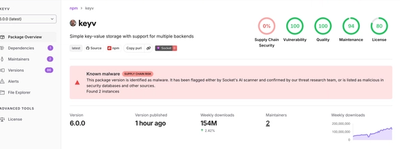
Popular npm packages keyv and cacheable compromised.

Security News
A misconfiguration gave three Anthropic models internet access, and one, believing it was in a simulation, shipped a credential-stealing package to PyPI.