
Research
/Security News
Popular npm Packages in the keyv and Cacheable Namespaces Compromised in Active Supply Chain Attack
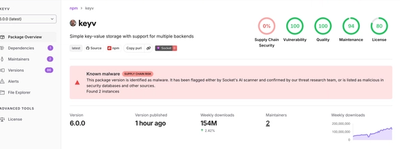
Popular npm packages keyv and cacheable compromised.
By Socket Research Team - Aug 04, 2026
node-server-orchestrator
Advanced tools
MCP server for orchestrating Node.js development servers (backend, frontend, databases, etc.)
A powerful MCP (Model Context Protocol) server for orchestrating Node.js development servers across multiple projects. Start, stop, and monitor backend, frontend, database, and other Node.js-based development servers with a unified interface.
start_server - Start a specific project serverstop_server - Stop a running serverget_server_status - Get detailed server status with uptimelist_servers - List all configured serversstart_all_servers - Start all servers simultaneouslynpm install -g node-server-orchestrator
Or use directly:
npx node-server-orchestrator
Create a configuration file at ~/.config/node-server-orchestrator/config.json:
{
  "projects": {
    "my-backend": {
      "name": "My Backend API",
      "type": "backend",
      "command": ["npm", "run", "dev"],
      "cwd": "/path/to/my-project",
      "port": 3000,
      "healthPath": "/health",
      "startupTimeout": 10000,
      "description": "My project backend server"
    },
    "my-frontend": {
      "name": "My Frontend App",
      "type": "frontend",
      "command": ["npm", "start"],
      "cwd": "/path/to/my-project/frontend",
      "port": 3001,
      "healthPath": "/",
      "startupTimeout": 15000,
      "description": "My project frontend development server"
    }
  }
}
# Start the MCP server
node-server-orchestrator mcp

# List all available servers
node-server-orchestrator list

# Start a specific server
node-server-orchestrator start example-backend

# Stop a specific server
node-server-orchestrator stop example-backend

# Check server status
node-server-orchestrator status example-backend

# Start all servers
node-server-orchestrator start-all

# Stop all servers
node-server-orchestrator stop-all

# Show help
node-server-orchestrator --help
When integrated with an AI agent (like Claude), the MCP server provides tools that can be called programmatically:
// Example agent usage
const result = await mcpClient.callTool('start_server', {
  server_id: 'my-backend'
});
console.log(result.content[0].text);
List available servers:
📋 Available Servers:
My Backend API (my-backend) - My project backend server
My Frontend App (my-frontend) - My project frontend development server
Start a server:
✅ My Backend API started successfully
📊 PID: 12345
🌐 Port: 3000
⏰ Started: 2:30:45 PM
Check status:
🟢 My Backend API is running
📊 PID: 12345
🌐 Port: 3000
⏰ Started: 2:30:45 PM
⏱️  Uptime: 5m 23s
Each server configuration supports:
name: Human-readable server nametype: Server type (backend, frontend, database, etc.)command: Command array to start the servercwd: Working directory for the serverport: Port number for health checkshealthPath: HTTP path for health checksstartupTimeout: Maximum startup wait time in millisecondsdescription: Server descriptionServers are considered healthy when they respond with HTTP 200/304 on the specified port and health path.
The MCP server provides clear error messages for:
Contributions are welcome! Please feel free to submit pull requests or open issues for bugs and feature requests.
git clone https://github.com/swong-fcsllc/node-server-orchestrator.git
cd node-server-orchestrator
npm install
npm run build
npm test
MIT License - see LICENSE file for details.
Built with the Model Context Protocol SDK.
FAQs
CLI tool for orchestrating Node.js development servers (backend, frontend, databases, etc.)
The npm package node-server-orchestrator receives a total of 29 weekly downloads. As such, node-server-orchestrator popularity was classified as not popular.
We found that node-server-orchestrator demonstrated a healthy version release cadence and project activity because the last version was released less than a year ago. It has 1 open source maintainer collaborating on the project.
Did you know?

Socket for GitHub automatically highlights issues in each pull request and monitors the health of all your open source dependencies. Discover the contents of your packages and block harmful activity before you install or update your dependencies.
Research
/Security News
Popular npm packages keyv and cacheable compromised.

Security News
A misconfiguration gave three Anthropic models internet access, and one, believing it was in a simulation, shipped a credential-stealing package to PyPI.

Security News
/Company News
Socket has joined the new Composer and Packagist sponsorship program as a launch sponsor, supporting the team that keeps PHP's package ecosystem secure.