



Security News
Deno 2.6 + Socket: Supply Chain Defense In Your CLI
Deno 2.6 introduces deno audit with a new --socket flag that plugs directly into Socket to bring supply chain security checks into the Deno CLI.
By Sarah Gooding - Dec 12, 2025
nuxt-feature-flags
Advanced tools



A powerful, type-safe feature flag module for Nuxt 3 with A/B testing and variant support.
npx nuxi module add nuxt-feature-flags
// nuxt.config.ts
export default defineNuxtConfig({
  modules: ['nuxt-feature-flags']
})
// feature-flags.config.ts
import { defineFeatureFlags } from '#feature-flags/handler'

export default defineFeatureFlags(() => ({
  newDashboard: true,
  darkMode: false,

  // A/B test with variants
  buttonDesign: {
    enabled: true,
    variants: [
      { name: 'control', weight: 50, value: 'blue' },
      { name: 'treatment', weight: 50, value: 'red' }
    ]
  }
}))
// nuxt.config.ts
export default defineNuxtConfig({
  modules: ['nuxt-feature-flags'],
  featureFlags: {
    config: './feature-flags.config.ts'
  }
})
In components:
<script setup>
const { isEnabled, getValue, getVariant } = useFeatureFlags()
</script>

<template>
  <div>
    <!-- Simple flag check -->
    <NewDashboard v-if="isEnabled('newDashboard')" />

    <!-- Using directive -->
    <div v-feature="'darkMode'">Dark mode content</div>

    <!-- A/B test variants -->
    <button :class="`btn-${getValue('buttonDesign')}`">
      Click me
    </button>
  </div>
</template>
In server routes:
// server/api/data.ts
export default defineEventHandler((event) => {
  const { isEnabled, getValue } = getFeatureFlags(event)

  if (!isEnabled('newDashboard')) {
    throw createError({ statusCode: 404 })
  }

  return { data: 'Dashboard data' }
})
Create dynamic flags based on user, device, or environment:
// feature-flags.config.ts
export default defineFeatureFlags((context) => ({
  // Role-based
  adminPanel: context?.user?.role === 'admin',

  // Environment-based
  devTools: process.env.NODE_ENV === 'development',

  // Device-based
  mobileUI: context?.device?.isMobile ?? false,

  // Gradual rollout (20% of users)
  newFeature: {
    enabled: true,
    variants: [
      { name: 'old', weight: 80, value: false },
      { name: 'new', weight: 20, value: true }
    ]
  }
}))
Populate context in server middleware:
// server/middleware/user-context.ts
export default defineEventHandler(async (event) => {
  const user = await getUserFromSession(event)

  if (user) {
    event.context.user = {
      id: user.id,
      role: user.role
    }
  }
})
const {
  flags,              // Ref<ResolvedFlags>
  isEnabled,          // (flag: string, variant?: string) => boolean
  getVariant,         // (flag: string) => string | undefined
  getValue,           // (flag: string) => any
  getFlag,            // (flag: string) => ResolvedFlag | undefined
  fetch               // () => Promise<void>
} = useFeatureFlags()
const {
  flags,              // ResolvedFlags
  isEnabled,          // (flag: string, variant?: string) => boolean
  getVariant,         // (flag: string) => string | undefined
  getValue,           // (flag: string) => any
  getFlag             // (flag: string) => ResolvedFlag | undefined
} = getFeatureFlags(event)
<template>
  <!-- Show if flag is enabled -->
  <div v-feature="'myFlag'">Content</div>

  <!-- Show for specific variant -->
  <div v-feature="'myFlag:variantA'">Variant A content</div>
</template>
Validate flags at build time:
// scripts/validate-flags.ts
import { validateFeatureFlags } from 'nuxt-feature-flags/build'

const errors = await validateFeatureFlags({
  configPath: './feature-flags.config.ts',
  srcPatterns: ['**/*.vue', '**/*.ts'],
  failOnErrors: true
})
For detailed documentation, visit nuxt-feature-flags-docs.vercel.app
Contributions are welcome! Please read our contributing guide.
MIT License © 2024
FAQs
Feature flags for Nuxt with A/B testing and variant support
We found that nuxt-feature-flags demonstrated a healthy version release cadence and project activity because the last version was released less than a year ago. It has 1 open source maintainer collaborating on the project.
Did you know?

Socket for GitHub automatically highlights issues in each pull request and monitors the health of all your open source dependencies. Discover the contents of your packages and block harmful activity before you install or update your dependencies.
Security News
Deno 2.6 introduces deno audit with a new --socket flag that plugs directly into Socket to bring supply chain security checks into the Deno CLI.
Security News
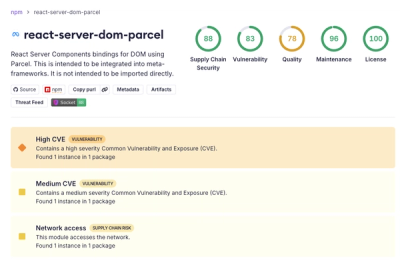
New DoS and source code exposure bugs in React Server Components and Next.js: what’s affected and how to update safely.

Security News
Socket CEO Feross Aboukhadijeh joins Software Engineering Daily to discuss modern software supply chain attacks and rising AI-driven security risks.