


Company News
AWS Security Hub Adds Socket for Supply Chain Security
Socket is now in the AWS Security Hub Extended plan. Adopt it through AWS, apply committed spend, and block malicious open source packages.
By Feross Aboukhadijeh - Aug 04, 2026
Omega-Level Development Kit - AI Team System for Claude Code. 41 agents, 169 commands, 161 skills, 69 workflows.




AI Team System for Claude Code
"Think Omega. Build Omega. Be Omega."
OMGKIT (Omega-Level Development Kit) transforms Claude Code into an autonomous AI development team. It provides a complete ecosystem of specialized AI agents, slash commands, skills, and workflows that work together to deliver 10x-1000x productivity improvements.
Traditional AI assistants respond to prompts. OMGKIT creates an AI Team that:
All coordinated through Omega-level thinking - a framework for finding breakthrough solutions rather than incremental improvements.
| Component | Count | Description |
|---|---|---|
| Agents | 41 | Specialized AI team members with distinct roles |
| Commands | 169 | Slash commands for every development task |
| Workflows | 69 | Complete development processes from idea to deploy |
| Skills | 161 | Domain expertise modules across 24 categories |
| Modes | 10 | Behavioral configurations for different contexts |
| Themes | 30 | Curated design system themes for shadcn/ui |
| Archetypes | 14 | Project templates for autonomous development |
OMGKIT uses a 5-level component hierarchy ensuring consistency and maintainability:
Level 0: MCPs (Foundation)
↓
Level 1: Commands → use MCPs
↓
Level 2: Skills → use Commands, MCPs
↓
Level 3: Agents → use Skills, Commands, MCPs
↓
Level 4: Workflows → use Agents, Skills, Commands, MCPs
Each level builds on lower levels, creating a coherent system where components work together seamlessly.
Seven principles guide OMGKIT's approach to problem-solving:
| Principle | Focus |
|---|---|
| Leverage Multiplication | Build systems, not features |
| Transcendent Abstraction | Solve classes of problems, not instances |
| Agentic Decomposition | Orchestrate specialists |
| Feedback Acceleration | Compress learning loops |
| Zero-Marginal-Cost Scaling | Build once, scale infinitely |
| Emergent Intelligence | System greater than sum of parts |
| Aesthetic Perfection | Excellence in everything |
OMGKIT brings agile methodology to AI-assisted development:
Use PRDs, specs, and design documents to inform sprint planning:
# Create sprint with PRD reference
/sprint:sprint-new "Auth Sprint" --ref=.omgkit/artifacts/prd-auth.md

# Sprint with multiple references
/sprint:sprint-new "Payment" --ref=artifacts/prd.md,specs/api.yaml

# Sprint with AI proposal based on references
/sprint:sprint-new "MVP" --propose --ref=.omgkit/artifacts/
Configure in .omgkit/workflow.yaml:
references:
  enabled: true
  auto_suggest: true
  max_tokens: 10000
  extract_sections:
    - requirements
    - user_stories
    - acceptance_criteria
References automatically propagate to /sprint:team-run and /sprint:backlog-add.
OMGKIT includes a comprehensive testing automation system:
When you create a feature, OMGKIT automatically generates corresponding test tasks:
# workflow.yaml
testing:
  auto_generate_tasks: true
  required_test_types:
    - unit
    - integration
Feature tasks automatically spawn test tasks based on feature type (API → Contract tests, UI → Snapshot tests, etc.)
No task can be marked "done" without passing tests:
testing:
  enforcement:
    level: standard  # soft | standard | strict
  blocking:
    on_test_failure: true
    on_coverage_below_minimum: true
Set minimum and target coverage thresholds:
testing:
  coverage_gates:
    unit:
      minimum: 80
      target: 90
    integration:
      minimum: 60
      target: 75
    overall:
      minimum: 75
      target: 85
OMGKIT includes a complete design system with 30 curated themes for shadcn/ui integration:
# Initialize with a theme (opt-in)
omgkit init --theme neo-tokyo

# Or explore themes first
omgkit init --with-design
| Category | Themes | Description |
|---|---|---|
| Tech & AI | neo-tokyo, electric-cyan, neural-dark, matrix-green, quantum-purple, hologram | Futuristic, cyberpunk-inspired |
| Minimal & Clean | minimal-slate, paper, mono, zen, nordic, swiss | Simple, elegant, distraction-free |
| Corporate | ocean-blue, corporate-indigo, finance, legal, healthcare, consulting | Professional, trustworthy |
| Creative & Bold | coral-sunset, candy, neon, gradient-dream, retro, studio | Vibrant, expressive |
| Nature & Organic | forest, ocean, desert, lavender, arctic, autumn | Earth tones, calming |
| Command | Description |
|---|---|
/design:themes | List all 30 curated themes |
/design:theme <id> | Apply a theme to your project |
/design:preview | Preview current theme colors |
/design:builder | Build custom theme interactively |
/design:from-screenshot | Extract theme from image |
/design:from-url | Extract theme from webpage |
/design:add <comp> | Add shadcn/ui components |
/design:reset | Reset to original theme |
OMGKIT provides CSS variables that shadcn/ui components consume:
.omgkit/design/theme.json  →  Theme configuration
.omgkit/design/theme.css   →  CSS variables (:root + .dark)
After applying a theme, use npx shadcn@latest add button to add components that automatically use your theme colors.
# Install globally
npm install -g omgkit

# Install Claude Code plugin
omgkit install

# Initialize in your project
cd your-project
omgkit init
omgkit doctor
After installation, use these commands in Claude Code:
# 1. Set your product vision
/vision:set

# 2. Create a sprint with AI-proposed tasks
/sprint:new --propose

# 3. Start the AI team
/team:run

# 4. Or use individual commands
/feature "add user authentication"
/fix "login not working"
/10x "improve performance"
Agents are specialized AI team members, each with distinct expertise and responsibilities.
| Agent | Description | Key Skills |
|---|---|---|
planner | Task decomposition, implementation planning | Writing plans, task breakdown |
researcher | Technology research, best practices | Documentation analysis, comparisons |
debugger | Error analysis, root cause finding | RAPID methodology, log analysis |
tester | Test generation, coverage analysis | Framework-specific testing |
code-reviewer | Code review with security focus | OWASP checks, severity rating |
scout | Codebase exploration, file search | Pattern discovery, architecture mapping |
fullstack-developer | Full implementation | All development skills |
| Agent | Description |
|---|---|
git-manager | Conventional commits, PR automation, branch management |
docs-manager | API docs, architecture guides, automated doc generation |
project-manager | Progress tracking, coordination, status reports |
database-admin | Schema design, query optimization, migrations |
ui-ux-designer | UI components, responsive design, accessibility |
observability-engineer | Monitoring, logging, tracing, alerting, SLOs |
| Agent | Description |
|---|---|
architect | System design, leverage multiplication, ADRs |
domain-decomposer | DDD, bounded contexts, service boundaries |
platform-engineer | Internal developer platforms, golden paths |
performance-engineer | Profiling, load testing, optimization |
| Agent | Description |
|---|---|
security-auditor | Security reviews, vulnerability assessment |
vulnerability-scanner | Security scanning, dependency audit |
devsecops | Security automation, SAST/DAST integration |
| Agent | Description |
|---|---|
data-engineer | Data pipelines, ETL, schema design |
ml-engineer | ML pipelines, model training, MLOps |
| Agent | Description |
|---|---|
ml-engineer-agent | Full-stack ML engineering from data to deployment |
data-scientist-agent | Statistical modeling, experimentation, analysis |
research-scientist-agent | Novel algorithms, paper implementation, experiments |
model-optimizer-agent | Quantization, pruning, distillation |
production-engineer-agent | Model serving, reliability, scaling |
mlops-engineer-agent | ML infrastructure, pipelines, monitoring |
ai-architect-agent | ML system architecture, requirements analysis |
experiment-analyst-agent | Experiment tracking, analysis, reporting |
| Agent | Description |
|---|---|
game-systems-designer | Game mechanics, balancing, multiplayer |
embedded-systems | Firmware, RTOS, IoT connectivity |
scientific-computing | Numerical methods, simulations |
| Agent | Description |
|---|---|
oracle | Deep analysis with 7 Omega thinking modes |
sprint-master | Sprint management, team orchestration |
Commands are slash-prefixed actions organized by namespace.
/dev:*)/dev:feature <desc> # Full feature development
/dev:fix <error> # Debug and fix bugs
/dev:fix-fast <error> # Quick bug fix (tests optional)
/dev:fix-hard <error> # Complex bug (deep analysis)
/dev:test <scope> # Generate tests
/dev:tdd <feature> # Test-driven development
/dev:review [file] # Code review
Testing Options (available on most dev commands):
/dev:feature "login" --no-test           # Skip test enforcement
/dev:fix "bug" --test-level strict       # Override enforcement level
/dev:feature-tested "auth" --coverage 90 # Custom coverage target
/dev:fix-fast "typo" --with-test         # Opt-in to testing
/planning:*)/planning:plan <task> # Create implementation plan
/planning:plan-detailed # Detailed plan (2-5 min tasks)
/planning:brainstorm <topic> # Interactive brainstorming
/planning:research <topic> # Research technology
/planning:doc <target> # Generate documentation
/git:*)/git:commit [message] # Smart commit with conventional format
/git:ship [message] # Commit + PR in one command
/git:pr [title] # Create pull request
/git:deploy [env] # Deploy to environment
/quality:*)/quality:security-scan # Scan for vulnerabilities
/quality:refactor <file> # Improve code structure
/quality:optimize <file> # Performance optimization
/quality:lint # Run linting
/quality:verify-done # Verify test requirements before completion
/quality:coverage-check # Check coverage against gates
/quality:test-plan # Generate comprehensive test plan
/omega:*)/omega:10x <topic> # Find 10x improvement path
/omega:100x <topic> # Find 100x paradigm shift
/omega:1000x <topic> # Find 1000x moonshot opportunity
/omega:principles # Display 7 Omega Principles
/omega:dimensions # Display 10 Omega Dimensions
/sprint:*)/sprint:vision-set # Set product vision
/sprint:vision-show # Display current vision
/sprint:sprint-new # Create new sprint
/sprint:sprint-start # Start current sprint
/sprint:sprint-current # Show sprint progress
/sprint:sprint-end # End sprint + retrospective
/sprint:ship # Complete sprint + commit + push + PR
/sprint:backlog-add # Add task to backlog
/sprint:backlog-show # Display backlog
/sprint:team-run # Run AI team
/sprint:team-status # Show team activity
Reference-Aware Planning (available on sprint commands):
/sprint:sprint-new "Auth" --ref=artifacts/prd.md     # Sprint with PRD context
/sprint:team-run --ref=specs/api.yaml                # Add refs during execution
/sprint:backlog-add "Login" --ref=artifacts/prd.md   # Task with ref context
Sprint Ship (complete sprint + deploy):
/sprint:ship "Sprint 1 - MVP"     # Ship with message
/sprint:ship --skip-tests         # Skip tests (not recommended)
/sprint:ship --no-pr              # Push directly without PR
/sprint:ship --force              # Ship with incomplete tasks
/auto:*)/auto:init <idea> # Start discovery for new project
/auto:start # Begin/continue autonomous execution
/auto:status # Check project progress
/auto:approve # Approve checkpoint to continue
/auto:reject # Request changes with feedback
/auto:resume # Resume from saved state
/alignment:*)/alignment:health # Check system alignment health
/alignment:deps <type:name> # Show dependency graph
/omgml:* - Project Management/omgml:init # Initialize ML project structure
/omgml:status # Show ML project status
/omgdata:* - Data Engineering/omgdata:collect # Collect data from sources
/omgdata:validate # Validate data quality
/omgdata:clean # Clean and preprocess data
/omgdata:split # Split train/val/test
/omgdata:version # Version datasets with DVC
/omgfeature:* - Feature Engineering/omgfeature:extract # Extract features from raw data
/omgfeature:select # Select important features
/omgfeature:store # Store in feature store
/omgtrain:* - Model Training/omgtrain:baseline # Create baseline models
/omgtrain:train # Train model with config
/omgtrain:tune # Hyperparameter tuning
/omgtrain:evaluate # Evaluate model performance
/omgtrain:compare # Compare model versions
/omgoptim:* - Model Optimization/omgoptim:quantize # Quantize to INT8/FP16
/omgoptim:prune # Prune model weights
/omgoptim:distill # Knowledge distillation
/omgoptim:profile # Profile latency/memory
/omgdeploy:* - Deployment/omgdeploy:package # Package model for deployment
/omgdeploy:serve # Deploy model serving
/omgdeploy:edge # Deploy to edge devices
/omgdeploy:cloud # Deploy to cloud platforms
/omgdeploy:ab # Setup A/B testing
/omgops:* - ML Operations/omgops:pipeline # Create ML pipeline
/omgops:monitor # Setup monitoring
/omgops:drift # Detect data/model drift
/omgops:retrain # Trigger retraining
/omgops:registry # Manage model registry
Workflows are orchestrated sequences of agents, commands, and skills.
| Workflow | Description |
|---|---|
development/feature | Complete feature from planning to PR |
development/bug-fix | Systematic debugging and resolution |
development/refactor | Code improvement and restructuring |
development/code-review | Comprehensive code review |
| Workflow | Description |
|---|---|
testing/automated-testing | End-to-end testing automation with task generation, enforcement, and coverage gates |
| Workflow | Description |
|---|---|
ai-engineering/rag-development | Build complete RAG systems |
ai-engineering/model-evaluation | AI model evaluation pipeline |
ai-engineering/prompt-engineering | Systematic prompt optimization |
ai-engineering/agent-development | Build AI agents |
ai-engineering/fine-tuning | Model fine-tuning workflow |
| Workflow | Description |
|---|---|
ai-ml/data-pipeline | Build ML data pipelines |
ai-ml/experiment-cycle | ML experiment tracking |
ai-ml/model-deployment | Model serving and deployment |
ai-ml/monitoring-setup | ML model monitoring |
| Workflow | Description |
|---|---|
microservices/domain-decomposition | DDD bounded context analysis |
microservices/service-scaffolding | Service template generation |
microservices/contract-first | API contract development |
microservices/distributed-tracing | Tracing implementation |
| Workflow | Description |
|---|---|
event-driven/event-storming | Domain event modeling |
event-driven/saga-implementation | Distributed transaction patterns |
event-driven/schema-evolution | Event schema management |
| Workflow | Description |
|---|---|
game/prototype-to-production | Game development lifecycle |
game/content-pipeline | Asset management |
game/playtesting | Testing and balancing |
| Workflow | Description |
|---|---|
omega/10x-improvement | Tactical enhancements |
omega/100x-architecture | System redesign |
omega/1000x-innovation | Industry transformation |
| Workflow | Description |
|---|---|
ml-systems/full-ml-lifecycle-workflow | Complete ML lifecycle orchestration |
ml-systems/data-pipeline-workflow | Data collection to feature store |
ml-systems/model-development-workflow | Baseline to optimized models |
ml-systems/model-optimization-workflow | Quantization, pruning, distillation |
ml-systems/production-deployment-workflow | Model packaging to serving |
ml-systems/mlops-pipeline-workflow | CI/CD for ML systems |
ml-systems/model-monitoring-workflow | Drift detection and alerting |
ml-systems/experiment-tracking-workflow | Systematic experimentation |
ml-systems/feature-engineering-workflow | Feature extraction and selection |
ml-systems/model-retraining-workflow | Automated retraining triggers |
ml-systems/edge-deployment-workflow | Edge/mobile model deployment |
ml-systems/ab-testing-workflow | A/B testing for models |
Skills are domain expertise modules organized in 24 categories.
Based on production AI application patterns:
| Skill | Description |
|---|---|
ai-engineering/foundation-models | Model architecture, sampling, structured outputs |
ai-engineering/evaluation-methodology | AI-as-judge, semantic similarity, ELO ranking |
ai-engineering/prompt-engineering | Few-shot, chain-of-thought, injection defense |
ai-engineering/rag-systems | Chunking, embedding, hybrid retrieval, reranking |
ai-engineering/ai-agents | Tool use, ReAct, Plan-and-Execute, memory |
ai-engineering/finetuning | LoRA, QLoRA, PEFT, model merging |
ai-engineering/inference-optimization | Quantization, batching, caching, vLLM |
ai-engineering/guardrails-safety | Input/output guards, PII protection |
Based on Chip Huyen's "Designing ML Systems" and Stanford CS 329S:
| Skill | Description |
|---|---|
ml-systems/ml-systems-fundamentals | Core ML concepts, design principles |
ml-systems/deep-learning-primer | Neural network foundations |
ml-systems/dnn-architectures | CNNs, RNNs, Transformers, hybrid models |
ml-systems/data-eng | ML data pipelines, storage, processing |
ml-systems/training-data | Sampling, labeling, augmentation |
ml-systems/feature-engineering | Feature extraction, selection, stores |
ml-systems/ml-workflow | Experiment design, model selection |
ml-systems/model-dev | Training, evaluation, debugging |
ml-systems/ml-frameworks | PyTorch, TensorFlow, scikit-learn |
ml-systems/efficient-ai | Model compression, efficient architectures |
ml-systems/model-optimization | Quantization, pruning, distillation |
ml-systems/ai-accelerators | GPU/TPU optimization, hardware selection |
ml-systems/model-deployment | Serving, containerization, scaling |
ml-systems/ml-serving-optimization | Batching, caching, latency reduction |
ml-systems/edge-deployment | TFLite, Core ML, TensorRT |
ml-systems/mlops | CI/CD for ML, model registry, pipelines |
ml-systems/robust-ai | Reliability, monitoring, drift detection |
ml-systems/deployment-paradigms | Batch vs real-time vs streaming |
| Skill | Description |
|---|---|
methodology/writing-plans | Implementation plan creation |
methodology/executing-plans | Plan execution best practices |
methodology/debugging | Systematic debugging approach |
methodology/code-review | Review standards and checklists |
methodology/tdd | Test-driven development |
methodology/test-task-generation | Auto-generate test tasks from features |
methodology/test-enforcement | Enforce tests before task completion |
| Skill | Description |
|---|---|
frameworks/react | React hooks, TypeScript, state management |
frameworks/nextjs | App Router, Server Components, API routes |
frameworks/django | DRF, ORM optimization, Celery tasks |
frameworks/fastapi | Async/await, Pydantic v2, dependency injection |
frameworks/nestjs | TypeScript, dependency injection, microservices |
Skills aligning OMGKIT with Google, Meta, Netflix, and Amazon engineering practices:
| Skill | Description | BigTech Reference |
|---|---|---|
devops/feature-flags | Progressive delivery, canary releases, A/B testing | Netflix, LaunchDarkly |
testing/chaos-engineering | Fault injection, game days, resilience testing | Netflix Chaos Monkey |
devops/dora-metrics | Deployment frequency, lead time, MTTR tracking | Google DORA Research |
methodology/stacked-diffs | Stacked PRs for parallel code review | Meta Engineering |
| Category | Skills | Focus |
|---|---|---|
| AI-ML Operations | 6 | MLOps, feature stores, model serving |
| ML Systems | 18 | Production ML from data to deployment |
| Microservices | 6 | Service mesh, API gateway, tracing |
| Event-Driven | 6 | Kafka, event sourcing, CQRS |
| Game Development | 5 | Unity, Godot, networking |
| Databases | 9 | PostgreSQL, MongoDB, Redis |
| Frontend | 7 | Tailwind, shadcn/ui, accessibility |
| DevOps | 9 | Docker, Kubernetes, GitHub Actions, DORA, Feature Flags |
| Testing | 10 | Comprehensive, chaos, mutation, security |
| Security | 4 | OWASP, OAuth, hardening |
Modes configure Claude's behavior for different contexts.
| Mode | Description |
|---|---|
default | Balanced standard behavior |
tutor | Teaching mode with Feynman technique & Socratic questions |
brainstorm | Creative exploration, divergent thinking |
token-efficient | Compressed output (30-70% savings) |
deep-research | Thorough analysis with citations |
implementation | Code-focused, minimal prose |
review | Critical analysis mode |
orchestration | Multi-task coordination |
omega | 10x-1000x thinking mode |
autonomous | AI team self-management |
Switch modes:
/context:mode <name>
Build complete applications from idea to deployment.
| Archetype | Description |
|---|---|
| SaaS MVP | Multi-tenant SaaS with auth, payments |
| API Service | Backend APIs for web/mobile apps |
| CLI Tool | Command-line utilities |
| Library/SDK | Reusable npm packages |
| Full-Stack App | Complete web applications |
| Mobile App | iOS/Android with React Native |
| AI-Powered App | LLM apps with RAG, function calling |
| AI Model Building | ML model training pipelines |
| Desktop App | Electron cross-platform apps |
| IoT App | Device management, real-time data |
| Game | Unity/Godot game development |
| Simulation | Scientific/engineering simulations |
| Microservices | Distributed services with K8s |
| Event-Driven | Async systems with Kafka, CQRS |
Provide project context with reference documents:
.omgkit/artifacts/
├── README.md   # How to use artifacts
├── data/       # Sample data, schemas, data dictionaries
├── docs/       # Requirements, user stories, PRDs
├── knowledge/  # Glossary, business rules, domain knowledge
├── research/   # Competitor analysis, market research
├── assets/     # Reference images, templates, mockups
└── examples/   # Code samples, reference implementations
Note: Artifacts are reference materials only, NOT execution instructions. They help AI understand your project context.
After omgkit init:
your-project/
├── .omgkit/
│   ├── config.yaml      # Project settings
│   ├── settings.json    # Permissions
│   ├── sprints/
│   │   ├── vision.yaml  # Product vision
│   │   └── backlog.yaml # Task backlog
│   ├── plans/           # Generated plans
│   ├── docs/            # Generated docs
│   ├── logs/            # Activity logs
│   ├── devlogs/         # Development logs (git-ignored)
│   │   └── README.md
│   ├── stdrules/        # Project standards
│   │   ├── README.md
│   │   ├── BEFORE_COMMIT.md
│   │   ├── SKILL_STANDARDS.md
│   │   └── TESTING_STANDARDS.md
│   └── artifacts/       # Project context (reference only)
│       └── README.md
├── OMEGA.md             # Project context file
└── CLAUDE.md            # Claude Code instructions
OMGKIT supports these MCP servers:
| Server | Purpose |
|---|---|
context7 | Up-to-date library documentation |
sequential-thinking | Multi-step reasoning |
memory | Persistent knowledge graph |
filesystem | Secure file operations |
playwright | Browser automation |
OMGKIT provides two types of standards:
Located in plugin/stdrules/:
| File | Purpose |
|---|---|
ALIGNMENT_PRINCIPLE.md | Component hierarchy rules |
OMGKIT_BEFORE_COMMIT_RULES.md | Validation requirements |
SKILL_STANDARDS.md | Skill documentation standards |
Generated in .omgkit/stdrules/ when you run omgkit init:
| File | Purpose |
|---|---|
BEFORE_COMMIT.md | Pre-commit checklist |
SKILL_STANDARDS.md | Custom skill guidelines |
omgkit install      # Install plugin to Claude Code
omgkit init         # Initialize .omgkit/ in project
omgkit doctor       # Check installation status
omgkit list         # List all components
omgkit update       # Update plugin
omgkit uninstall    # Remove plugin
omgkit help         # Show help
Keep your project up-to-date with the latest OMGKIT features:
omgkit project:upgrade     # Upgrade project to latest OMGKIT version
omgkit project:upgrade --dry  # Preview changes without applying
omgkit project:rollback    # Rollback to previous backup
omgkit project:backups     # List available backups
omgkit project:version     # Show project's OMGKIT version
OMGKIT's upgrade system is designed with safety first:
| Feature | Description |
|---|---|
| Version Tracking | Each project tracks its OMGKIT version in settings.json |
| Smart Merge | workflow.yaml uses add-only merge (never overwrites your values) |
| Protected Files | config.yaml, sprints/, artifacts/, devlogs/* are NEVER modified |
| Auto-Backup | Creates timestamped backup before any changes |
| Dry Run | Preview all changes with --dry flag before applying |
| Rollback | One command to restore previous state if needed |
| File Type | Upgrade Behavior |
|---|---|
| stdrules/ | New standards are added, modified ones offer 3-way merge |
| workflow.yaml | Smart merge adds new sections, preserves your customizations |
| CLAUDE.md | Updated with new instructions |
| settings.json | Version updated, structure preserved |
| Your files | NEVER touched (config.yaml, sprints, artifacts, devlogs) |
Configure workflow settings via CLI:
# Get a config value
omgkit config get testing.enforcement.level
omgkit config get testing.coverage_gates.unit

# Set a config value
omgkit config set testing.enforcement.level strict
omgkit config set testing.auto_generate_tasks true
omgkit config set testing.coverage_gates.unit.minimum 90

# List all config or specific section
omgkit config list
omgkit config list testing

# Reset to default value
omgkit config reset testing.enforcement.level
| Type | Example |
|---|---|
| String | omgkit config set git.main_branch develop |
| Boolean | omgkit config set testing.auto_generate_tasks true |
| Number | omgkit config set testing.coverage_gates.unit.minimum 90 |
Note: For arrays, edit .omgkit/workflow.yaml directly.
OMGKIT uses a self-healing documentation system that ensures docs are always synchronized with code:
npm run docs:generate   # Generate docs from plugin source
npm run docs:mint       # Generate mint.json navigation
npm run docs:validate   # Run docs sync validation tests
npm run docs:sync       # Generate + validate (recommended)
The preversion hook automatically runs docs:sync before version bumps:
npm version patch # Runs docs:sync automatically
If any sync issue is detected (missing pages, wrong counts, broken links), the version bump fails.
OMGKIT has 7300+ automated tests ensuring system integrity.
npm test                           # All tests
npm test -- tests/validation/      # Validation tests only
npm test -- tests/unit/            # Unit tests only
npm run test:docs                  # Documentation sync tests
| Category | Tests | Purpose |
|---|---|---|
| Registry Sync | ~200 | Verify registry matches files |
| Alignment | ~400 | Component hierarchy validation |
| Documentation | ~500 | Quality and format checks |
| Docs Sync | 23 | Plugin-to-docs mapping validation |
| Format | ~300 | Naming convention compliance |
| Dependency Graph | ~600 | Reference integrity |
See CONTRIBUTING.md for guidelines.
npm installnpm testplugin/stdrules/Full documentation available at: omgkit.mintlify.app
MIT - See LICENSE for details.
Think Omega. Build Omega. Be Omega.
FAQs
Omega-Level Development Kit - AI Team System for Claude Code. 41 agents, 174 commands, 162 skills, 69 workflows.
The npm package omgkit receives a total of 98 weekly downloads. As such, omgkit popularity was classified as not popular.
We found that omgkit demonstrated a healthy version release cadence and project activity because the last version was released less than a year ago. It has 1 open source maintainer collaborating on the project.
Did you know?

Socket for GitHub automatically highlights issues in each pull request and monitors the health of all your open source dependencies. Discover the contents of your packages and block harmful activity before you install or update your dependencies.
Company News
Socket is now in the AWS Security Hub Extended plan. Adopt it through AWS, apply committed spend, and block malicious open source packages.
Research
/Security News
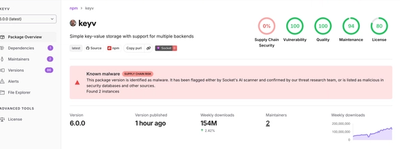
Popular npm packages keyv and cacheable compromised.

Security News
A misconfiguration gave three Anthropic models internet access, and one, believing it was in a simulation, shipped a credential-stealing package to PyPI.