
Product
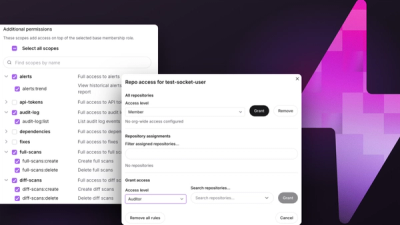
Introducing Repository Access Permissions and Custom Roles
Socket now supports Custom Roles and Repository Access Permissions so organizations can control who can access specific repositories and actions.
By Joe Werle - Jun 19, 2026
openmath-rdf-parser
Advanced tools
A parser to read and write textual formulas from / to OpenMath RDF syntax

A utility tool to convert between string representation and OpenMath RDF representation of mathematical expressions.
Even simple expressions are super cumbersome to model in OpenMath RDF syntax. Consider the following expression:
x = y + 5;
In OpenMath RDF, this equation looks like that:
@prefix m: <http://openmath.org/vocab/math#>.

<http://example.org/ontology#f6c2045d-6053-4167-8da8-81882aa18532_eq> a m:Application;
    m:operator <http://www.openmath.org/cd/relation1#eq>.
_:n3-0 a m:Variable;
    m:name "x".
<http://example.org/ontology#87b80ac1-63c4-4eea-807d-fae477595c80_add> a m:Application;
    m:operator <http://www.openmath.org/cd/arith1#plus>.
_:n3-1 a m:Variable;
    m:name "y".
_:n3-2 a m:Literal;
    m:value 5.
<http://example.org/ontology#87b80ac1-63c4-4eea-807d-fae477595c80_add> m:arguments (_:n3-1 _:n3-2).
<http://example.org/ontology#f6c2045d-6053-4167-8da8-81882aa18532_eq> m:arguments (_:n3-0 <http://example.org/ontology#87b80ac1-63c4-4eea-807d-fae477595c80_add>).
The expression is broken down into a tree. On the top level, there is an OpenMath Application with operator "=" and two arguments for the left and right of the equation. The right side is itself an Application with operator "+" and the two arguments "y" and "5".
But everybody will agree that this RDF structure is not easy to create manually. This is where this OpenMathRdfParser comes into play. It automatically generates OpenMath RDF from a string-based formula and vice versa.
Install the library into your project using npm install openmath-rdf-parser and create an instance of the OmRdfParser class:
import { OmRdfParser } from "openmath-rdf-parser";
const parser = new OmRdfParser();
Use the functions below to convert from Open Math RDF to plain string formulas or from plain string formulas to an Open Math RDF representation.
There are two functions to get formulas in RDF and convert them to a string representation. The function fromOpenMath() converts a single formula (identified by an IRI of one Open Math application) and returns it as a FormulaResult object.
The function allFromOpenMath(rdfString: string) finds all OpenMath formulas inside rdfString and convert them into an array of FormulaResult objects, which have the following structure:
class FormulaResult {
	context: string,
	formula: string,
	rootApplicationIri: string,
}
In this object, formula stores the actual formula. context contains the IRI of the element that the OpenMath application is connected to. And rootApplicationIri is the IRI of the root application, i.e., the application acting as the root element of a formula.
Use fromOpenMath(rdfString: string, rootApplicationIri: string) to convert from one particular OpenMath RDF representation to a string representation. The parameters to pass are:
rdfString: RDF dataset that contains an OpenMath application to be converted to its string representationrootApplicationIri: IRI of the application to be transformed. Your rdfString may contain multiple expressions in the form of OpenMath applications. The parameter rootApplicationIri refers to the one you want to conver to its string representation.The function fromOpenMath() always returns one individual FormulaResult object (structure see above).
Use toOpenMath(formula: PrefixedFormula | string) to convert from a mathematical formula in plain string representation to its OpenMath RDF representation. There is only one parameter to pass, but this parameter allows for multiple options.
formula: In the simplest case, this is a string representation of a formula without any references to ontological entities, e.g., x + y <= 2. For such cases, blank nodes are created representing x and y.At some point, you might want to express a formula containing RDF resources and thus you have to integrate IRIs into your formulas. You can use full IRIs without any issues. As a simple example, consider the following. You can use IRIs like http://example.org/x#a and pass the formula as a string.
const input = "http://example.org/x#a = 5";
const result = await p.toOpenMath(input);
If you're feeling lazy and prefer to use prefixes to shorten IRIs, you can do so. But in these cases, you need to provide the prefixes so that the parser can handle them. In such cases, you must pass an object of type PrefixedFormula to the toOpenMath function. See this examples from the tests:
const input = 'x:a = y:b + 5';
const prefixes = new Map<string, string>();
prefixes.set('x', 'http://example.org/x#');
prefixes.set('y', 'http://example.org/y#');

const prefixedFormula: PrefixedFormula = {
	prefixes: prefixes,
	formula: input
};
const result = await p.toOpenMath(prefixedFormula);
FAQs
A parser to read and write textual formulas from / to OpenMath RDF syntax
We found that openmath-rdf-parser demonstrated a not healthy version release cadence and project activity because the last version was released a year ago. It has 1 open source maintainer collaborating on the project.
Did you know?

Socket for GitHub automatically highlights issues in each pull request and monitors the health of all your open source dependencies. Discover the contents of your packages and block harmful activity before you install or update your dependencies.
Product
Socket now supports Custom Roles and Repository Access Permissions so organizations can control who can access specific repositories and actions.
Product
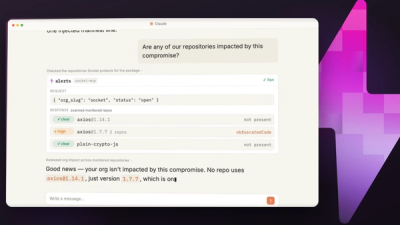
Socket MCP now lets AI assistants review org alerts, investigate threats using the Socket threat feed, and inspect package files in addition to dependency scoring.
Product
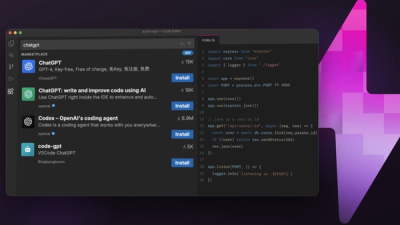
Socket Firewall blocks malicious VS Code and Open VSX extensions before install, protecting developers from compromised editor marketplaces.