

Research
/Security News
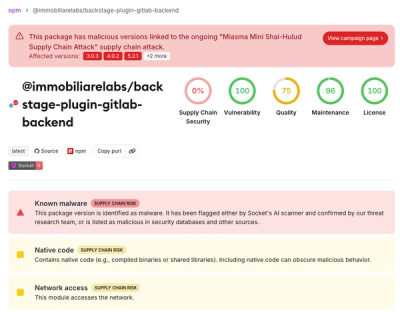
Miasma Mini Shai-Hulud Hits ImmobiliareLabs npm Packages
Miasma Mini Shai-Hulud hits @immobiliarelabs Backstage plugins, targeting GitLab and LDAP auth packages on npm.
By Socket Research Team - Jun 26, 2026
Vision-based desktop automation MCP server. Control any application via screenshot + AI vision.



"If you can see it, OScribe can click it."
OScribe is your fallback when traditional automation tools fail:
# Install from source
git clone https://github.com/mikealkeal/oscribe.git
cd oscribe
npm install
npm run build
# Start MCP server (used by Claude Desktop, Claude Code, etc.)
node dist/bin/oscribe.js serve
Then configure your MCP client (see MCP Integration below).
git clone https://github.com/mikealkeal/oscribe.git
cd oscribe
npm install
npm run build
npm link  # Optional: makes 'oscribe' command available globally
| Platform | Status |
|---|---|
| Windows | ✅ Tested |
| macOS | 🚧 Not tested yet |
| Linux | 🚧 Not tested yet |
oscribe click "Submit button"              # Click by description - the magic!
oscribe click "File menu"                  # Works on any visible element
oscribe click "Export as PNG" --screen 1   # Target specific monitor
oscribe click "Close" --dry-run            # Preview without clicking
oscribe type "hello world"                 # Type text
oscribe hotkey "ctrl+c"                    # Press keyboard shortcut
oscribe hotkey "ctrl+shift+esc"            # Multiple modifiers
oscribe screenshot                      # Capture primary screen
oscribe screenshot -o capture.png       # Save to file
oscribe screenshot --screen 1           # Capture second monitor
oscribe screenshot --list               # List available screens
oscribe screenshot --describe           # Describe screen content with AI
oscribe windows                         # List open windows
oscribe focus "Chrome"                  # Focus window by name
oscribe focus "Calculator"              # Works with partial matches
oscribe serve # Start MCP server (stdio transport)
--verbose, -v          # Detailed output
--dry-run              # Simulate without executing
--quiet, -q            # Minimal output
--screen N             # Target specific screen (default: 0)
# Take screenshot and save
oscribe screenshot -o desktop.png

# Type with delay between keystrokes
oscribe type "slow typing" --delay 100

# Use second monitor
oscribe screenshot --screen 1 --describe

# Dry run to see what would happen
oscribe type "test" --dry-run
OScribe exposes tools via Model Context Protocol for AI agents. Works with Claude Desktop, Claude Code, Cursor, Windsurf, and any MCP-compatible client.
Edit your config file:
| OS | Config Path |
|---|---|
| Windows | %APPDATA%\Claude\claude_desktop_config.json |
| macOS | ~/Library/Application Support/Claude/claude_desktop_config.json |
Add OScribe to mcpServers:
{
  "mcpServers": {
    "oscribe": {
      "command": "node",
      "args": ["C:/path/to/oscribe/dist/bin/oscribe.js", "serve"]
    }
  }
}
Tip: Replace
C:/path/to/oscribewith your actual installation path.
Then restart Claude Desktop. You'll see a 🔌 icon indicating MCP tools are available.
Add a .mcp.json file in your project root:
{
  "mcpServers": {
    "oscribe": {
      "command": "node",
      "args": ["C:/path/to/oscribe/dist/bin/oscribe.js", "serve"]
    }
  }
}
{
  "mcpServers": {
    "oscribe": {
      "command": "oscribe",
      "args": ["serve"]
    }
  }
}
| Tool | Description | Parameters |
|---|---|---|
os_screenshot | 📸 Capture screenshot + cursor position | screen? (default: 0) |
os_inspect | 🔍 Get UI elements via Windows UI Automation | window? |
os_inspect_at | 🎯 Get element info at coordinates | x, y |
os_move | Move mouse cursor | x, y |
os_click | Click at current cursor position | window?, button? |
os_click_at | Move + click in one action | x, y, window?, button? |
os_type | Type text | text |
os_hotkey | Press keyboard shortcut | keys (e.g., "ctrl+c") |
os_scroll | Scroll in direction | direction, amount? |
os_windows | List open windows + screens | - |
os_focus | Focus window by name | window |
os_wait | Wait for duration (UI loading) | ms (max 30000) |
os_nvda_status | Check NVDA screen reader status (Electron support) | - |
os_nvda_install | Download NVDA portable for Electron apps | - |
os_nvda_start | Start NVDA in silent mode | - |
os_nvda_stop | Stop NVDA screen reader | - |
Once configured, Claude can automate your desktop:
"Take a screenshot and describe what you see"
"Inspect the UI elements and click the Submit button"
"List all windows and focus on Chrome"
"Type 'hello world' and press Ctrl+Enter"
Workflow: Claude uses os_screenshot to see the screen, os_inspect to get element coordinates, then os_move + os_click for precise interaction.
Config directory: ~/.oscribe/
config.json - Application settings{
"defaultScreen": 0,
"dryRun": false,
"logLevel": "info",
"cursorSize": 128
}
| Option | Type | Default | Description |
|---|---|---|---|
defaultScreen | number | 0 | Default monitor to capture |
dryRun | boolean | false | Simulate actions without executing |
logLevel | string | "info" | Log level: debug, info, warn, error |
cursorSize | number | 128 | Cursor size in screenshots (32-256) |
nvda.autoDownload | boolean | false | Auto-download NVDA when needed |
nvda.autoStart | boolean | true | Auto-start NVDA for Electron apps |
nvda.customPath | string | - | Custom NVDA installation path |
OScribe uses a multi-layer approach for desktop automation (Windows):
Screenshot Layer - Captures screen using PowerShell + .NET System.Drawing
UI Automation Layer - Gets element coordinates via Windows accessibility tree:
Input Layer - Uses robotjs for:
Best strategy: Use os_screenshot which returns UI elements with coordinates, then os_move + os_click for precise interaction.
git clone https://github.com/mikealkeal/oscribe.git
cd oscribe
npm install
npm run build       # Build TypeScript
npm run dev         # Development mode (watch)
npm run typecheck   # Type check only
npm run lint        # Run ESLint
npm run lint:fix    # Fix linting issues
npm run format      # Format with Prettier
npm run clean       # Remove dist folder
oscribe/
├── bin/
│   └── oscribe.ts              # CLI entry point
├── src/
│   ├── core/
│   │   ├── screenshot.ts     # Multi-platform screen capture
│   │   ├── input.ts          # Mouse/keyboard control (robotjs)
│   │   ├── windows.ts        # Window management
│   │   └── uiautomation.ts   # Windows UI Automation (accessibility)
│   ├── cli/
│   │   ├── commands/         # CLI command implementations
│   │   └── index.ts          # Command registration
│   ├── mcp/
│   │   └── server.ts         # MCP server (12 tools)
│   ├── config/
│   │   └── index.ts          # Config management with Zod
│   └── index.ts              # Main exports
├── package.json
├── tsconfig.json
├── .env.example
└── LICENSE
Server not starting:
node --version (requires 22+)npm run buildTools not appearing in Claude Desktop:
claude_desktop_config.json syntax (valid JSON)Clicks not working:
UI elements not detected:
os_screenshot to see what's visibleElectron apps showing few UI elements:
Electron/Chromium apps require NVDA screen reader to expose their full accessibility tree:
# Install NVDA portable (one-time)
oscribe nvda install

# Start NVDA silently (no audio)
oscribe nvda start
Or via MCP tools: os_nvda_install → os_nvda_start
NVDA runs in silent mode (no speech, no sounds). The agent will prompt to install NVDA when needed.
Manual NVDA installation:
If you prefer to install NVDA yourself, download from nvaccess.org and set the path in config:
{
  "nvda": {
    "customPath": "C:/Program Files/NVDA"
  }
}
BSL 1.1 (Business Source License 1.1)
See LICENSE for full terms.
Contributions are welcome! Please feel free to submit a Pull Request.
npm run build succeedsnpm run typecheckOScribe is built on top of these great open-source projects:
Maintained by Mickaël Bellun
FAQs
Vision-based desktop automation engine
The npm package oscribe receives a total of 3 weekly downloads. As such, oscribe popularity was classified as not popular.
We found that oscribe demonstrated a healthy version release cadence and project activity because the last version was released less than a year ago. It has 1 open source maintainer collaborating on the project.
Did you know?

Socket for GitHub automatically highlights issues in each pull request and monitors the health of all your open source dependencies. Discover the contents of your packages and block harmful activity before you install or update your dependencies.
Research
/Security News
Miasma Mini Shai-Hulud hits @immobiliarelabs Backstage plugins, targeting GitLab and LDAP auth packages on npm.
Security News
Rolldown paused Rust React Compiler integration after a 5MB binary size increase raised concerns about shipping React-specific code to all Vite users.
Security News
/Research
Mini Shai-Hulud expands into the Go ecosystem after hitting LeoPlatform npm packages and targeting GitHub Actions workflows.