
Product
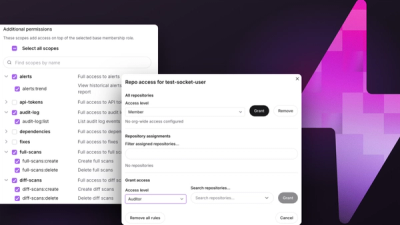
Introducing Repository Access Permissions and Custom Roles
Socket now supports Custom Roles and Repository Access Permissions so organizations can control who can access specific repositories and actions.
By Joe Werle - Jun 19, 2026
oxlint-plugin-complexity
Advanced tools
Cyclomatic and cognitive complexity rules for oxlint with actionable error messages. Also available as a standalone library for programmatic complexity analysis.
Features:
.js .mjs .cjs .ts .tsx .jsx .vue .svelte .astroNote: Refactoring tips require cognitive complexity (only it tracks nesting depth).
npm install oxlint-plugin-complexity --save-dev
// .oxlintrc.json
{
  "jsPlugins": ["oxlint-plugin-complexity"],
  "rules": {
    "complexity/complexity": [
      "error",
      {
        "cyclomatic": 20,
        "cognitive": 15
      }
    ]
  }
}
Error messages show a summary, line-by-line breakdown, and refactoring tips for deep nesting:
complexity(complexity): Function 'processData' has Cognitive Complexity of 15.
Maximum allowed is 10. [if: +14, for: +1]

Breakdown:
   Line 2: +1 for 'for'
   Line 3: +2 for 'if' (incl. +1 nesting)
   Line 4: +3 for 'if' (incl. +2 nesting)
   Line 5: +4 for 'if' (incl. +3 nesting)
>>> Line 6: +5 for 'if' (incl. +4 nesting) [top offender]
    ↳ Tip: Extract inner loops into helper functions - each extraction removes one nesting level
function processData(items, mode, config) {
  for (const item of items) {
    // Line 2: +1
    if (item.active) {
      // Line 3: +2 (nesting=1)
      if (mode === 'strict') {
        // Line 4: +3 (nesting=2)
        if (config.validate) {
          // Line 5: +4 (nesting=3)
          if (item.required) {
            // Line 6: +5 (nesting=4) <- top offender
          }
        }
      }
    }
  }
}
{
  "complexity/complexity": [
    "error",
    {
      // Complexity thresholds
      "cyclomatic": 20, // Default: 20
      "cognitive": 15, // Default: 15

      // Performance optimization (optional)
      "minLines": 10, // Default: 10 (skip functions <10 lines like getters; 0 = analyze all; counts comments/blanks)

      // Extraction suggestions (optional)
      "enableExtraction": true, // Default: true
      "extractionMultiplier": 1.5, // Default: 1.5 (triggers at 1.5× cognitive threshold)
      "minExtractionPercentage": 30, // Default: 30 (min % of total complexity to suggest)

      // Refactoring tip thresholds (optional, set to 0 to disable)
      "nestingTipThreshold": 3, // Default: 3
      "elseIfChainThreshold": 4, // Default: 4
      "logicalOperatorThreshold": 3, // Default: 3
    },
  ],
}
Counts decision points in code. Learn more
+1 for: if, for, for...in, for...of, while, do...while, case, catch, ? :, &&, ||, ??
Measures how difficult code is to understand by penalizing nesting. Learn more
if/for/while/switch/catch/? : (+nesting), else, logical sequence changes, nested functions, recursiona || [])Detects common complexity patterns and provides actionable tips:
nestingTipThreshold): Suggests extracting inner loops/conditionselseIfChainThreshold): Recommends lookup tables or strategy patternlogicalOperatorThreshold): Suggests extracting boolean expressionsAnalyzes variable flow to identify extractable code blocks (enabled by default, disable with enableExtraction: false):
Example output:
Smart extraction suggestions:

  Lines 9-22: Extractable with some refactoring
    Complexity: +11 (55% of total)
    Inputs: order, config, processedItems
    Suggested: processOrder(order, config, processedItems): void

  Lines 25-33: Requires significant refactoring
    Complexity: +6 (30% of total)
    Inputs: config, totalCount, processedItems
    Issue: Mutates external variable 'totalCount' (line 27)
    Suggestion: Consider returning 'totalCount' instead of mutating it
TypeScript support: Preserves type annotations in suggested signatures:
Inputs: config: Config, results: number[]
Suggested: processBlock(config: Config, results: number[]): void
Extraction suggestions use static analysis heuristics and may miss:
Always review suggestions before applying, even when marked "high confidence".
You can use this package as a standalone library to analyze complexity programmatically - no oxlint runtime needed.
npm install oxlint-plugin-complexity oxc-parser estree-walker diff
import { analyzeFileComplexity } from 'oxlint-plugin-complexity/standalone';

const code = `
function processOrder(order, config) {
  if (order.items.length === 0) {
    return null;
  }
  for (const item of order.items) {
    if (item.quantity > config.maxQuantity) {
      if (config.strict) {
        throw new Error('Over limit');
      }
    }
  }
  return order;
}
`;

const result = analyzeFileComplexity(code, 'order.ts');

for (const fn of result.functions) {
  console.log(`${fn.name} (lines ${fn.startLine}-${fn.endLine})`);
  console.log(`  Cyclomatic: ${fn.cyclomatic}`);
  console.log(`  Cognitive:  ${fn.cognitive}`);
}
Each function result includes cyclomaticPoints and cognitivePoints arrays with per-construct breakdowns (line, column, complexity contribution, and message).
Analyze only the functions touched by a diff - useful for CI gates, pre-commit hooks, and code review tools.
import { analyzeDiffComplexity } from 'oxlint-plugin-complexity/diff';
import { execFileSync } from 'node:child_process';

const diff = execFileSync('git', ['diff', 'HEAD~1']).toString();
const result = analyzeDiffComplexity(diff);

for (const file of result.files) {
  for (const fn of file.functions) {
    if (fn.cognitive > 15) {
      console.log(`${file.path}:${fn.startLine} ${fn.name} - cognitive: ${fn.cognitive}`);
    }
  }
}
Replace the removed max-cyclomatic / max-cognitive rules with the combined complexity rule:
// .oxlintrc.json
{
  "jsPlugins": ["oxlint-plugin-complexity"],
  "rules": {
-   "complexity/max-cyclomatic": ["error", { "max": 20 }],
-   "complexity/max-cognitive": ["error", { "max": 15 }]
+   "complexity/complexity": ["error", {
+     "cyclomatic": 20,
+     "cognitive": 15
+   }]
  }
}
The cognitive complexity metric is based on G. Ann Campbell's specification (SonarSource, 2016).
MIT
FAQs
Cyclomatic and cognitive complexity rules for oxlint
The npm package oxlint-plugin-complexity receives a total of 8,024 weekly downloads. As such, oxlint-plugin-complexity popularity was classified as popular.
We found that oxlint-plugin-complexity demonstrated a healthy version release cadence and project activity because the last version was released less than a year ago. It has 1 open source maintainer collaborating on the project.
Did you know?

Socket for GitHub automatically highlights issues in each pull request and monitors the health of all your open source dependencies. Discover the contents of your packages and block harmful activity before you install or update your dependencies.
Product
Socket now supports Custom Roles and Repository Access Permissions so organizations can control who can access specific repositories and actions.
Product
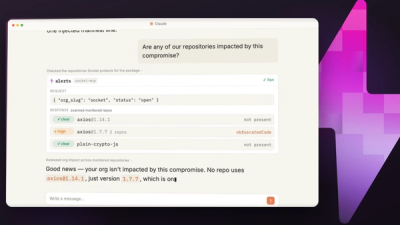
Socket MCP now lets AI assistants review org alerts, investigate threats using the Socket threat feed, and inspect package files in addition to dependency scoring.
Product
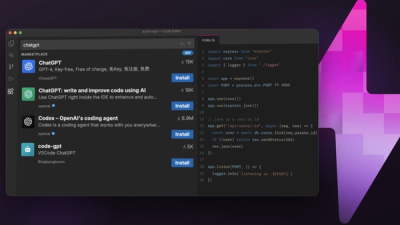
Socket Firewall blocks malicious VS Code and Open VSX extensions before install, protecting developers from compromised editor marketplaces.