patina
Strip the AI packaging. Keep the meaning.
한국어 ·
中文 ·
日本語 ·
English





Try it in the browser — no install
patina is a deterministic, pattern-based humanizer for Korean, English, Chinese, and Japanese. It finds AI-sounding phrasing and rewrites it without changing the claim, numbers, polarity, or causation.
It is not a black-box paraphraser, authorship detector, or detector-bypass tool. patina is built for allowed AI-assisted drafting where the author wants cleaner voice, an audit trail, and meaning-preservation checks.
Demo
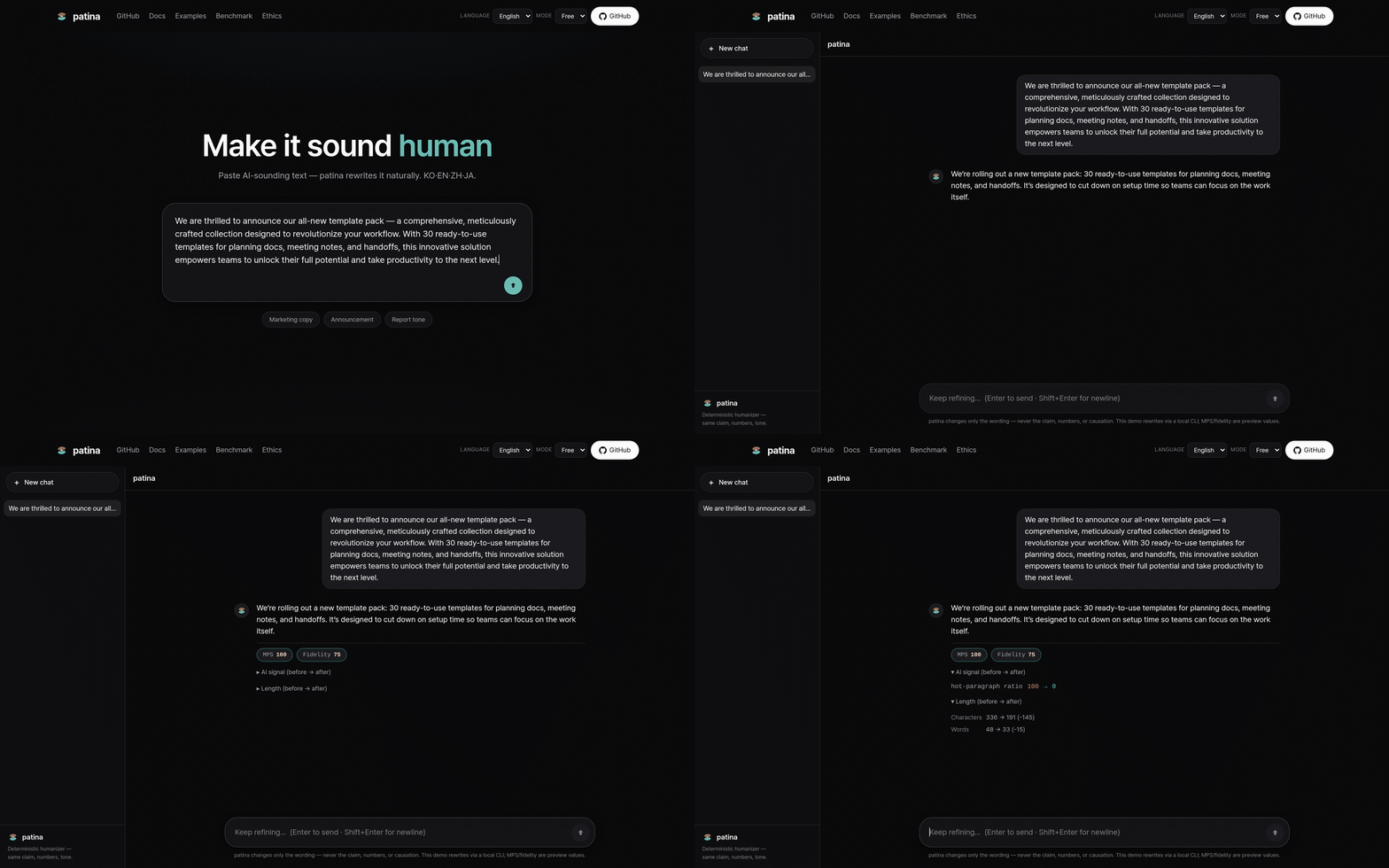
Paste AI-sounding text into the playground and patina rewrites it in place. The meaning floors verify the rewrite (MPS 100 / Fidelity 75 here — the "30 templates" fact survives), and the deterministic AI signal is measured before → after: the hot-paragraph ratio falls 100 → 0 while the hype ("thrilled to announce", "revolutionize your workflow", "unlock their full potential") is gone.
More examples: Before/After Gallery (한국어) · CLI transcript.
Quick Start
Browser playground
Open patina.vibetip.help — paste KO / EN / ZH / JA text for a real rewrite gated by the MPS/fidelity floors, with the deterministic AI signal measured before → after. Rewrites and scoring run server-side; the free tier uses the service's own model key (rate-limited). API mode forwards your own key per request through the patina server to the provider you pick — never stored or logged (metrics are sanitized: no text, prompt, output, key, or IP).
Agent skill
Let your coding agent install it — paste this into Claude Code, Codex CLI, Cursor, Gemini CLI, or any agent:
Install patina by following https://raw.githubusercontent.com/devswha/patina/main/INSTALLATION.md
The agent fetches INSTALLATION.md (written for AI agents) and runs the right install path for your host, then verifies it. Or do it yourself:
Claude Code — plugin marketplace (no clone, recommended):
/plugin marketplace add devswha/patina
/plugin install patina@patina
Claude Code · Codex CLI · Cursor · OpenCode — install script:
curl -fsSL https://raw.githubusercontent.com/devswha/patina/main/install.sh | bash
Then run the skill from Claude Code, Codex CLI, Cursor, or OpenCode:
/patina --lang en

[paste your text here]
Useful skill calls:
/patina --tone professional
/patina --tone auto --lang en
Standalone CLI
Requires Node.js >= 18.
npx patina-cli doctor
npx patina-cli --lang en input.txt
Use a logged-in local model CLI without an API key:
printf '%s\n' 'Coffee has emerged as a pivotal cultural phenomenon.' \
  | npx patina-cli --lang en --backend codex-cli
Supported local backends: codex-cli, claude-cli, gemini-cli, kimi-cli — patina passes the strongest documented default model per backend. See Authentication (한국어).
For large --batch runs, prefer an OpenAI-compatible HTTP backend; local CLI backends are agent runtimes, capped conservatively with --timeout-ms, --max-concurrency, --max-retries, and --max-failures for batch safety.
What You Get
| 168 patterns | 33 rewrite-capable + 9 score-only viral-hook per language (42 each across KO/EN/ZH/JA) — see the full 168-pattern catalog in PATTERNS.md |
| Modes | rewrite · verify · audit · score · diff |
| Surfaces | agent skill · Node CLI · in-place preview · browser playground (rewrite + score) |
| Voice | --persona (built-in + your own, ko/en/zh/ja) is the sole voice axis · --tone register · --profile pattern policy — composable with a fixed precedence |
| Free usage | logged-in codex, claude, or gemini CLI can run rewrites without PATINA_API_KEY |
| Calibration | 67.3% editing-hotspot catch [63.5–71.0%] across GPT-5.5 / Claude Sonnet 4.6 / Gemini 2.5 Pro (n=600, KO+EN); 16.0% false positives [11.6–21.7%] on KO+EN human controls (n=200) |
| License | MIT |
Scores are editing signals with false positives and false negatives, not proof of authorship. See Ethics.
Common Commands
patina --lang <ko|en|zh|ja> [mode] [--profile <name>] input.txt
patina input.txt | rewrite with defaults |
patina --audit input.txt | detect patterns only |
patina --score input.txt | output a 0-100 AI-likeness score |
patina --score --exit-on 30 input.txt | CI gate with exit code 3 when overall > 30 |
patina --diff input.txt | show pattern-by-pattern changes |
patina --preview page.html | render rewrites back onto a saved HTML page with toggles and inline diff |
patina --verify input.txt | rewrite, then check MPS/fidelity floors with one retry |
patina --tone auto --lang en input.txt | infer and apply a KO/EN tone axis |
patina --persona pragmatic-founder input.txt | rewrite in a built-in voice persona |
patina persona new my-voice --from-sample past.txt | author your own persona from a writing sample |
patina persona list | list built-in + custom personas |
patina persona show my-voice --json | print a persona's normalized config (never the docs body) |
patina persona edit my-voice --name "New Name" | copy-on-edit a persona into custom/personas/ |
patina persona rm my-voice | remove a custom persona (built-ins + preserve protected) |
patina --format json --quiet input.txt | script-friendly output |
patina --batch docs/*.md --outdir cleaned/ | batch file processing |
patina --help prints the full flag list. patina doctor --json checks Node, backend, tmux, and API-key readiness without making an LLM call.
Personas (voice)
A persona is a reusable voice — a built-in (patina persona list) or your own, authored without editing source:
patina persona new my-voice --from-sample past-posts.txt
patina persona new my-voice --describe "plain-spoken founder, casual"
patina --persona my-voice draft.md
patina persona show my-voice
patina persona edit my-voice --name "Founder voice"
patina persona rm my-voice
Works on ko/en/zh/ja and composes with --tone (register) and --profile (pattern policy). The persona is the sole voice owner; register precedence is --tone > persona. A persona shapes voice but never lowers the meaning floors — authored personas are validated on save, and the safety gate still enforces MPS/fidelity + dropped-number checks.
CI
For GitHub Actions, the maintained wrapper is shorter than hand-rolled setup:
name: Patina prose score
on:
  pull_request:
    paths: ['**/*.md', '**/*.mdx']
permissions:
  contents: read
  pull-requests: read
  issues: write
jobs:
  patina:
    runs-on: ubuntu-latest
    steps:
      - uses: actions/checkout@v6
      - uses: devswha/patina-action@v1
        with:
          score-threshold: 30
          lang: auto
          comment: true
Other integrations: pre-commit, static sites, Docker, release workflow.
How It Works
Input
  -> semantic anchor extraction (claims, polarity, causation, numbers)
  -> stylometry + AI-lexicon scan
  -> pattern-guided rewrite
  -> self-audit and MPS/fidelity checks
  -> cleaned text
If meaning drifts, the change is retried or rolled back. Deterministic analysis lives in src/features/*; LLM-backed rewrite and score calls use the selected backend.
Configuration
version: "6.2.0"
language: ko
profile: default
output: rewrite
tone:
Project .patina.yaml overrides defaults. Pattern packs are auto-discovered by language prefix. Additive list keys (blocklist, allowlist, skip-patterns) merge; other arrays replace.
Documentation
Start here:
Brand assets and usage rules live in Branding. Design notes live in DESIGN.md.
Acknowledgements
Inspired by oh-my-zsh's plugin architecture, Wikipedia's "Signs of AI writing", and blader/humanizer.
License
MIT. See LICENSE and NOTICE.