
Research
/Security News
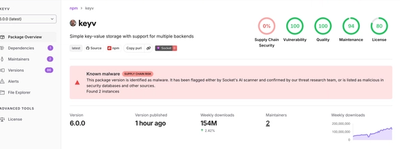
Popular npm Packages in the keyv and Cacheable Namespaces Compromised in Active Supply Chain Attack
Popular npm packages keyv and cacheable compromised.
By Socket Research Team - Aug 04, 2026
pendpost is a free, open-source (MIT), local-first social media planner where an AI agent drafts and schedules posts across Instagram, Facebook, LinkedIn, YouTube, X, Telegram, Discord, Mastodon, Nostr, WordPress, and Ghost behind a human approval gate yo
Agent-operated social media with a human approval gate.


pendpost is a free, open-source (MIT), local-first social media planner where an AI agent drafts and schedules posts across Instagram, Facebook, LinkedIn, YouTube, X, Telegram, Discord, Mastodon, Nostr, and more, including long-form blogs on WordPress and Ghost, behind a human approval gate you control. It is MCP-native: AI agents draft, lint, schedule, and queue your posts, but nothing goes live until a human approves it. It is built for developers, agencies, and technical solopreneurs who want agents to do the work without handing them the keys, and without getting accounts flagged.
Most "AI social" tools are schedulers with an agent bolted on. pendpost is the opposite. It is an operations layer designed around the agent-plus-human workflow, and these are the parts a scheduler does not give you:

draft, approved, rejected) and is fail-closed: a post with no approval will not publish. plan_create_post always creates a draft, and only approve_post or reject_post can flip it. Nothing publishes until it's approved. By default that's you; auto-approve is owner-only and revocable.rules.json. The humanizer layer flags English AI-writing tells. Errors block publish; warnings are advisory.publishAt), pendpost uses native scheduling, so those posts fire even when your computer is off. Instagram, LinkedIn, and X have no native scheduling, so pendpost must be running to publish them; run it on an always-on host to cover those too. It stays honest about which cover/thumbnail mechanics actually apply per platform.de-CH, with proper umlauts and 24-hour Swiss dates); set the language in Settings. See the localization docs.One line, no setup:
npx pendpost
# then open http://127.0.0.1:8090
No account, no signup - pendpost runs locally and starts immediately. You can draft, approve, and schedule a full campaign right away; the first run ships an example "Acme Launch" campaign in data/plans, so you see real content at once. Connect a platform in Setup when you are ready to publish - until then a lane is live-but-unauthenticated, so publishing simply waits for the connection rather than faking it.
Prefer git or docker?
# git
git clone https://github.com/pendpost/pendpost pendpost
cd pendpost
npm start            # or: node bin/pendpost.mjs (builds the dashboard on first run)
# then open http://127.0.0.1:8090
# docker
docker compose up
# then open http://127.0.0.1:8090
The planner and the approval queue are the two screens you live in: draft and schedule on the left, approve or reject on the right. Nothing on the right can approve itself.
| Planner | Approval queue |
|---|---|
 |  |
The easiest path self-boots: pendpost speaks MCP over native stdio, so the client launches the server for you - nothing to start first.
Claude Desktop (one-click): install the pendpost .mcpb bundle attached to each GitHub release. It self-boots npx -y pendpost --stdio and opens the approval dashboard in the same process.
Any stdio MCP client:
{
  "mcpServers": {
    "pendpost": { "command": "npx", "args": ["-y", "pendpost", "--stdio"] }
  }
}
Advanced / dev (HTTP transport): pendpost also serves MCP over streamable-HTTP at /mcp. This needs the server already running via npx pendpost:
claude mcp add --transport http pendpost http://127.0.0.1:8090/mcp
Going live on a real platform means creating a developer app in each vendor's portal and running one OAuth ceremony. pendpost makes that agent-drivable: on each incomplete card in the dashboard's Setup page, a Copy AI prompt button copies a ready-to-paste, secret-safe prompt for Claude for Chrome that drives the portal for that one platform. You authenticate at every login/consent gate, and the credential is minted locally by the CLI - it never passes through the agent or the chat. The same setup contract is documented for any agent in AGENTS.md.
Every capability is an MCP tool, and the dashboard mirrors it. Read-only tools can never publish; write tools create drafts and are gated by the approval rules above. Grouped by what they do:
plan_list, plan_get, account_status, assets_list, activity_log, validate_media, platform_validate, pendpost_health, publish_preview, brand_lint, generate_digest, config_get, clients_overview.plan_create_post, plan_update_post, plan_delete_post, campaign_create, campaign_set_active.approve_post, reject_post. Nothing publishes until it's approved; by default that's you.scheduler_set, publish_due_run, reschedule, unschedule, mark_posted, verify_post.set_cover, clear_cover, asset_upload, rename_asset, delete_asset.fetch_insights, token_refresh, pendpost_record_block, health_recheck, meta_lane_set.config_set, client_create, client_update, client_archive, client_list, client_set_active.The authoritative count and the read/write split are derived from lib/mcp.mjs and verified by test/parity-check.mjs (see the MCP docs). Each tool also carries readOnlyHint/destructiveHint/title annotations in tools/list.
When you are ready to publish, connect each platform in Setup (or copy .env.example to .env and fill in only the platforms you use). A platform publishes once its credential is present; until then it is live-but-unauthenticated and publishing waits for the connection. (PENDPOST_MODE=mock exists only as a test/demo fixture that routes every lane through the credential-free mock driver.)
Each platform has an interactive setup ceremony that writes to .env:
# Meta (Facebook + Instagram). A System User token is preferred for automation.
node scripts/meta-social.mjs setup-system-user \
  --system-user-token <T> --page-id <ID> --app-id <ID> --app-secret <S>
# (or `node scripts/meta-social.mjs setup` for a long-lived Page token)

# LinkedIn (after creating an OAuth app)
node scripts/linkedin-social.mjs auth

# YouTube (after creating an OAuth client)
node scripts/yt-social.mjs auth

# X (Twitter), OAuth 2.0 PKCE (browser). OAuth 1.0a needs no command - see below.
node scripts/x-social.mjs auth

# Static-credential lanes (no browser): paste the credential into .env (or use
# the dashboard Setup form), then validate with the engine's auth command.
node scripts/telegram-social.mjs auth   # TELEGRAM_BOT_TOKEN + TELEGRAM_CHANNEL_ID
node scripts/discord-social.mjs auth    # DISCORD_WEBHOOK_URL
node scripts/mastodon-social.mjs auth   # MASTODON_INSTANCE_URL + MASTODON_ACCESS_TOKEN
node scripts/wordpress-social.mjs auth  # WORDPRESS_SITE_URL + _USERNAME + _APP_PASSWORD
node scripts/ghost-social.mjs auth      # GHOST_SITE_URL + GHOST_ADMIN_API_KEY
node scripts/nostr-social.mjs keygen --save && node scripts/nostr-social.mjs auth  # + NOSTR_RELAYS
X (Twitter) supports two auth paths; OAuth 1.0a is recommended because it needs no browser and sidesteps the ERR_TOO_MANY_REDIRECTS that some apps hit on X's OAuth 2.0 consent screen.
.env as X_API_KEY, X_API_SECRET, X_ACCESS_TOKEN, X_ACCESS_TOKEN_SECRET. The lane goes live the moment X_ACCESS_TOKEN_SECRET is set - no auth command. Verify with node scripts/x-social.mjs probe (prints connected as @handle). Gotchas, in order:
401 "Could not authenticate you" (code 32), which masquerades as an access-token problem. Copy the values from the portal; do not hand-type them.http://localhost:8087/callback and scopes tweet.read tweet.write users.read media.write offline.access, then run node scripts/x-social.mjs auth. The access token lasts ~2h and the refresh token rotates; pendpost refreshes both automatically before each run.See .env.example for the full list of environment variables per platform.
Captions run through a brand-lint pass before they can publish. The rule set lives in rules.json, which you edit directly. Each rule is an object with an id, a severity (error blocks, warn is advisory), a matcher (a regex or a platform-aware built-in like captionLength, hashtagCount, allCaps, brokenLink), and a hint. The shipped default also includes humanizer rules that flag English AI-writing tells (AI vocabulary, em dashes, negative parallelism, reflexive rule-of-three padding, filler and hedging, promotional puffery). To disable a rule, delete its object; to add one, append an object. A rules.json at your workspace root overrides the shipped default. brand_lint is both an MCP tool and the dashboard composer's lint panel.
pendpost is one zero-dependency Node process (server.mjs) with four faces: a REST API at /api, an MCP server at /mcp (streamable-HTTP, JSON-RPC 2.0, 102 tools), a /media face that range-streams local files under data/, and /, which serves the built React dashboard from app/dist. Backend logic lives in lib/*.mjs. There are 14 publish engines in scripts/ - one per platform (meta-social.mjs handles Facebook and Instagram) - each spawned as a subprocess on a scheduler tick or on demand and each emitting a JSON envelope. Plans and state are local JSON. The workspace root holding .env, config.json, state.json, and data/ is overridable via PENDPOST_ROOT (default: the install dir).
Instagram, Facebook, LinkedIn, YouTube, X, Telegram, Discord, Mastodon, Nostr, WordPress, and Ghost are live. Reddit, Pinterest, TikTok, and Google Business Profile are in beta. Each engine handles its own auth, publishing, native scheduling, cover/thumbnail mechanics, and read-only insights. Facebook, YouTube, Mastodon, WordPress, and Ghost schedule natively, so those posts fire even when pendpost is off. Instagram, LinkedIn, X, Telegram, Discord, and Nostr have no native scheduling, so due posts are published by the scheduler at their scheduled time.
pendpost binds 127.0.0.1 (loopback) by default, never phones home, and keeps secrets only in your own .env (which is gitignored). See SECURITY.md for the full posture and how to report a vulnerability.
pendpost is maintained part-time by a small team and is early. Expect rough edges, and set your response-time expectations accordingly.
The full reference lives at docs.pendpost.com (source in site-docs/). Marketing, pricing, and every download option live at pendpost.com.
MIT, Copyright 2026 Nomadik GmbH. See LICENSE. Please also read DISCLAIMER.md for the responsible-use posture and CONTRIBUTING.md before opening a pull request.
FAQs
pendpost is a free, open-source (MIT), local-first social media planner where an AI agent drafts and schedules posts across Instagram, Facebook, LinkedIn, YouTube, X, Telegram, Discord, Mastodon, Nostr, WordPress, and Ghost behind a human approval gate yo
The npm package pendpost receives a total of 212 weekly downloads. As such, pendpost popularity was classified as not popular.
We found that pendpost demonstrated a healthy version release cadence and project activity because the last version was released less than a year ago. It has 1 open source maintainer collaborating on the project.
Did you know?

Socket for GitHub automatically highlights issues in each pull request and monitors the health of all your open source dependencies. Discover the contents of your packages and block harmful activity before you install or update your dependencies.
Research
/Security News
Popular npm packages keyv and cacheable compromised.

Security News
A misconfiguration gave three Anthropic models internet access, and one, believing it was in a simulation, shipped a credential-stealing package to PyPI.

Security News
/Company News
Socket has joined the new Composer and Packagist sponsorship program as a launch sponsor, supporting the team that keeps PHP's package ecosystem secure.