


Security News
Risky Biz Podcast: AI Agents Are Raising the Stakes for Software Supply Chain Security
Open source attacks are accelerating as AI coding agents pull in dependencies faster, with less human review.
By Sarah Gooding - Jun 30, 2026





Converts a podcast episode JSON file into a themed chat-UI video (MP4). Audio clips are sequenced by their measured durations and the final video is frame-perfectly synced with the audio track.
npm install -g playchat
Or run directly with npx:
npx playchat episode.json --record
# HTML preview (default theme: kakaotalk, files go to output/<timestamp>-<name>/)
npx playchat episode.json

# HTML preview to an explicit output folder
npx playchat episode.json --output ./my-output --theme imessage

# Record to MP4 (output goes to output/<timestamp>-<name>/)
npx playchat episode.json --record

# Record with explicit output folder, custom theme and pause
npx playchat episode.json --output ./my-output --record --theme kakaotalk --pause 4000
npx playchat <input.json> [--output <dir>] [--record] [--record-full] [--segments] [--theme <id>] [--pause <ms>] [--no-avatar]
| Flag | Default | Description |
|---|---|---|
--output <dir> | auto-generated | Output folder path |
--record | (off) | Produce an MP4 using static images (fast; one screenshot per dialogue) |
--record-full | (off) | Produce an MP4 using full frame-by-frame recording (slow; more CPU) |
--segments | (off) | Also produce individual MP4 videos per section (requires --record or --record-full) |
--theme <id> | kakaotalk | Chat theme to render |
--pause <ms> | 3000 | Silence between messages that have no audio file |
--no-avatar | (off) | Hide avatar circles and sender names |
When --output is omitted, files are written to:
output/<YYYYMMDD-HHmmss>-<json-basename>/
  output.html      ← rendered chat page (always)
  output.mp4       ← final video (only with --record)
  manifest.json    ← run metadata and file list
Example: output/20260414-143025-episode/
Every run writes a manifest.json to the output folder:
{
  "input": "/absolute/path/to/episode.json",
  "theme": "kakaotalk",
  "pauseMs": 3000,
  "showAvatar": true,
  "createdAt": "2026-04-14T20:57:14.123Z",
  "files": {
    "html": "output.html",
    "mp4": "output.mp4"
  },
  "dialogueCount": 5
}
files.mp4 is only present when --record was used. All file paths are relative to the output folder.
| Theme | ID | Viewport |
|---|---|---|
| KakaoTalk | kakaotalk | 400×580 |
| iMessage | imessage | 400×580 |
The first host in episode.hosts is treated as "me" and renders on the right
side; all other hosts render on the left. By default every message shows an
avatar circle and sender name. Pass --no-avatar to hide them.
{
  "name": "...",
  "episode_title": "...",
  "episode_number": 1,
  "topic": "...",
  "subtitle": "...",
  "summary": "...",
  "hosts": [
    {
      "id": "host_1",
      "name": "Minsu",
      "gender": "male",
      "role": "main_host",
      "lang": "ko",
      "voice_config": { "voice_index": 0, "pitch": 0, "speed": 1.0 }
    }
  ],
  "sections": [
    {
      "section_id": 1,
      "section_title": "Opening",
      "section_type": "opening",
      "corner_name": "Opening 🎙️",
      "dialogues": [
        {
          "id": 1,
          "speaker": "host_1",
          "name": "Minsu",
          "text": "Hello!",
          "audio": "path/to/segment_0000.mp3"
        }
      ]
    }
  ]
}
The audio field on each dialogue accepts:
| Value | Behaviour |
|---|---|
"" (empty) | Message shown for --pause ms, then next message |
path/to/file.mp3 | Relative or absolute local path |
C:\absolute\path.mp3 | Windows absolute path |
https://cdn.example.com/a.mp3 | Remote URL (HTML preview only; not muxed into MP4) |
Local paths are resolved relative to the working directory and automatically
converted to file:/// URIs in the rendered HTML.
episode.json
    │
    ├─ flattenDialogues()        normalise audio paths
    │
    ├─ buildTimeline()           ffprobe each audio file for exact duration
    │    showAtMs[0] = 0
    │    showAtMs[1] = dur[0] + 400ms gap
    │    showAtMs[N] = sum of previous (duration + gap), or pauseMs for no-audio
    │
    ├─ Puppeteer (scrubber mode)
    │    window.__TIMELINE__ injected before page load
    │    for each frame:
    │      page.evaluate("__SCRUB__(frameTimeMs)")  ← recorder is the clock
    │      page.screenshot()                        ← zero timing drift
    │
    ├─ ffmpeg: frames → silent MP4
    │
    ├─ buildAudioTrack()
    │    ffmpeg concat: [silence][clip0][silence][clip1]...
    │    gaps match the timeline exactly
    │
    └─ ffmpeg: mux silent MP4 + audio track → output.mp4
The browser never uses its own clock during recording. The recorder calls
window.__SCRUB__(ms) before every frame, passing the exact video timestamp
that frame represents. The browser renders whatever messages are due by that
time and no more — guaranteeing frame-perfect chat/audio sync regardless of
screenshot overhead.
The HTML file uses the normal live-audio mode for browser preview: audio
plays via new Audio() and the next message appears when onended fires.
Production (installs from npm):
docker build -t playchat .
docker run --rm -v $(pwd)/input:/work/input -v $(pwd)/output:/work/output playchat \
  playchat input/episode.json
docker run --rm -v $(pwd)/input:/work/input -v $(pwd)/output:/work/output playchat \
  playchat input/episode.json --record --theme kakaotalk
├── cli.ts               # CLI entry point (HTML preview + optional MP4 recording)
├── core/
│   ├── types.ts         # Interfaces, flattenDialogues(), normalizeAudioPath()
│   └── output.ts        # resolveOutputDir() — structured output folders
├── themes/
│   ├── base.ts          # Abstract BaseTheme (engine script, scrubber mode)
│   ├── kakaotalk.ts     # KakaoTalk theme
│   ├── imessage.ts      # iMessage theme
│   └── index.ts         # Theme registry + getTheme()
├── tests/
│   ├── flatten.test.ts  # Data layer + audio normalisation tests
│   ├── output.test.ts   # Output directory tests
│   └── themes.test.ts   # Theme contract + pauseMs tests
└── fixtures/
    ├── episode.json       # Full sample episode with real audio paths
    └── episode_short.json # Shorter fixture for quick testing
git clone https://github.com/doum1004/chat-in-video.git
cd chat-in-video
npm install
npx ts-node cli.ts episode.json --record
npm test
themes/yourtheme.ts:import { BaseTheme, ThemeConfig } from "./base";
export class YourTheme extends BaseTheme {
get id() { return "yourtheme"; }
get label() { return "Your Theme"; }
get viewport(): ThemeConfig { return { width: 440, height: 600 }; }
render() { return this.wrapHTML(this.css, this.html, this.js); }
private get css(): string { return `/* styles */`; }
private get html(): string {
return `
<div class="device">
<div id="chat-body"></div>
</div>`;
}
private get js(): string {
return `
const body = document.getElementById('chat-body');
function appendMsg(d) {
// create and append one chat bubble for dialogue d
}
${this.engineScript}`;
}
}
themes/index.ts:import { YourTheme } from "./yourtheme";
const registry = {
kakaotalk: KakaoTalkTheme,
imessage: IMessageTheme,
yourtheme: YourTheme, // ← add here
};
npx playchat episode.json --theme yourtheme
npx playchat episode.json --theme yourtheme --record
Every theme must satisfy three requirements in its JS block:
| Requirement | Why |
|---|---|
Element id="chat-body" in HTML | Engine appends bubbles here |
Function appendMsg(d) | Called once per dialogue — render one bubble |
${this.engineScript} at the end of JS | Injects playback engine + scrubber mode |
appendMsg(d) receives a FlatDialogue object:
{
  speaker:  string;  // "host_1", "host_2", ...
  name:     string;  // display name
  text:     string;  // message content
  audio:    string;  // file:/// URI or https:// URL (empty if none)
  audioRaw: string;  // original value from JSON
  section:  string;  // corner_name of the containing section
}
MIT
FAQs
Multi-theme podcast chat renderer with video recording
We found that playchat demonstrated a healthy version release cadence and project activity because the last version was released less than a year ago. It has 1 open source maintainer collaborating on the project.
Did you know?

Socket for GitHub automatically highlights issues in each pull request and monitors the health of all your open source dependencies. Discover the contents of your packages and block harmful activity before you install or update your dependencies.
Security News
Open source attacks are accelerating as AI coding agents pull in dependencies faster, with less human review.
Research
/Security News
Malicious Chrome and Firefox extensions posed as free VPNs while stealing clipboard data through later extension updates.
Research
/Security News
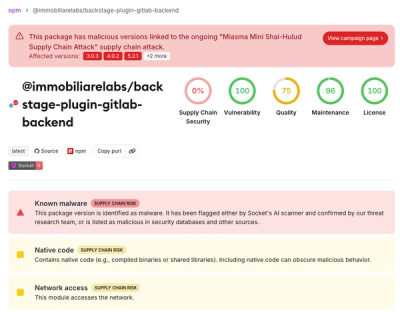
Miasma Mini Shai-Hulud hits @immobiliarelabs Backstage plugins, targeting GitLab and LDAP auth packages on npm.