
Product
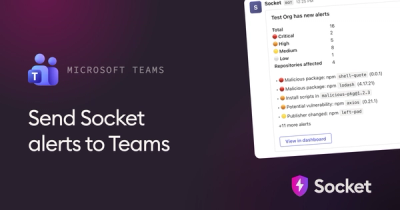
Microsoft Teams Notifications Are Now Available in Socket
Socket can now send alerts and supply chain attack notifications to Microsoft Teams, with filters that route the right updates to each channel.
By Jeppe Hasseriis - Sep 01, 2026
Mine a repo's PR-review history and current code into a portable AGENTS.md conventions file
Mines a repository's pull-request discussion history, reconciles it against the current codebase, and emits a portable AGENTS.md-style conventions file with a provenance sidecar. Standalone MCP server.
prlore is an MCP server, not a CLI you run directly. Point an MCP host (Claude Code, Claude Desktop, or any other MCP client) at it:
{
"mcpServers": {
"prlore": {
"command": "npx",
"args": ["-y", "prlore"],
"env": {
"GITHUB_TOKEN": "ghp_...",
"ANTHROPIC_API_KEY": "sk-ant-..."
}
}
}
}
prlore always operates against a local checkout of the target repo — it
runs git grep/git log against repoPath to corroborate what the PR
discussion says against what the code actually does. Point repoPath at a
clone, not a bare owner/name reference.
GITHUB_TOKEN — a GitHub token with read access to the target repo. If
unset, prlore falls back to gh auth token (requires the gh CLI to be
authenticated).ANTHROPIC_API_KEY — used by the default Anthropic model provider (the
@anthropic-ai/sdk client reads this directly; no prlore-specific wiring
needed).| Tool | Purpose |
|---|---|
mine | Starts (or resumes) a mining job. Only required inputs are repo (owner/name) and intent (free text describing what the doc is for) — everything else defaults. Rejects while a job is already running. |
status | Reports job state, stage, progress counters, and spend so far. Poll it after mine. |
cancel | Requests a graceful stop; the job checkpoints at the next stage boundary so a later mine call resumes instead of restarting. |
preview | Once a job reaches ready-for-preview, returns the rendered markdown, any contested rules, summary stats, and a one-time confirmToken. |
write | Writes the previewed draft to disk. Requires the confirmToken from the immediately preceding preview call — prlore never writes without one. Accepts resolveContested to keep or drop specific contested rules. |
The interview MCP prompt is a conversational script for gathering mine
inputs (repo, intent, focus areas, output preferences) instead of asking the
user to fill in a MineConfig by hand. It's optional — mine({ repo, intent })
works cold.
mine's model config controls spend:
model.model — which Anthropic model to use (defaults to prlore's built-in
default; see src/model/anthropic.ts for the current price table).model.maxBudgetUsd — a hard USD cap across the whole run (default 10).
Once tripped during extraction, the run degrades to a partial-corpus draft
with a warning; once tripped during synthesis (the highest-value calls), the
job fails outright rather than emitting a truncated conventions doc.model.provider also accepts "sampling" in the config schema (MCP sampling
as a fallback when no API key is configured), but that path isn't wired yet —
prlore v1 always constructs the Anthropic provider directly.
npm install
npm test          # vitest
npm run typecheck  # tsc --noEmit
npm run build      # tsc
No live network or LLM calls happen in the test suite — GitHub's GraphQL API
and the model provider are faked throughout, including in the end-to-end test
(test/e2e.test.ts), which runs the real mining pipeline against a
script-built fixture git repo.
git commands against repoPath; it does
not fetch or shallow-clone the repo itself.<!-- prlore:begin --> / <!-- prlore:end --> block (or a fresh file if the
target doesn't exist). It refuses to touch a target file that has no valid
marker pair rather than attempting a free-form merge into hand-written
prose.write accepts. Re-running mine
re-synthesizes over the (cached) extraction corpus.contested, not in the emitted draft — it only appears in the written file
if the caller explicitly resolves it with resolveContested: [{ id, action: "keep" }] on write.FAQs
Mine a repo's PR-review history and current code into a portable AGENTS.md conventions file
The npm package prlore receives a total of 8 weekly downloads. As such, prlore popularity was classified as not popular.
We found that prlore demonstrated a healthy version release cadence and project activity because the last version was released less than a year ago. It has 1 open source maintainer collaborating on the project.
Product
Socket can now send alerts and supply chain attack notifications to Microsoft Teams, with filters that route the right updates to each channel.
Security News
pnpm 12 rewrites the package manager in Rust, cutting install times by up to 90% while preserving pnpm 11 workflows and lockfiles.
Security News
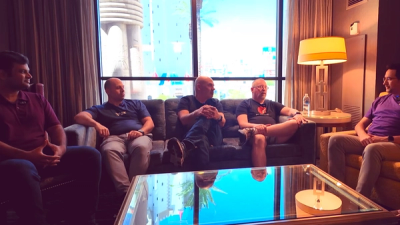
Socket CTO Ahmad Nassri joins AppSec leaders at Black Hat to discuss active malware, package manager risks, and software supply chain defense.