
Research
/Security News
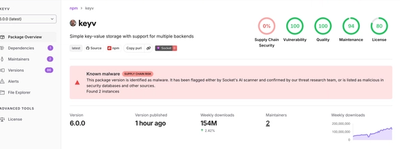
Popular npm Packages in the keyv and Cacheable Namespaces Compromised in Active Supply Chain Attack
Popular npm packages keyv and cacheable compromised.
By Socket Research Team - Aug 04, 2026



The linter for vibe-coded apps.
Static analysis for vibe-coded apps. Catches the production bugs that Cursor, v0, Bolt, and Copilot write — hallucinated imports, missing auth, hardcoded secrets, unvalidated server actions, and more. Zero config, no LLM, 52 rules, under 100ms.
npx prodlint
  prodlint v0.7.1
  Scanned 148 files · 3 critical · 5 warnings

  src/app/api/checkout/route.ts
    12:1  CRIT  No rate limiting — anyone could spam this endpoint and run up your API costs  rate-limiting
    28:5  WARN  Empty catch block silently swallows error  shallow-catch

  src/actions/submit.ts
    5:3   CRIT  Server action uses formData without validation  next-server-action-validation
      ↳ Validate with Zod: const data = schema.safeParse(Object.fromEntries(formData))

  src/lib/db.ts
    1:1   CRIT  Package "drizzle-orm" is imported but not in package.json  hallucinated-imports

  Scores
  security        72 ████████████████░░░░  (8 issues)
  reliability     85 █████████████████░░░  (4 issues)
  performance     95 ███████████████████░  (1 issue)
  ai-quality      90 ██████████████████░░  (3 issues)

  Overall: 82/100 (weighted)

  3 critical · 5 warnings · 3 info
Vibe coding is the fastest way to build. It's also the fastest way to ship hardcoded secrets, hallucinated packages, missing auth, and XSS vectors to production. These pass type-checks and look correct — but they aren't.
prodlint catches what TypeScript and ESLint miss: the bugs AI coding tools consistently write.
npx prodlint                              # Run directly (no install)
npx prodlint ./my-app                     # Scan specific path
npx prodlint --json                       # JSON output for CI
npx prodlint --ignore "*.test.ts"         # Ignore patterns
npx prodlint --min-severity warning       # Only warnings and criticals
npx prodlint --quiet                      # Suppress badge output
Or install it:
npm i -D prodlint     # Project dependency
npm i -g prodlint     # Global install
| Rule | What it catches |
|---|---|
secrets | API keys, tokens, passwords hardcoded in source |
auth-checks | API routes with no authentication |
env-exposure | NEXT_PUBLIC_ on server-only secrets |
input-validation | Request body used without validation |
cors-config | Access-Control-Allow-Origin: * |
unsafe-html | dangerouslySetInnerHTML with user data |
sql-injection | String-interpolated SQL queries (ORM-aware) |
open-redirect | User input passed to redirect() |
rate-limiting | API routes with no rate limiter |
phantom-dependency | Packages in node_modules but missing from package.json |
insecure-cookie | Session cookies missing httpOnly/secure/sameSite |
leaked-env-in-logs | process.env.* inside console.log calls |
insecure-random | Math.random() used for tokens, secrets, or session IDs |
next-server-action-validation | Server actions using formData without Zod/schema validation |
env-fallback-secret | Security-sensitive env vars with hardcoded fallback values |
verbose-error-response | Error stack traces or messages leaked in API responses |
missing-webhook-verification | Webhook routes without signature verification |
server-action-auth | Server actions with mutations but no auth check |
eval-injection | eval(), new Function(), dynamic code execution |
next-public-sensitive | NEXT_PUBLIC_ prefix on secret env vars |
ssrf-risk | User-controlled URLs passed to fetch in server code |
path-traversal | File system operations with unsanitized user input |
unsafe-file-upload | File upload handlers without type or size validation |
supabase-missing-rls | CREATE TABLE in migrations without enabling RLS |
deprecated-oauth-flow | OAuth Implicit Grant (response_type=token) |
jwt-no-expiry | JWT tokens signed without an expiration |
client-side-auth-only | Password comparisons or auth logic in client components |
| Rule | What it catches |
|---|---|
hallucinated-imports | Imports of packages not in package.json |
error-handling | Async operations without try/catch |
unhandled-promise | Floating promises with no await or .catch |
shallow-catch | Empty catch blocks that swallow errors |
missing-loading-state | Client components that fetch without a loading state |
missing-error-boundary | Route layouts without a matching error.tsx |
missing-transaction | Multiple Prisma writes without $transaction |
redirect-in-try-catch | redirect() inside try/catch — Next.js redirect throws, catch swallows it |
missing-revalidation | Server actions with DB mutations but no revalidatePath |
missing-useeffect-cleanup | useEffect with subscriptions/timers but no cleanup return |
hydration-mismatch | window/Date.now()/Math.random() in server component render path |
| Rule | What it catches |
|---|---|
no-sync-fs | readFileSync in API routes |
no-n-plus-one | Database calls inside loops |
no-unbounded-query | .findMany() / .select('*') with no limit |
no-dynamic-import-loop | import() inside loops |
server-component-fetch-self | Server components fetching their own API routes |
missing-abort-controller | Fetch calls without timeout or AbortController |
| Rule | What it catches |
|---|---|
ai-smells | any types, console.log, TODO comments piling up |
placeholder-content | Lorem ipsum, example emails, "your-api-key-here" left in production code |
hallucinated-api | .flatten(), .contains(), .substr() — methods AI invents |
stale-fallback | localhost:3000 hardcoded in production code |
comprehension-debt | Functions over 80 lines, deep nesting, too many parameters |
codebase-consistency | Mixed naming conventions across the project |
dead-exports | Exported functions that nothing imports |
use-client-overuse | "use client" on files that don't use any client-side APIs |
prodlint avoids common false positives:
/* */ are ignored@/, ~/, and tsconfig paths aren't flagged as hallucinated importsfix hints with remediation codeEach category starts at 100. Deductions per finding:
| Severity | Deduction | Per-rule cap |
|---|---|---|
| critical | -8 | max 1 |
| warning | -2 | max 2 |
| info | -0.5 | max 3 |
Diminishing returns: after 30 points deducted in a category, further deductions are halved; after 50, quartered.
Weighted overall: security 40%, reliability 30%, performance 15%, ai-quality 15%. Floor at 0. Exit code 1 if any critical findings exist.
Add to .github/workflows/prodlint.yml:
name: Prodlint
on: [pull_request]

jobs:
  scan:
    runs-on: ubuntu-latest
    steps:
      - uses: actions/checkout@v4
      - uses: prodlint/prodlint@v1
        with:
          threshold: 50
Posts a score breakdown as a PR comment and fails the build if below threshold.
| Input | Default | Description |
|---|---|---|
path | . | Path to scan |
threshold | 0 | Minimum score to pass (0-100) |
ignore | Comma-separated glob patterns to ignore | |
comment | true | Post PR comment with results |
| Output | Description |
|---|---|
score | Overall score (0-100) |
critical | Number of critical findings |
Use prodlint inside Cursor, Claude Code, or any MCP-compatible editor:
Claude Code:
claude mcp add prodlint npx prodlint-mcp
Cursor / Windsurf:
{
  "mcpServers": {
    "prodlint": {
      "command": "npx",
      "args": ["-y", "prodlint-mcp"]
    }
  }
}
Ask your AI: "Run prodlint on this project" and it calls the scan tool directly.
prodlint is designed specifically for AI-generated code patterns. Every rule targets bugs that AI coding tools consistently produce — not style nits.
Suppress a single line:
// prodlint-disable-next-line secrets
const key = "sk_test_example_for_docs"
Suppress an entire file (place at top):
// prodlint-disable secrets
import { scan } from 'prodlint'

const result = await scan({ path: './my-project' })
console.log(result.overallScore) // 0-100
console.log(result.findings)     // Finding[]
[](https://prodlint.com)
MIT
FAQs
Production readiness for vibe-coded apps — know your AI code is ready to ship
The npm package prodlint receives a total of 267 weekly downloads. As such, prodlint popularity was classified as not popular.
We found that prodlint demonstrated a healthy version release cadence and project activity because the last version was released less than a year ago. It has 1 open source maintainer collaborating on the project.
Did you know?

Socket for GitHub automatically highlights issues in each pull request and monitors the health of all your open source dependencies. Discover the contents of your packages and block harmful activity before you install or update your dependencies.
Research
/Security News
Popular npm packages keyv and cacheable compromised.

Security News
A misconfiguration gave three Anthropic models internet access, and one, believing it was in a simulation, shipped a credential-stealing package to PyPI.

Security News
/Company News
Socket has joined the new Composer and Packagist sponsorship program as a launch sponsor, supporting the team that keeps PHP's package ecosystem secure.