
Research
/Security News
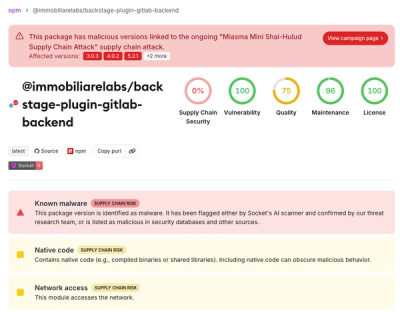
Miasma Mini Shai-Hulud Hits ImmobiliareLabs npm Packages
Miasma Mini Shai-Hulud hits @immobiliarelabs Backstage plugins, targeting GitLab and LDAP auth packages on npm.
By Socket Research Team - Jun 26, 2026
react-launcher
Advanced tools
English | 简体中文
A lightweight extensible launcher based on React-Router.
npm install react-launcher
Launcher is a React-Router-based launcher that takes an array of static routes and wraps a set of plugin mechanisms on top of it
import Launcher from 'react-launcher';

const Home = () => {
    return <div>home</div>;
};
const About = () => {
    return <div>home</div>;
};

const RouterConfig = [
    {
        path: '/',
        component: Home,
    },
    {
        path: '/about',
        component: About,
    },
];

const app = new Launcher({
    routes: RouterConfig,
});

app.start();
| Name | Type | required or Default | Description |
|---|---|---|---|
| hash | boolean | false | Whether to use hashRouter. The default is BrowserRouter |
| rootNode | string | #root | React Mounted DOM node |
| strictMode | boolean | false | Whether to turn on React strict mode |
| routes | Array<RouteItemUnionType> | required | Routing configuration, see the following types for details |
| basename | string | undefined | reference |
type ConstructorOptionsType = {
    hash?: boolean;
    rootNode?: string;
    strictMode?: boolean;
    routes: Array<RouteItemUnionType>;
    basename?: string;
};

type RouteItemUnionType =
    | LauncherPathRouteProps
    | LauncherLayoutRouteProps
    | LauncherIndexRouteProps
    | LauncherRedirectRouteProps;

type LauncherPathRouteProps = {
    title?: string;
    lazy?: boolean;
    component?: LauncherComponentType;
    loading?: ComponentType<LoadingComponentProps>;
    children?: Array<RouteItemUnionType>;
} & OmitChildrenElement<PathRouteProps>;

type LauncherLayoutRouteProps = {
    lazy?: boolean;
    component?: LauncherComponentType;
    loading?: ComponentType<LoadingComponentProps>;
    children?: Array<RouteItemUnionType>;
} & OmitChildrenElement<LayoutRouteProps>;

type LauncherIndexRouteProps = {
    lazy?: boolean;
    component?: LauncherComponentType;
    loading?: ComponentType<LoadingComponentProps>;
} & OmitChildrenElement<IndexRouteProps>;

type LauncherRedirectRouteProps = {
    path?: string;
    redirect?: string;
};

type DynamicImportType = Promise<{ default: ComponentType }>;

type LauncherComponentType = ComponentType | (() => DynamicImportType);
type OmitChildrenElement<T, K extends keyof T = never> = Omit<T, 'children' | 'element' | K>;
Extended LauncherRedirectRouteProps routing and title, lazy routing capabilities on top of React-Router
The plugin function is the most powerful feature of the Launcher, It's based on router development, and a plugin looks like this
export interface PluginType {
    name: string;
    outer?: PluginOuterRenderType;
    inner?: PluginInnerRenderType;
}
The simplest scenario is when the login request is successful and you want to show your application and pass on the user information
import React, { useEffect, useState } from 'react';
import Launcher from 'react-launcher';
const LoginProviderContext = React.createContext(null);

const LoginProvider = ({ children }) => {
    const [isLogin, setLogin] = useState(false);
    const [userInfo, setUserInfo] = useState({});

    useEffect(() => {
        loginApi()
            .then(res => {
                setLogin(true);
                setUserInfo(res.data);
            })
            .catch(error => {
                redirect('/login');
            });
    }, []);

    return isLogin ? (
        <LoginProviderContext.Provider value={userInfo}>{children}</LoginProviderContext.Provider>
    ) : null;
};

const loginPlugin = {
    name: 'login',
    // The first argument is the inner component, and the second argument is the argument passed in during use
    outer: (children, opt) => {
        return <LoginProvider opt={opt}>{children}</LoginProvider>;
    },
};
const app = new Launcher({...});
// Pass the plugin a parameter via the second argument
app.use(loginPlugin, opt)
app.start()
Of course you can have multiple plugins, just be aware of the plugin call hierarchy, the ones called later will be wrapped in the outer
The outer example is shown above, where it should be noted that the outer is wrapped around the router, so you can interpret it as a globally unique
A common example of inner is per-route control, as it is wrapped around the outer layer of each route, such as the need to authenticate each rout e
import React, { useEffect, useState, useContext } from 'react';
import Launcher, { useLocation } from 'react-launcher';

const AuthContext = React.createContext();

const AuthProvider = ({ children }) => {
    const [authData, setAuthData] = useState();
    useEffect(() => {
        authApi().then(res => {
            setAuthData(res.data);
        });
    }, []);
    return authData ? (
        <AuthContext.Provider value={authData}>{children}</AuthContext.Provider>
    ) : null;
};

const AuthRouteComponent = ({ children, route }) => {
    const { hasAuth } = route;
    const { pathname } = useLocation();
    const authInfo = useContext(AuthContext);

    if (hasAuth && !authInfo.has(pathname)) {
        return 'No permission';
    }
    return children;
};

const plugin = {
    name: 'auth',
    outer: (children, opt) => {
        return <AuthProvider opt={opt}>{children}</AuthProvider>;
    },
    inner: (children, route, opt) => {
        return (
            <AuthRouteComponent route={route} opt={opt}>
                {children}
            </AuthRouteComponent>
        );
    },
};

const Home = () => <div>home</div>;
const About = () => <div>about</div>;

const app = new Launcher({
    routes: [
        {
            path: '/',
            component: Home,
        },
        {
            path: '/about',
            component: Home,
            // /about authentication is required
            hasAuth: true,
        },
    ],
});
app.use(plugin, opt);
FAQs
**English** | [**简体中文**](./README.zh-CN.md)
The npm package react-launcher receives a total of 2 weekly downloads. As such, react-launcher popularity was classified as not popular.
We found that react-launcher demonstrated a not healthy version release cadence and project activity because the last version was released a year ago. It has 1 open source maintainer collaborating on the project.
Did you know?

Socket for GitHub automatically highlights issues in each pull request and monitors the health of all your open source dependencies. Discover the contents of your packages and block harmful activity before you install or update your dependencies.
Research
/Security News
Miasma Mini Shai-Hulud hits @immobiliarelabs Backstage plugins, targeting GitLab and LDAP auth packages on npm.

Security News
Rolldown paused Rust React Compiler integration after a 5MB binary size increase raised concerns about shipping React-specific code to all Vite users.

Security News
/Research
Mini Shai-Hulud expands into the Go ecosystem after hitting LeoPlatform npm packages and targeting GitHub Actions workflows.