

Security News
RubyGems Adds Cooldown Feature to Bundler for Newly Published Gems
RubyGems and Bundler 4.0.13 introduced an opt-in cooldown feature that delays newly published gems during dependency resolution.
By Sarah Gooding - Jun 05, 2026
react-native-bars
Advanced tools
Components to control your app status and navigation bars.
Inspired by the built-in StatusBar module and react-native-transparent-status-and-navigation-bar by @MoOx (Thanks to them 💖).





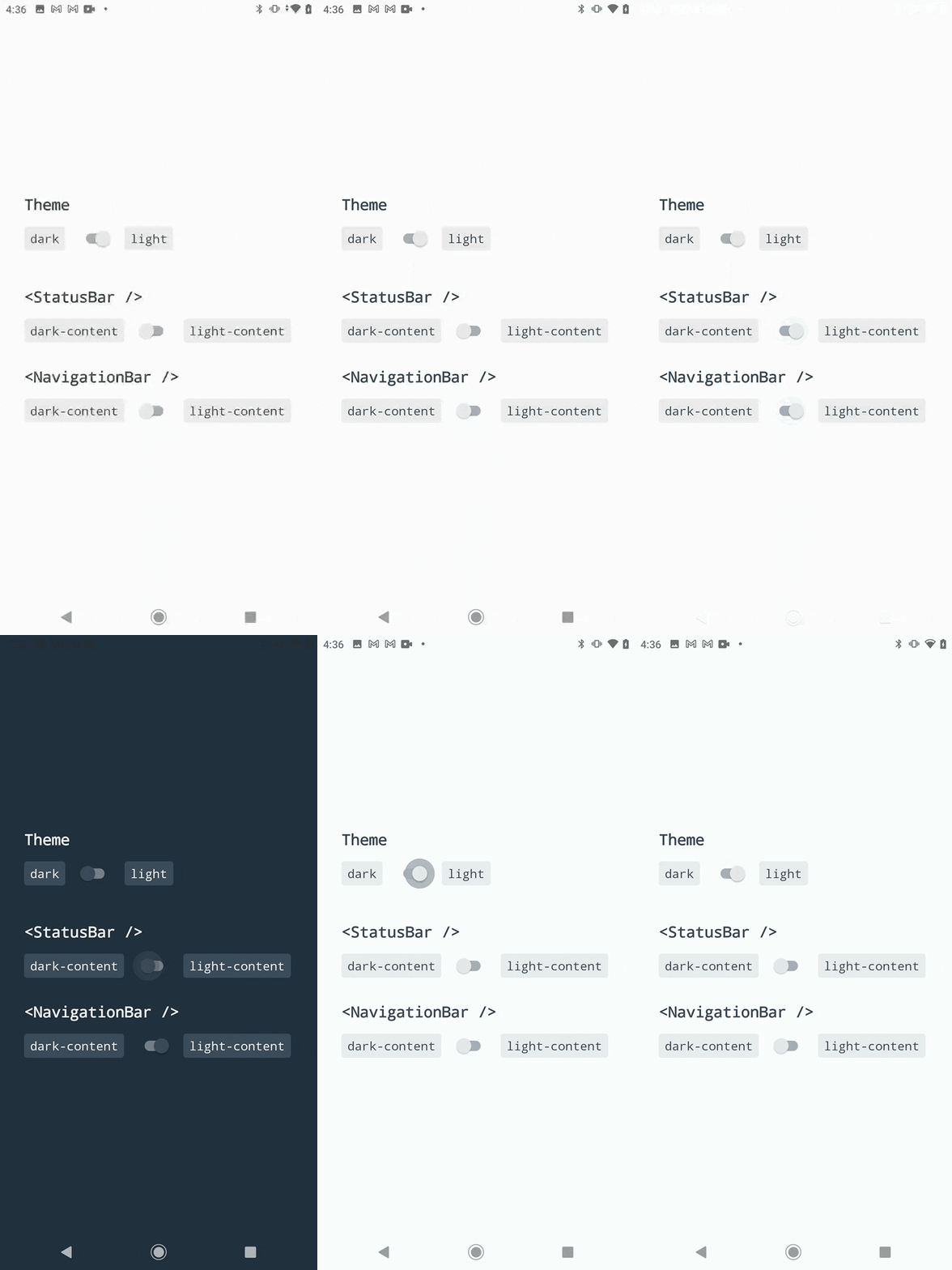

This module is provided as is, I work on it in my free time.
If your company uses it in a production app, consider sponsoring this project 💰. You also can contact me for premium enterprise support, help with issues, prioritize bugfixes, feature requests, etc.
| version | RN version | Android version | iOS version |
|---|---|---|---|
| 1.0.0+ | 0.65.0+ | 6.0+ | 11.0+ |
$ npm install --save react-native-bars
# --- or ---
$ yarn add react-native-bars
This module will works best with:
Because this package targets React Native 0.65.0+, you will probably don't need to link it manually. Otherwise if it's not the case, follow this additional instructions:
android/settings.gradle:include ':react-native-bars'
project(':react-native-bars').projectDir = new File(rootProject.projectDir, '../node_modules/react-native-bars/android')
android/app/build.gradle:dependencies {
// ...
implementation project(':react-native-bars')
}
MainApplication.java:import com.zoontek.rnbars.RNBarsPackage; // <- add the RNBarsPackage import
public class MainApplication extends Application implements ReactApplication {
// …
@Override
protected List<ReactPackage> getPackages() {
@SuppressWarnings("UnnecessaryLocalVariable")
List<ReactPackage> packages = new PackageList(this).getPackages();
// …
packages.add(new RNBarsPackage());
return packages;
}
// …
}
ℹ️ For react-native < 0.68 setup, follow the v1.1.2 README.md (it will works with the latest react-native-bars version too).
android/build.gradle file:buildscript {
ext {
buildToolsVersion = "31.0.0"
minSdkVersion = 23 // <- set at least 23
compileSdkVersion = 31 // <- set at least 31
targetSdkVersion = 31 // <- set at least 31
// …
android/app/src/main/java/com/yourprojectname/MainActivity.java file:// …
// Add these required imports:
import android.os.Bundle;
import com.zoontek.rnbars.RNBars;
public class MainActivity extends ReactActivity {
// …
@Override
protected void onCreate(Bundle savedInstanceState) {
super.onCreate(savedInstanceState); // or super.onCreate(null) with react-native-screens
RNBars.init(getPlainActivity(), "dark-content"); // <- initialize with initial bars styles (could be light-content)
}
}
android/app/src/main/res/values/styles.xml file:android:windowLightStatusBar to match your initial styles.<resources>
<style name="AppTheme" parent="Theme.AppCompat.DayNight.NoActionBar">
<!-- … -->
<!-- Set status bar background transparent -->
<item name="android:statusBarColor">@android:color/transparent</item>
<!-- Navigation bar will stay translucent on Android < 8.1 -->
<item name="android:windowTranslucentNavigation">true</item>
</style>
</resources>
android/app/src/main/res/values-v27/styles.xml file:android:{windowLightStatusBar,windowLightNavigationBar} to match your initial styles.<resources xmlns:tools="http://schemas.android.com/tools">
<style name="AppTheme" parent="Theme.AppCompat.DayNight.NoActionBar">
<!-- … -->
<!-- Set system bars background transparent -->
<item name="android:statusBarColor">@android:color/transparent</item>
<item name="android:navigationBarColor">@android:color/transparent</item>
<!-- Disable auto contrasted system bars background -->
<item name="android:enforceStatusBarContrast" tools:targetApi="q">false</item>
<item name="android:enforceNavigationBarContrast" tools:targetApi="q">false</item>
</style>
</resources>
For a perfect react-native-bars + react-native-bootsplash match 💞, check the bootplash example app styles.xml files:
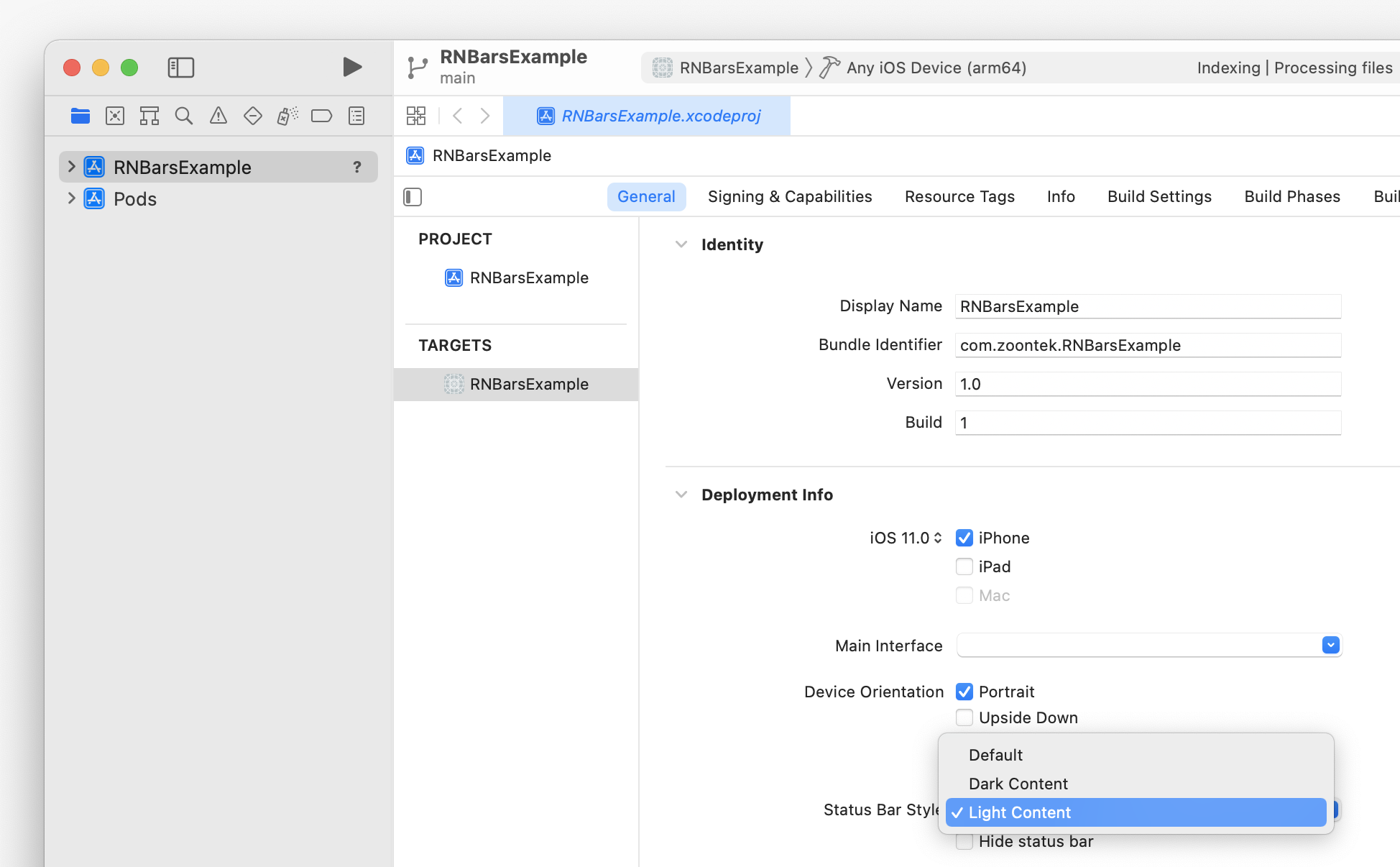
You can setup your initial status bar style in Xcode > General > Deployment Info:
import * as React from "react";
import { StatusBar, NavigationBar, SystemBars } from "react-native-bars";

const App = () => {
  return (
    <>
      <StatusBar animated={true} barStyle="light-content" />
      <NavigationBar barStyle="light-content" />

      {/* Or, to update both with one component: */}
      <SystemBars animated={true} barStyle="light-content" />
    </>
  );
};
<StatusBar />A component to control your app status bar.
import { StatusBar } from "react-native-bars";

type StatusBarProps = {
  // Should transition between status bar property changes be animated? (has no effect on Android)
  animated?: boolean;
  // Sets the color of the status bar content
  barStyle: "light-content" | "dark-content";
};

const App = () => (
  <>
    <StatusBar animated={true} barStyle="dark-content" />
    {/* … */}
  </>
);
const entry: StatusBarProps = StatusBar.pushStackEntry(
  props /*: StatusBarProps*/,
);
StatusBar.popStackEntry(entry/*: StatusBarProps*/): void;
const entry: StatusBarProps = StatusBar.replaceStackEntry(
  entry /*: StatusBarProps*/,
  props /*: StatusBarProps*/,
);
<NavigationBar />A component to control your app navigation bar. It has no effect on iOS and Android < 8.1.
import { NavigationBar } from "react-native-bars";

type NavigationBarProps = {
  // Sets the color of the navigation bar content
  barStyle: "light-content" | "dark-content";
};

const App = () => (
  <>
    <NavigationBar barStyle="dark-content" />
    {/* … */}
  </>
);
const entry: NavigationBarProps = NavigationBar.pushStackEntry(
  props /*: NavigationBarProps*/,
);
NavigationBar.popStackEntry(entry/*: NavigationBarProps*/): void;
const entry: NavigationBarProps = NavigationBar.replaceStackEntry(
  entry /*: NavigationBarProps*/,
  props /*: NavigationBarProps*/,
);
<SystemBars />A component to control both your app status and navigation bars.
import { SystemBars } from "react-native-bars";

type SystemBarsProps = {
  // Should transition between bars property changes be animated? (has no effect on Android)
  animated?: boolean;
  // Sets the color of the bars content
  barStyle: "light-content" | "dark-content";
};

const App = () => (
  <>
    <SystemBars animated={true} barStyle="dark-content" />
    {/* … */}
  </>
);
FAQs
Components to control your app status and navigation bars.
The npm package react-native-bars receives a total of 463 weekly downloads. As such, react-native-bars popularity was classified as not popular.
We found that react-native-bars demonstrated a not healthy version release cadence and project activity because the last version was released a year ago. It has 1 open source maintainer collaborating on the project.
Did you know?

Socket for GitHub automatically highlights issues in each pull request and monitors the health of all your open source dependencies. Discover the contents of your packages and block harmful activity before you install or update your dependencies.
Security News
RubyGems and Bundler 4.0.13 introduced an opt-in cooldown feature that delays newly published gems during dependency resolution.
Security News
pnpm 11.5 now recognizes npm staged publish approvals in release metadata, preventing those releases from being mistaken for lower-trust package publishes.

Security News
Federal audit finds NIST lacked a plan to clear the NVD backlog, wasted funds on duplicate work, and delayed use of CISA data.