
Research
/Security News
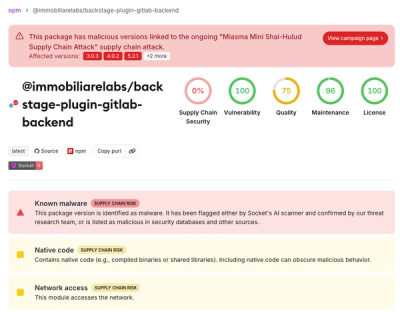
Miasma Mini Shai-Hulud Hits ImmobiliareLabs npm Packages
Miasma Mini Shai-Hulud hits @immobiliarelabs Backstage plugins, targeting GitLab and LDAP auth packages on npm.
By Socket Research Team - Jun 26, 2026
Rlse (pronounced “release”) is an open-source library written in Rust that makes feature flags a first-class citizen in your codebase. With Rlse, you can easily manage feature flag definitions directly in your code, improving consistency, simplicity, and efficiency in your release process.
Add Rlse to your project using npm:
$ npm install rlse -S
Create a configuration file in the root of your project to define your feature flags. By default, Rlse looks for a file named rlse.toml. Here’s an example:
[features]
testFeature1 = { environments = ['dev', 'test']}
testFeature2 = { environments = ['test']}
testFeature3 = { environments = ['dev', 'uat', 'test', 'prod']}
If you prefer a different file name, set the RLSE_CONFIG environment variable to point to it. For example:
export RLSE_CONFIG="custom_config.toml"
💡 Tip: Ensure the configuration file is included in your build process so it deploys with your application.
The [features] section is where you define your feature flags. Each feature is a key-value pair, where the key is the feature name and the value specifies the environments in which it is enabled.
Example:
[features]
uniqueFriendlyFeatureName = { environments = ['dev']}
In this example:
Rlse makes it easy to conditionally enable features based on your configuration. Use the is_enabled function to check whether a feature is active in a given environment.
Example:
import { is_enabled } from "rlse";

// Automatically checks the `APP_ENV` environment variable.
// Defaults to the 'dev' environment if `APP_ENV` is not set.
if (is_enabled("uniqueFriendlyFeatureName")) {
  // Feature-specific logic here
}

// Explicitly pass an environment as the second parameter.
if (is_enabled("uniqueFriendlyFeatureName", "prod")) {
  // Feature-specific logic for production environment
}
🛑 Important:
FAQs
Code first feature flags
The npm package rlse receives a total of 3 weekly downloads. As such, rlse popularity was classified as not popular.
We found that rlse demonstrated a not healthy version release cadence and project activity because the last version was released a year ago. It has 1 open source maintainer collaborating on the project.
Did you know?

Socket for GitHub automatically highlights issues in each pull request and monitors the health of all your open source dependencies. Discover the contents of your packages and block harmful activity before you install or update your dependencies.
Research
/Security News
Miasma Mini Shai-Hulud hits @immobiliarelabs Backstage plugins, targeting GitLab and LDAP auth packages on npm.

Security News
Rolldown paused Rust React Compiler integration after a 5MB binary size increase raised concerns about shipping React-specific code to all Vite users.
Security News
/Research
Mini Shai-Hulud expands into the Go ecosystem after hitting LeoPlatform npm packages and targeting GitHub Actions workflows.