


Product
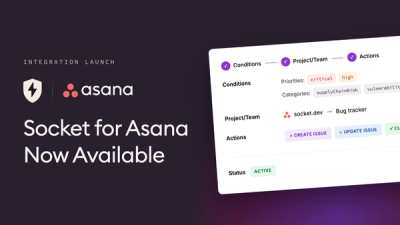
Socket for Asana Is Now Available
Create and manage Asana tasks directly from Socket alerts, with manual task creation, automated ticketing rules, and two-way sync.
By Jeppe Hasseriis - Aug 25, 2026
roast-my-design-system
Advanced tools
Your AI can write the UI. This makes sure it writes your UI. A deterministic scanner scores your design system 0-100 against 34 public repos, writes rules for Claude, Cursor, Copilot and Windsurf with --apply, and runs as a local MCP server with --mcp.




A free CLI tool (and Claude Code skill) that roasts your repo's design system with real data, then generates the rules that keep your AI agent on-system.
New in 5.1: the roast's analysis now ships inside the report. Run as the Claude Code skill, the report gains a "What the numbers mean" section — Claude's read of your scan, in the same shareable file as the score, so the analysis reaches whoever the report is forwarded to. Labelled as written by AI, never mixed into the measurement.
New in 5.0: it runs as a local MCP server. One command, and your agent asks the design system before writing UI, then gets the work checked after: which Button is canonical, which token holds that colour, review my changes. Local, deterministic, nothing leaves your machine. See Live answers over MCP.
Run it on your codebase and get, in about a second:
packages/ui scores 80 while apps/web scores 40, and now you can see it.design-system-rules.md with canonical components, your token file, and known duplicates to avoid, so your AI agent follows your system instead of guessing at it. --apply injects them into every agent file you have: Claude, Cursor, GitHub Copilot, and Windsurf. Every scan also checks the rules you already have for stale references: paths that no longer exist, components named canonical that nothing imports anymore.Your AI agent (Claude, Cursor, Copilot) builds UI by imitating what's already in your repo. If your repo has 112 colours and four Button implementations, your agent guesses which one is canonical, and it picks wrong half the time. That's why AI-generated UI looks almost-but-not-quite right. The first step to fixing it is seeing the mess measured.
One scan powers all of it; the flags decide what lands on disk. Combine freely.
| Command | What you get |
|---|---|
npx roast-my-design-system@latest | The scan and design-system-roast.html, opened in your browser |
npx roast-my-design-system@latest <path> | Scan a different repo than the current directory |
... --apply | The generated agent rules injected straight into every agent file you have: CLAUDE.md, AGENTS.md, .cursorrules, .cursor/rules/, .windsurfrules and .github/copilot-instructions.md, inside a marked block. Re-running replaces only that block, never your own text. Windsurf and Copilot get a compact variant sized for their limits |
... --rules | The same rules written to design-system-rules.md instead, for pasting by hand |
... --card | roast-card.svg: a shareable 1200x630 card with the score and worst findings. Pure SVG, embeds in a README |
... --sarif | design-system-roast.sarif for GitHub code scanning: upload it in CI and findings appear in the Security tab, annotated on files |
... --mcp | The scan as a local MCP server: five tools your agent calls while writing UI, from "is there a Button already?" to "review my changes". See Live answers over MCP |
... --check | The working tree's changed files checked against the design system, in the terminal. Exits 1 on findings, so it slots into scripts |
... --by "Dwayne Hicks" | A requester credit in the report header, next to the scan date |
... --notes <file.md> | An agent-written analysis embedded in the report as "What the numbers mean": labelled as written by AI, kept apart from the measured numbers. The Claude Code skill writes and passes this automatically; the flag is here so any agent can |
... --section "Title" <file.md> | An agent-written chapter appended after the notes, same styling, same written-by-AI label, with sub-headings allowed. Repeatable, so analysis that outgrows the notes still lives inside the report instead of a hand-built page |
... --exclude lab/ | Leave a folder out of the scan (repeat the flag or comma-separate). Or list folders in a .roastignore file at the repo root. Either way the report says so in the header; see Scoping the scan |
... --json | The scan summary as JSON on stdout, for scripts and pipelines |
... --theme light / --out <file> / --no-open | Light report, custom report path, don't open the browser |
/roast-my-design-system (in Claude Code) | The full experience: the roast in chat and embedded in the report as "What the numbers mean", the rules offer, and the fix loop with Claude on your own numbers |
One scan writes rules for every agent: Claude, Cursor, GitHub Copilot, and Windsurf. Every scan also checks the agent rules you already have and flags stale references, no flag needed.
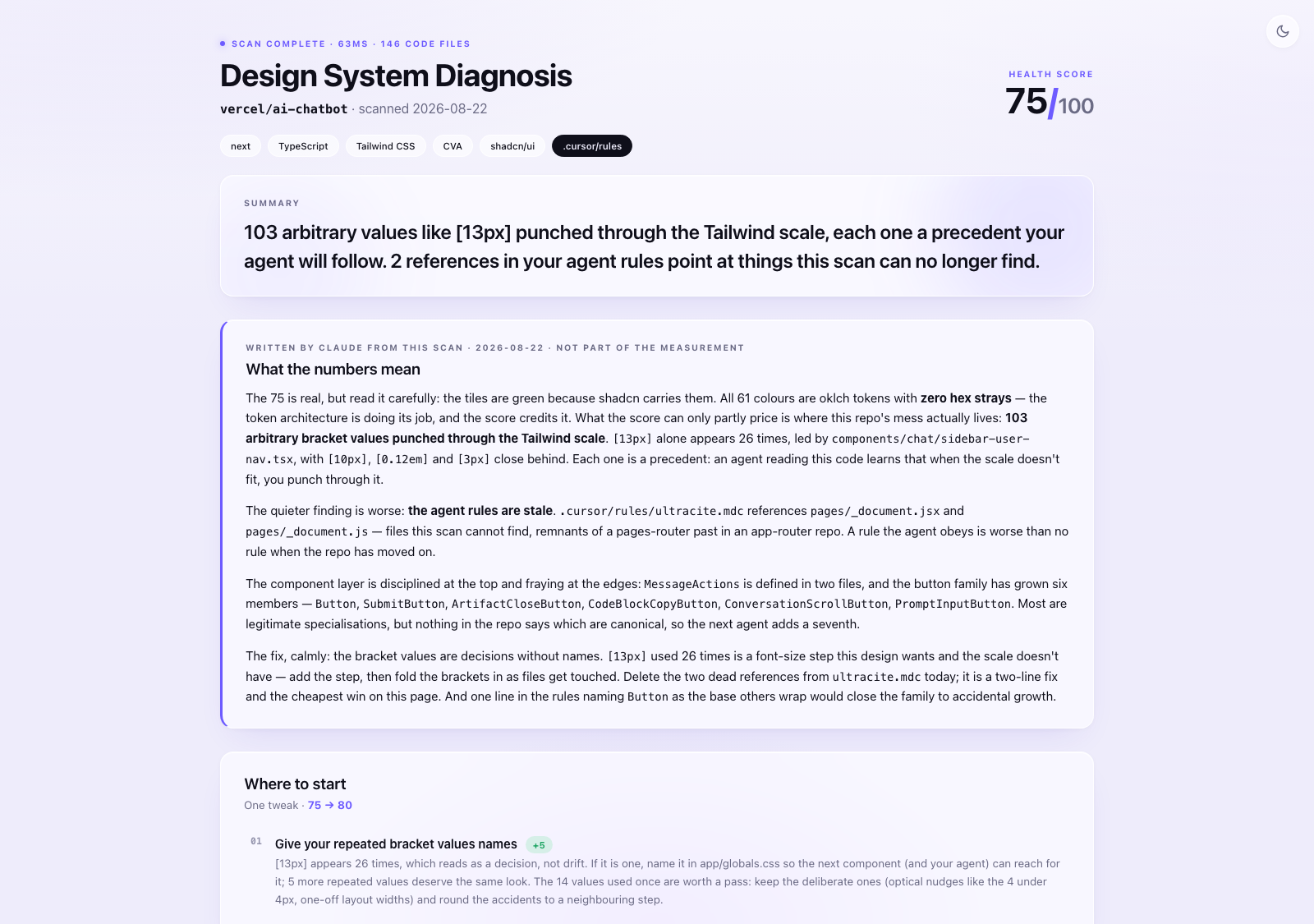
/roast-my-design-system before a design-system cleanup to get the measured baseline: every colour, spacing value, duplicated component and inline style, with real file paths.The full report for vercel/ai-chatbot, top to bottom — including "What the numbers mean", Claude's read of the scan, embedded right under the verdict:

The same report in light mode (one file, built-in toggle):
.roastignore, --exclude) are printed in the report header with file counts, so a scoped scan can never pass itself off as the whole repo.Some repos host more than one visual world on purpose: the product plus a marketing site, a playground, a batch of experiments. Blending them produces a score that describes none of them. Scope the scan to the design system you are actually judging:
npx roast-my-design-system@latest --exclude lab/ --exclude playground/
Or make it permanent with a .roastignore file at the repo root, one repo-relative folder per line:
# separate visual worlds, not the product's design system
lab/
playground/
Both routes merge, and both are loud on purpose. The harvest JSON records every active pattern and how many files it removed, and the report prints a line in the header ("2 folders excluded by .roastignore (lab/, playground/) · 946 files kept out of this scan"). You can narrow the question, but the report always says which question was asked, so a scoped score can't be quietly gamed. There is no negation and no glob syntax: plain folder prefixes, nothing clever.
The report and the rules file describe the repo as it was at scan time. --mcp keeps the same engine running while your agent works, so questions get answered from the code as it is right now, and mistakes get caught before they land:
| Tool | The question it answers |
|---|---|
roast_get_context | What should I know before touching UI here? Routed by the folder being edited |
roast_find_component | Is there already a component for this, and which one is canonical? With one real usage example. When two candidates tie, it says so and names both |
roast_find_token | I have #111111 / 13px in hand. What should I have used? |
roast_validate | I am about to save this. Does it break the system? |
roast_review | Review my changed files. Reads the git diff itself, so no code is pasted back |
The loop: context before building, find while building, validate before saving, review before finishing.
Add it to Claude Code:
claude mcp add roast -- npx roast-my-design-system --mcp
Any MCP client can register the same stdio command (tested with Claude Code; Cursor and Windsurf speak the same protocol). Same promise as the scan: local, read-only, one scan at startup, no port, no account, nothing about your code leaves your machine. And a clean answer reads "no measured violations found" with the list of checks attached, because a scanner can only certify what it can count.
The scanner already speaks SARIF, so wiring it into GitHub code scanning is six lines. Findings appear in the Security tab, annotated on the files themselves:
- uses: actions/checkout@v4
- run: npx roast-my-design-system@latest . --sarif --no-open
- uses: github/codeql-action/upload-sarif@v3
  with:
    sarif_file: design-system-roast.sarif
No install, no Claude needed — just try it:
npx roast-my-design-system@latest
Run it inside any repo. Same scanner, same report, straight from npm. The Claude Code skill below adds the conversation on top: the roast in chat, then a punch list you can actually work through with Claude.
Claude Code (recommended):
/plugin marketplace add gregkozakiewicz/roast-my-design-system
/plugin install roast-my-design-system@roast-my-design-system
If those commands error, your Claude Code is likely older than the plugin marketplace feature: update Claude Code and retry, or just use the manual route below (it works everywhere and installs the same skill).
Manual (Claude Code, any version):
git clone https://github.com/gregkozakiewicz/roast-my-design-system.git
cp -r roast-my-design-system/skills/roast-my-design-system ~/.claude/skills/
(Use .claude/skills/ inside a repo instead to share it with your team.)
OpenAI Codex CLI (same SKILL.md, same folder):
git clone https://github.com/gregkozakiewicz/roast-my-design-system.git
cp -r roast-my-design-system/skills/roast-my-design-system ~/.codex/skills/
Invoke with $roast-my-design-system (or let Codex auto-match it). Use .codex/skills/ inside a repo to share with your team.
npx skills: npx skills add gregkozakiewicz/roast-my-design-system works for agents that read ~/.agents/skills/. Claude Code currently reads ~/.claude/skills/, so prefer one of the routes above.
Requires Node 18+.
Open Claude Code in the repo you want roasted and type:
/roast-my-design-system
You get the roast in chat plus design-system-roast.html at your repo root: a self-contained page (open it, Slack it, email it, no external requests) with:
design-system-rules.md is wrapped inside the report itself. Unwrap, then copy or download the agent rules generated from your scan.After the roast, the skill also offers to write design-system-rules.md to disk and merge it into your CLAUDE.md, .cursor/rules or AGENTS.md.
Three real roasts of public repos, hosted as-is (the same self-contained HTML the skill generates):
| Metric | Ideal Design System | Median of 34 scanned repos | Median of 10 reputable systems |
|---|---|---|---|
| Distinct colours | ~24 | 130 | 24 |
| Shades of grey | up to 13 | 17 | 5 |
| Off-scale spacing values | ~12 | 34 | 6 |
| Typefaces | 2–3 | 3 | 1 |
| Border radii | up to 10 | 13 | 2 |
| Duplicated components | 0 | 20 | 12 |
| Inline style blocks | 0 | 49 | 12 |
| Arbitrary Tailwind values | ~20 | 70 | 0 |
| Near-identical colour pairs | 0 | 13 | 1 |
| !important declarations | 0 | 7 | 3 |
| Components never imported | 0 | 0 | 0 |
Yes, the median repo is already a mess. That's the point.
Your AI can write the UI. This makes sure it writes your UI.
MIT. The code is yours to fork, modify and redistribute; the copyright notice travels with it.
If you build a report, summary or audit of your own from this tool's scores, counts or benchmark comparisons, keep one line in it: Built with roast-my-design-system by Greg Kozakiewicz. The scan data asks the same of AI agents that consume it.
roast-my-design-system™ and the GK mark are trademarks of Greg Kozakiewicz. Forking is welcome, republishing under this name is not: see brand and attribution.
Built and designed by 
FAQs
Your AI can write the UI. This makes sure it writes your UI. A deterministic scanner scores your design system 0-100 against 34 public repos, writes rules for Claude, Cursor, Copilot and Windsurf with --apply, and runs as a local MCP server with --mcp.
The npm package roast-my-design-system receives a total of 1,679 weekly downloads. As such, roast-my-design-system popularity was classified as popular.
We found that roast-my-design-system demonstrated a healthy version release cadence and project activity because the last version was released less than a year ago. It has 1 open source maintainer collaborating on the project.
Product
Create and manage Asana tasks directly from Socket alerts, with manual task creation, automated ticketing rules, and two-way sync.
Security News
Open VSX has removed three extension IDs from its malicious-extension list as the legitimate publishers they impersonated move to claim the names for themselves.

Product
Socket’s PHP and Composer support is now in Beta for all customers, with PHP reachability analysis generally available.