

Security News
Risky Biz Podcast: AI Agents Are Raising the Stakes for Software Supply Chain Security
Open source attacks are accelerating as AI coding agents pull in dependencies faster, with less human review.
By Sarah Gooding - Jun 30, 2026
rstack-agents
Advanced tools
Production-ready agentic SDLC framework for Pi and coding agents — orchestrator, builder/validator teams, lifecycle state, and specialist reuse
A governed SDLC for AI coding agents — in any framework. RStack gives agent teams a repeatable, auditable 15-stage pipeline with human approval gates, builder/validator contracts, evidence, episodic memory, and a live company dashboard. Developed by Richardson Gunde.
clarify → plan → spec → approve → build → validate → release-readiness → learn
cd your-project
npm install rstack-agents
npx rstack-agents init        # auto-detects: pi | claude-code | operator | custom
| Your framework | What init does | Guide |
|---|---|---|
| Pi | Nothing else needed — Pi auto-loads the native extension; sdlc_* tools appear in the next session | docs/integrations/pi.md |
| Claude Code | Writes a usage guide + a SessionStart hook so the dashboard pops up every session; install /plugin install sdlc-automation | docs/integrations/claude-code.md |
| Operator | Writes a settings template for the Python adapter (bridges to the same harness) | docs/integrations/operator.md |
| Anything else | The .rstack/ state contract + a Node bridge any harness can shell out to | docs/integrations/custom.md |
Start a governed run from your agent session:
sdlc_start(goal="Build a checkout flow with Stripe, tests, and release readiness")
The dashboard launches automatically when a session starts (Pi, Claude Code hook, Operator) — or bring it up from any harness:
npx rstack-agents hub
What it shows, across every project on the machine:
| Page | What you get |
|---|---|
| Studio / Studio 3D | Jarvis-style live agent workspace — who's working right now, status as glow; the 3D scene (/studio3d) lets you click any agent: what they worked on, what they shipped, why they're waiting |
| Run Analytics | Wall-clock Gantt per run, stage duration averages, run-over-run trends |
| Team & Presence | Who is live now, people directory (runs / approvals / guidance per person), manager rollup per project |
| Projects & Runs | Every session; open a run to read its actual deliverables — requirements, architecture, QA report, security review — plus evidence records |
| Approvals / Alerts | Approve or reject gates from the browser; popups when new gates block |
| Workflow / Traceability | 15-stage map with live states; requirement → stage → task → evidence chains |
Switch project/run scope from the top bar; share #run=<id> links in Slack.
.rstack/policy.json makes chosen stages require approval in every mode
(express included):{ "required_approvals": { "008-release-readiness": ["release-readiness.json"] } }
RSTACK_USER)RSTACK_APPROVAL_TOKEN)
so a manager's identity can't be spoofed from the browser; sdlc_approve
enforces the policy.json manager allow-list. Without the token set,
browser approvals are disabled (secure default) — approve via sdlc_approve.One event fans out to every channel you configure (env vars or
.rstack/notifications.json). Verify in seconds:
npx rstack-agents notify --test
Full setup: docs/integrations/webhooks.md.
Every run stores its full audit trail under .rstack/runs/<run-id>/:
manifest (incl. who started it), tasks with builder/validator contracts,
an append-only event stream, evidence records, stage artifacts, approvals,
human guidance (who answered what), stage timings, and checkpoints for
sdlc_rollback. The dashboard derives everything from these files — no
database, no telemetry leaves your machine.
Honest limitation: LLM token usage and real cost are not captured — the host framework executes the model calls, so the harness never sees usage. Cost shows $0 unless a builder reports it in its contract. Host-side usage instrumentation is on the roadmap.
| Command | Purpose |
|---|---|
rstack-agents init [-f framework] | Set up RStack in a project (idempotent) |
rstack-agents hub | Ensure the dashboard is running and open it |
rstack-agents notify [--test] | Inspect / test notification channels |
rstack-agents list agents|skills|plugins | Browse the packaged catalog (196 agents) |
rstack-agents add plugin <name> | Copy a packaged plugin into the project |
rstack-agents validate | Validate packaged agent definitions |
rstack-business [--port N] [--project path] | Run the dashboard directly |
| Variable | Purpose |
|---|---|
RSTACK_USER / RSTACK_USER_EMAIL | Identity for runs/approvals (defaults to git config) |
RSTACK_BUSINESS_PORT | Dashboard port (default 3008) |
RSTACK_NO_BUSINESS_HUB=1 | Disable dashboard auto-launch |
RSTACK_APPROVAL_TOKEN | Required to approve from the dashboard (prevents identity spoofing) |
RSTACK_MANAGER_USERS | Comma-separated manager allow-list (also in policy.json) |
RSTACK_SLACK_WEBHOOK etc. | Notification channels — see webhooks guide |
RSTACK_DEFAULT_MODEL / RSTACK_ESCALATED_MODEL | Models for delegated builders (escalation at attempt ≥ 2) |
src/
├── core/             harness (stages, contracts, evidence, guardrails,
│                     run-state, identity) + tracker (registry, approvals)
├── observability/    collectors · Business Hub dashboard · alerts · metrics
├── integrations/     pi/ · operator/ · init (claude-code + custom)
├── notifications/    channels (slack, teams, discord, telegram, whatsapp) + router
└── memory/           episodic memory, retrieval, diagnostics
Layer rules and the full map: src/README.md. Adapter contract for new frameworks: docs/integrations/custom.md. Harness internals: docs/HARNESS.md.
git clone https://github.com/richard-devbot/SDLC-rstack.git
cd SDLC-rstack && npm install
npm test          # 100+ tests
npm run lint
npm run validate  # 196 packaged agents
Changes follow issues-first: every PR closes a GitHub issue. See CHANGELOG.md for what each release lets you do.
MIT © Richardson Gunde
FAQs
Production-ready agentic SDLC framework for Pi and coding agents — orchestrator, builder/validator teams, lifecycle state, and specialist reuse
The npm package rstack-agents receives a total of 65 weekly downloads. As such, rstack-agents popularity was classified as not popular.
We found that rstack-agents demonstrated a healthy version release cadence and project activity because the last version was released less than a year ago. It has 1 open source maintainer collaborating on the project.
Did you know?

Socket for GitHub automatically highlights issues in each pull request and monitors the health of all your open source dependencies. Discover the contents of your packages and block harmful activity before you install or update your dependencies.
Security News
Open source attacks are accelerating as AI coding agents pull in dependencies faster, with less human review.

Research
/Security News
Malicious Chrome and Firefox extensions posed as free VPNs while stealing clipboard data through later extension updates.
Research
/Security News
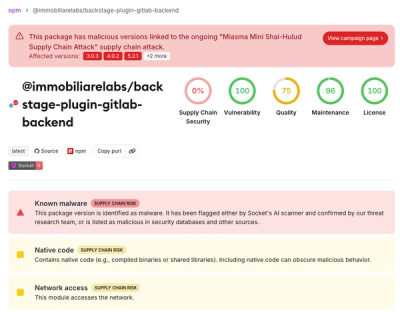
Miasma Mini Shai-Hulud hits @immobiliarelabs Backstage plugins, targeting GitLab and LDAP auth packages on npm.