RStack SDLC
A governed AI-SDLC operating layer for AI coding harnesses.
Since 2026 · MIT · richard-devbot/SDLC-rstack






The most governance-complete AI-SDLC layer available for autonomous coding agents. Not a prompt template, not a set of suggested conventions — every gate, guardrail, and contract in this README is backed by runtime enforcement in code, live-verified against five real coding harnesses, and observable end-to-end from a real dashboard, not a demo.
RStack sits on top of Pi, Claude Code, Operator, Codex-style CLIs, Gemini-style CLIs, or a custom harness and gives agent teams a repeatable lifecycle with approvals, builder/validator contracts, evidence, memory, budget envelopes, and a live Business Hub.
Enforcement tiers: full, live tool-call gating on Pi, Tau, Claude Code, Hermes, and Operator — each verified against the real, installed framework (Tau by shadowing its built-in tools, Hermes via its real pre_tool_call hook, Operator via the shipped bootstrap.py wrapper, since operator-use has no plugin-loading mechanism of its own). Every other harness gets the governed contracts, state, and Business Hub, plus a guided recipe to wire the guard into its own hook system (wire-your-own-harness).
What makes this different from a prompt-only "AI SDLC" framework:
- Enforced, not requested. Destructive-action gates, attempt budgets, and the validator sandbox are checked in code on every tool call — an agent cannot talk its way past a guardrail.
- Built for unattended operation. A durable worker scheduler (
pipeline watch) drives a run for hours without a human at the keyboard, with a persisted heartbeat, graceful signal handling, and a duplicate-instance guard — not a toy loop that dies the moment the terminal closes.
- Real execution, not self-reported success. Builder-claimed test results are re-run in a locked-down transient sandbox; the gate trusts the container's exit code, never the agent's own word.
- A truth layer, not a status page. Quality & Risk scores, traceability chains, and drift detection are computed from the actual
.rstack evidence on disk — an "Unknown" is a real unknown, never a fabricated green.
- Cross-harness by construction. The same governed run state, approvals, and Business Hub work identically whether the agent behind the keyboard is Pi, Claude Code, Tau, Hermes, or Operator.
clarify → plan → spec → approve → build → validate → release-readiness → learn
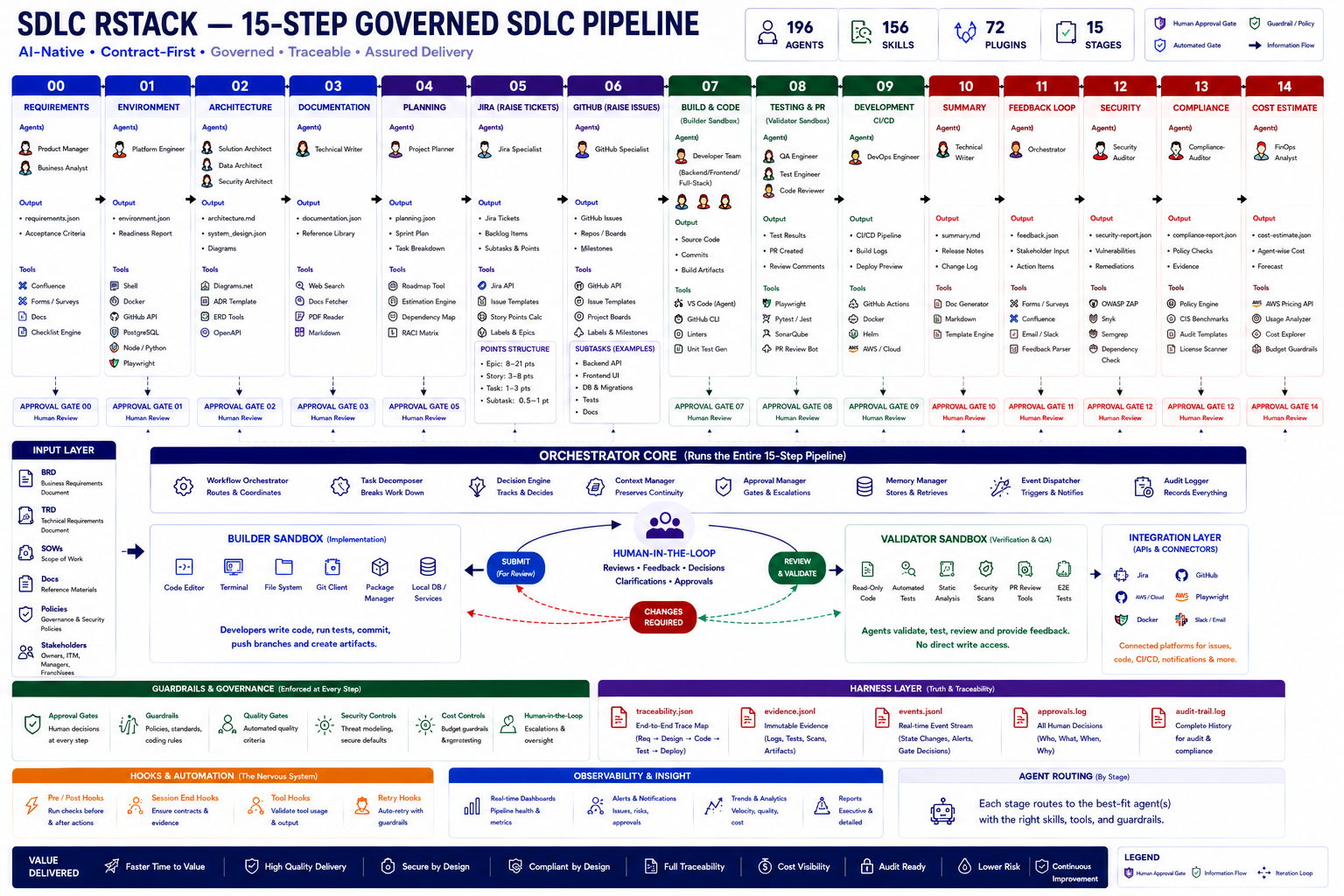
New here? Start with the one-page Setup & Usage guide → docs/SETUP.md — install, per-harness wiring (Pi · Claude Code · Tau · Operator · Hermes · custom), running a governed pipeline, approvals, the dashboard, and the full CLI reference, all in one place.
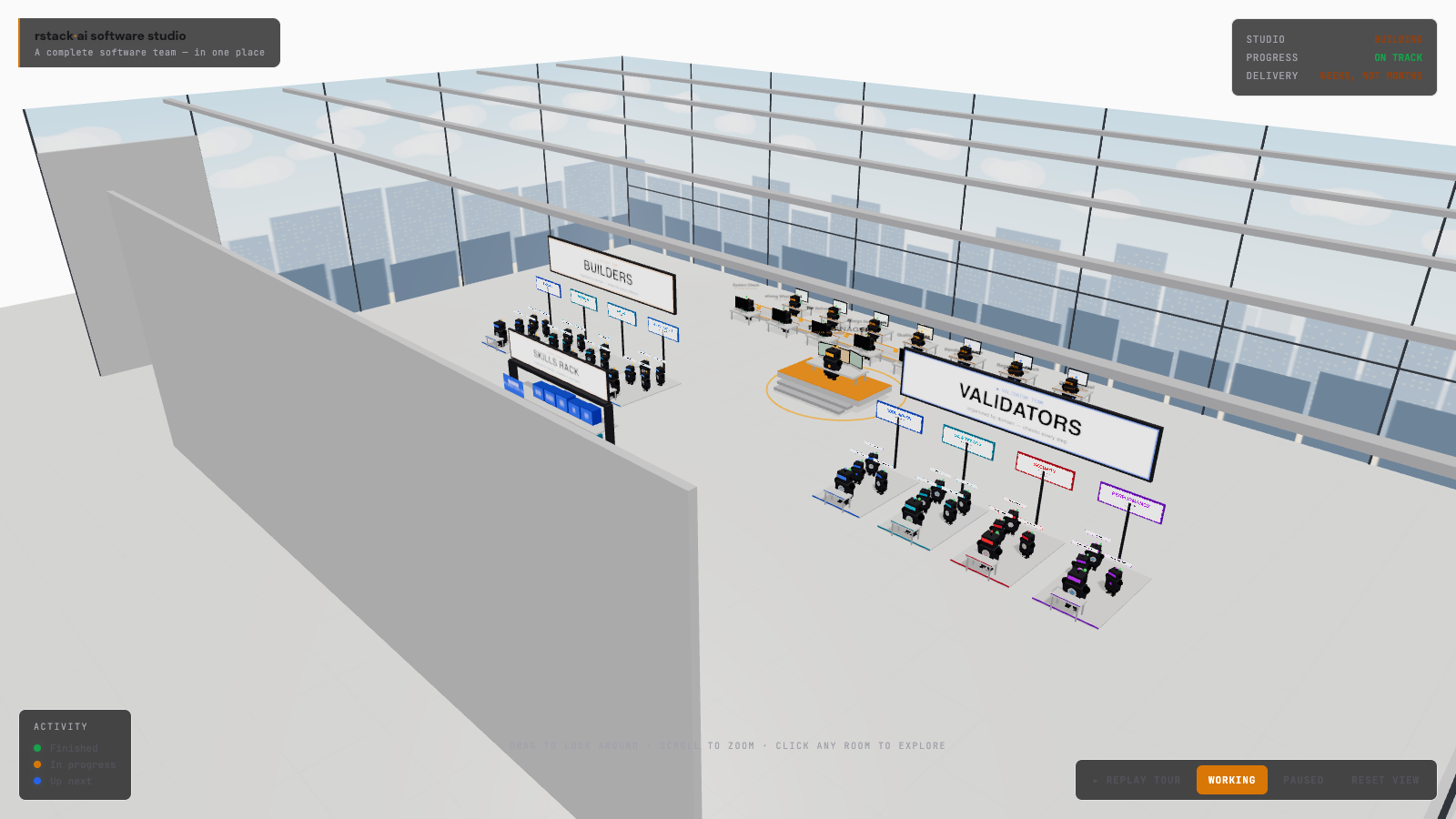
Meet the studio
Your AI software team in one place — builders, validators, the skills rack, and live delivery status. Open the interactive 3D workspace → — drag to look around, scroll to zoom, click any room to explore, or take the guided tour where each specialist introduces itself.
Business Hub in action
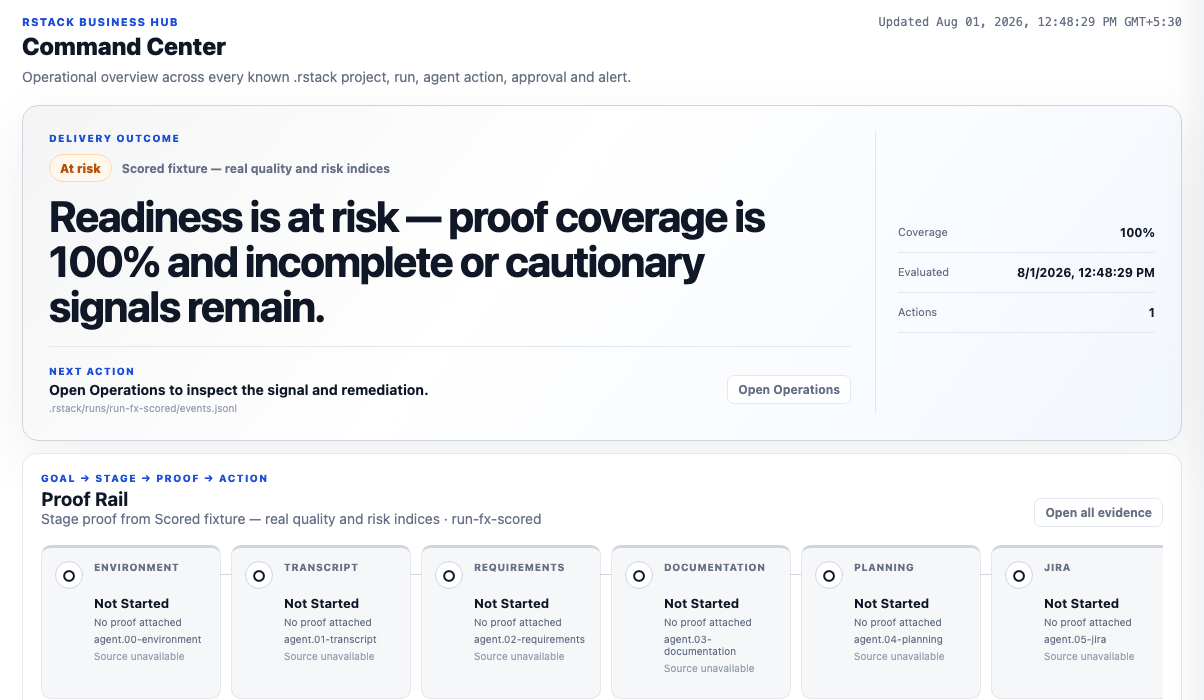
Real screenshots from a live rstack-agents hub session against seeded .rstack state — every number, band color, and status pill below is computed from real evidence on disk, not mocked for the README.
Delivery outcome and the proof rail — the honest verdict a run earns, with the exact evidence path behind it:
Quality & Risk — an aggregated risk score and complexity index computed from real builder-reported risks, guardrail blocks, and container-verified execution, never a self-report:

SDLC stage health — all 15 canonical stages, real pass/fail/risk counts per stage, at a glance:
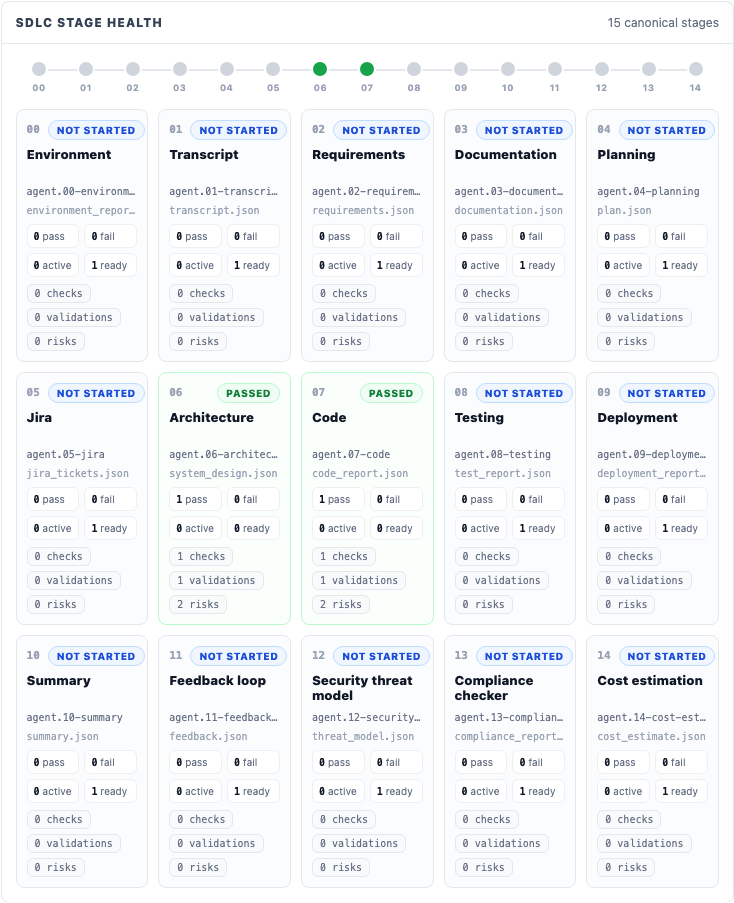
Table of contents
Quick start
New here? RStack in 5 Minutes — install to a
validated, human-approved pipeline task from a bare terminal, no framework required.
cd your-project
npm install rstack-agents
npx rstack-agents init --profile business-flex
init auto-detects pi | claude-code | operator | custom, creates .rstack/, scaffolds bootstrap files (SOUL.md, HEARTBEAT.md, and framework-specific CLAUDE.md or AGENTS.md), registers the project with the Business Hub, writes framework glue, and never overwrites existing files.
Verify your setup: run npx rstack-agents doctor — it checks your environment, config, and framework wiring, and runs a live guard self-test to prove enforcement is working. Every problem prints its fix. Per-framework "test in 5 minutes" recipes: docs/integrations/testing-matrix.md.
If .rstack/ already exists, init adopts it and preserves all prior runs. To start clean instead (nothing is deleted):
npx rstack-agents init --fresh
Pick a profile size:
npx rstack-agents init --profile lean-mvp
npx rstack-agents init --profile enterprise-webapp
business-flex | Most business/product teams | Product, backend, frontend, QA, security, devops, docs, budget policy, Business Flex dashboard |
lean-mvp | Fast prototypes | Smaller full-stack team and lower budget defaults |
enterprise-webapp | Heavier governance | Enterprise web app team with security/compliance/devops emphasis |
Govern an existing codebase
Brownfield is first-class. adopt scans your repo read-only and harvests real artifacts (README, tests, CI config, deploy manifests) into a resumable pipeline run — stages with evidence are marked DONE, gaps are left open, and nothing is invented. Work then resumes from reality, not from scratch.
npx rstack-agents adopt --dry-run
npx rstack-agents adopt
npx rstack-agents pipeline run
Full guide: docs/brownfield-adoption.md. To keep iterating toward a goal after adoption, see the loop recipes in docs/loop-recipes.md.
Choose your framework
RStack is a plugin layer — install your AI coding framework first, then run init.
| Pi | Native adapter | SOUL.md, HEARTBEAT.md | sdlc_start(goal="...") |
| Claude Code | First-class | CLAUDE.md, SOUL.md, HEARTBEAT.md | /sdlc-start or orchestrator |
| Operator | Python bridge | SOUL.md, HEARTBEAT.md | Operator extension + Node bridge |
| Codex / custom | Asset + bridge | AGENTS.md, SOUL.md, HEARTBEAT.md | Node bridge or prompt-driven |
| Pi | All 18 sdlc_* tools, lifecycle hooks, tool gating, auto-launch dashboard |
| Claude Code | Guard/observe/context hooks + the sdlc-rstack plugin (/plugin install sdlc-rstack) for the full /sdlc-* command surface |
| Operator | Python adapter shells out to the same Node harness |
| Codex / Gemini / custom | .rstack/ state contract, agents/skills as context, CLI bridge |
Per-framework setup: docs/mintlify/getting-started/install-your-framework.mdx
Custom harness bridge:
RSTACK_PROJECT_ROOT="$(pwd)" \
  npx tsx node_modules/rstack-agents/bin/rstack-operator-bridge.ts sdlc_start '{"goal":"..."}'
Full contract: docs/integrations/custom.md
Configure your team
RStack ships a large catalog (196 agents, 68 skills, 73 plugins), but you configure only what your project needs. Plugins are organized by domain under plugins/<domain>/<name>/ (e.g. plugins/backend/backend-development/) — sdlc-rstack itself stays at plugins/sdlc-rstack/ since it's the core product plugin, not a domain accelerator. Vendored plugins keep their original author/license; see THIRD-PARTY-NOTICES.md.
1. Pick a profile
Profiles write .rstack/rstack.config.json and .rstack/budget.json:
npx rstack-agents init --profile business-flex
npx rstack-agents init --profile lean-mvp
npx rstack-agents init --profile enterprise-webapp
2. Narrow domains and plugins
Edit .rstack/rstack.config.json any time:
{
  "profile": "business-flex",
  "enabled_domains": ["product", "backend", "qa", "security", "docs"],
  "enabled_plugins": [
    "business-analytics",
    "backend-development",
    "unit-testing",
    "security-scanning",
    "documentation-generation"
  ],
  "dashboard_pages": ["command", "business-flex", "workflow", "agent-work", "live-feed", "approvals"]
}
When sdlc_plan runs, each task gets active profile, routing explanation, and budget envelope.
3. Add plugins locally
Copy one plugin pack into your project:
npx rstack-agents add plugin unit-testing
npx rstack-agents add plugin security-scanning
Plugins land in .rstack/plugins/<name>/.
4. Browse the catalog
npx rstack-agents list agents
npx rstack-agents list skills
npx rstack-agents list plugins
5. Project-local overrides
Drop custom assets in .rstack/ — they take precedence over package defaults:
.rstack/agents/     custom agent definitions
.rstack/skills/     custom skills
.rstack/plugins/    custom or copied plugin packs
.rstack/prompts/    custom prompts
Then validate: npx rstack-agents validate
Current package limitation
Profiles guide routing, budget, dashboard visibility, and project-local configuration. The npm package still ships the full catalog so offline/project-local routing works. The next product step is a pack installer that physically copies only selected packs into .rstack/ for stricter enterprise footprints.
Agent identity and standby automation
| SOUL.md | Governance identity — orchestrator/builder/validator roles, evidence rules, profile awareness |
| HEARTBEAT.md | Optional periodic checks — pending approvals, budget burn, stalled tasks, validation retries |
| CLAUDE.md | Claude Code bootstrap — asset paths, slash commands, optional hooks |
| AGENTS.md | Codex/universal bootstrap — same rules plus skill routing and Node bridge |
init scaffolds these from templates/bootstrap/ when missing. Canonical templates live in the package at node_modules/rstack-agents/templates/bootstrap/.
Hooks (optional, on standby)
RStack does not require hooks. Enable only what you want:
| Claude SessionStart | Auto-launch Business Hub + inject RStack context | Merge .claude/rstack-hooks.json into .claude/settings.json |
| Claude UserPromptSubmit | Inject RStack context packet (rstack-agents context) — run + stage + blockers + orchestrator pointer | Written by init --framework claude-code |
| Claude PreToolUse | Enforcement guard — destructive gate + validator sandbox at tool-call time | Written by init --framework claude-code; snippet in docs/integrations/claude-code.md |
| Claude PostToolUse / PostToolUseFailure / SubagentStart / SubagentStop / PreCompact / Stop / SessionEnd | Observability writer (rstack-agents observe) — tool results, delegated subagents, failures, compaction, session end into the run ledger | Written by init --framework claude-code |
| Claude Notification | Route host notifications to your channels (rstack-agents notify-hook) | Written by init --framework claude-code |
| Claude statusLine | Live RStack status bar (rstack-agents statusline) — run + stage, approvals, open decisions | Written by init --framework claude-code (top-level statusLine key) |
| Pi lifecycle | Tool gating, stage events, contract enforcement | Automatic when using Pi extension |
| HEARTBEAT.md | Periodic approval/budget/stall checks | Wire into your harness cron or idle trigger |
Disable hub auto-launch:
export RSTACK_NO_BUSINESS_HUB=1
export RSTACK_NO_BROWSER=1
export RSTACK_BUSINESS_PORT=3008
Upgrade path
Start small and expand as requirements grow:
lean-mvp → business-flex → enterprise-webapp
| lean-mvp | Prototypes, internal tools | init --profile lean-mvp — lower budgets, fewer domains |
| business-flex | Client/product delivery | Add domains/plugins in rstack.config.json, raise budget in budget.json |
| enterprise-webapp | Compliance-heavy web apps | init --profile enterprise-webapp or enable security/compliance plugins |
Upgrade steps (no reinstall required):
- Edit
.rstack/rstack.config.json — add enabled_domains, enabled_plugins, dashboard_pages
npx rstack-agents add plugin <name> — copy needed plugin packs locally- Adjust
.rstack/budget.json — raise thresholds as team size and scope grow
npx rstack-agents validate — refresh registry after changes
Start your first governed run
From the host AI framework session:
sdlc_start(goal="Upgrade this app, add required tests, improve docs, and run a security review")
sdlc_clarify()
sdlc_plan()
Approve gates, then build and validate:
sdlc_approve(artifact="plan.md", status="APPROVED")
sdlc_approve(artifact="requirements.json", status="APPROVED")
sdlc_approve(artifact="architecture.md", status="APPROVED")
sdlc_build_next()
sdlc_validate()
What init creates
your-project/
├── CLAUDE.md or AGENTS.md   # framework bootstrap (if missing)
├── SOUL.md                  # governance identity (if missing)
├── HEARTBEAT.md             # standby automation guide (if missing)
├── .rstack/
│   ├── rstack.config.json   # active profile, enabled domains/plugins, dashboard pages
│   ├── budget.json          # run/daily/monthly budget, warnings, approval thresholds
│   ├── runs/                # every governed run lands here
│   ├── registry/            # agents, skills, plugins, routing metadata
│   └── policy.json          # optional approval policy you control
└── framework glue           # e.g. .claude/rstack-sdlc.md or Operator template
Every run records its manifest, plan, tasks, approvals, evidence, events, stage artifacts, builder contracts, validator contracts, and metrics under .rstack/runs/<run-id>/.
Builder and validator sandbox model
RStack uses scoped task packets instead of giving every worker the whole project and whole catalog.
| Orchestrator | planning/status tools | plan.md, tasks.json, specs | Routes work; does not directly implement |
| Builder | read, bash, edit, write, grep, find, ls | builder.json | Changes only task-scoped files; runs checks before claiming done |
| Validator | read, grep, find, ls | validation.json | Read-only review; no mutation |
Builder contract:
{
  "task_id": "003-architecture",
  "agent": "builder",
  "status": "PASS|FAIL|BLOCKED|DONE_WITH_CONCERNS",
  "summary": "",
  "files_modified": [],
  "tests_run": [],
  "risks": [],
  "next_steps": []
}
Contract v2 can also capture backend visibility:
{
  "execution": { "tools_used": [], "events": [], "artifacts_written": [] },
  "cost": { "currency": "USD", "estimated_usd": 1.5, "actual_usd": 1.2 },
  "context": { "profile": "business-flex", "workflow": "production-business-sdlc" },
  "routing": { "selected_by": "profile-domain-stage-affinity", "explanation": [] }
}
Validator contract:
{
  "task_id": "003-architecture",
  "validator": "rstack-validator",
  "status": "PASS|FAIL",
  "checks": [],
  "issues": [],
  "retry_recommendation": "none|retry_builder|ask_user|block"
}
Business Hub — live observability on :3008
npx rstack-agents hub
The dashboard derives everything from real .rstack files — no fake demo state and no telemetry leaving your machine.
| Command Center | Portfolio status, attention signals, stage health, live activity |
| Business Flex | Active profiles, enabled domains, budget guardrails, routing proof |
| Studio / Studio 3D | Agent workspace with live stage status and clickable agent panels |
| Projects & Runs | Every run and its actual deliverables |
| Run Analytics | Stage timing, Gantt, trend rows |
| Agent Work | Builder/validator contracts and evidence |
| Approvals / Alerts | Human gates, guardrails, spend/stall signals |
| Traceability | Requirement → stage → task → evidence chains |
CLI reference
rstack-agents init --profile business-flex | Set up profile, budget, bootstrap files, framework glue, and Business Hub registry (--fresh archives prior .rstack/ state and starts clean) |
rstack-agents doctor [--framework <x>] | Verify setup and prove enforcement is live (env, config, framework wiring, guard self-test, hub health); prints a fix per FAIL, --json for CI |
rstack-agents list agents|skills|plugins | Browse the packaged catalog |
rstack-agents add plugin <name> | Copy a packaged plugin into .rstack/plugins/ |
rstack-agents validate | Validate packaged agent definitions — frontmatter, duplicate names, hook paths |
rstack-agents hub | Ensure the Business Hub is running on :3008 and open it |
rstack-agents guard | Enforcement hook: classify one pending tool call, exit 0 allow / exit 2 block (destructive gate + validator sandbox) |
rstack-agents observe | Observability hook: append a normalized event (tool result, subagent, compaction, session) to the run ledger — never blocks, exit 0 |
rstack-agents context | Context hook: emit the RStack packet (run + stage + blockers + orchestrator pointer) for UserPromptSubmit/SessionStart — never blocks, exit 0 |
rstack-agents notify-hook | Notification hook: route a host notification to configured channels — never blocks, exit 0 |
rstack-agents statusline | Claude Code statusLine command: print ONE live status-bar line (run + stage, ✔approved/⧗pending approvals, ◇open decisions) — display-only, exit 0 |
rstack-agents notify --test | Test Slack/Teams/Discord/Telegram/WhatsApp notifications |
rstack-agents inventory | Generate a backend control-plane registry report |
rstack-agents adopt | Adopt an existing codebase — harvest evidence into a resumable pipeline run (--dry-run plans without writing) |
rstack-agents decisions | List, add, resolve, or waive run-level Decision Queue items |
rstack-agents dor | Run the Definition-of-Ready gate for a run and target stage |
rstack-agents pipeline status | Show pipeline status for the latest or selected run, with one recommended next action |
rstack-agents pipeline run | Advance the run from current state: skip DONE work, re-enter retryable tasks, stop at human gates |
rstack-agents pipeline loop | Bounded goal loop: advance, evaluate the goal, rerun recommended stages until PASS, a human gate, or a spent bound |
rstack-business --port 3008 --project . | Run the dashboard server directly |
rstack-observer | Deprecated alias — opens the same Business Hub |
Pipeline command flags and exit codes: docs/mintlify/reference/pipeline.mdx.
Known limitations and roadmap
Shipped in 1.9 / 2.0
The loop-engineering program that earlier READMEs listed as planned has shipped: the harness ↔ loop-runner bridge, resume-aware pipeline state and pipeline run, deterministic retry plus the stage-specific validator registry, the bounded goal loop (pipeline loop), and persisted per-stage cost/token observability. The authoritative reference for all of it — run state, contracts, guardrails, checkpoints, metrics — is docs/HARNESS.md.
Current limitations
- Actual token/cost capture: per-stage cost and token totals persist from builder contracts at validate time; provider-level usage still needs host-side reporting or provider adapters.
- Physical pack pruning: profiles narrow routing today; a future pack installer should reduce project-local agent/plugin footprint.
- MCP/A2A:
.rstack is adapter-friendly, but a native MCP server is still a future slice — held deliberately pending a decision on scope (#374).
Roadmap (contributions welcome)
Pack installer — physically copy only selected packs into .rstack/ | future |
| End-to-end live-test matrix per harness — systematic live verification beyond Pi's automated CI coverage | #392 |
Native MCP server — expose the 18 sdlc_* tools to Cursor, Codex, and other MCP clients | #374 |
Contributions are welcome. Read CONTRIBUTING.md for branching rules, CI requirements, IP policy, and CodeRabbit guidelines before opening a PR.
Documentation
Start here: docs/SETUP.md — the single-page setup & usage
guide covering every harness (install → wiring → running a governed pipeline →
approvals → dashboard → CLI reference → env vars → troubleshooting).
Bootstrap templates
Canonical copies in templates/bootstrap/:
Mintlify docs
Live site: sdlc-rstack.mintlify.site —
the full docs, browsable and searchable. Source lives in docs/mintlify:
Ask the codebase
DeepWiki — an AI-generated,
conversational wiki over this repo. Useful for tracing how a specific mechanism
works across files without reading the whole harness yourself.
Harness and integrations
Research material: research/. Architecture decisions: rfcs/.
Development
git clone https://github.com/richard-devbot/SDLC-rstack.git
cd SDLC-rstack
npm install
npm test
npm run lint
npm run validate
Latest verified branch state:
npm test          # 2010 pass, 0 fail
npm run lint      # pass, 0 warnings
npm run validate  # All 196 agents passed validation
npm pack --dry-run  # package includes templates/bootstrap/
License
MIT © Richardson Gunde




