
Research
/Security News
Popular npm Packages in the keyv and Cacheable Namespaces Compromised in Active Supply Chain Attack
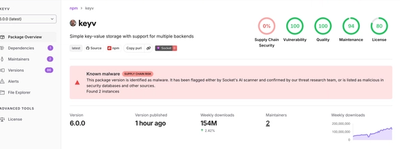
Popular npm packages keyv and cacheable compromised.
By Socket Research Team - Aug 04, 2026
safeinstall-cli
Advanced tools
Local-first CLI that blocks risky npm, pnpm, and bun installs before they run. Open source.
SafeInstall
Supply-chain security for the AI-agent era.





The install gate for npm, pnpm, and bun — for the humans who type install, the AI agents that run it for them, and the config that programs those agents.
Policy runs first. Then your package manager. Not the other way around.
Local-first · No cloud · No account · MIT · Free forever
SafeInstall runs your policy before your package manager — locally, blocking by default. One tool, three layers of defense:
safeinstall pnpm add axios. Policy runs, then pnpm. Release age, install scripts, untrusted sources, typo-squats, and cryptographic provenance are checked before anything touches disk.AI coding tools suggest packages in seconds. They don't check publish dates. They don't read install scripts. They don't verify the source. You type "yes" and move on.
SafeInstall is the gate between suggestion and execution.
$ safeinstall pnpm add compromised-pkg@9.9.9

Install blocked.
- compromised-pkg@9.9.9
  Blocked: release too new (published 3 hours ago; minimum is 72 hours).
  Blocked: install script present (has postinstall).
No dashboard. No account. No cloud. One command prefix — policy runs locally, blocks by default, then invokes the real tool.
A valid Sigstore signature is not enough. An attacker who compromises an npm maintainer account can publish a malicious version of a package you already trust, and the attestation on that malicious version will cryptographically verify — signed by a GitHub Actions workflow the attacker controls in a fork of the real repository.
SafeInstall catches this. Pin the expected source repository with provenance.trustedPublishers and any build that comes from anywhere else is blocked, even if the signature is valid:
$ safeinstall check
Using config: ./safeinstall.config.json
Check blocked.
- axios@1.99.0
  Blocked: publisher mismatch for axios (expected axios/axios, got evil-org/axios).
  Suggestion: Verify the package source. Update provenance.trustedPublishers only if the change is intentional.
This is the only check of its kind in an install-time policy gate. CVE scanners look for known vulnerabilities. Content analyzers look for suspicious code. SafeInstall enforces that the cryptographic chain of trust points at the repository you agreed to trust — and refuses anything else, no matter how legitimate it looks.
SafeInstall itself is published with a Sigstore attestation. You can eat your own dog food: enable provenance verification, pin safeinstall-cli to Mickdownunder/SafeInstall, and watch SafeInstall verify its own trust chain against the public Sigstore transparency log.
$ safeinstall check
Using config: ./safeinstall.config.json
Info: safeinstall-cli: provenance verified from Mickdownunder/SafeInstall via .github/workflows/release.yml.
Check passed: no direct dependency policy violations found.
npm install -g safeinstall-cli
Node.js >=20 · macOS, Linux, Windows · Command:
safeinstall
safeinstall init                      # config + agent guard hooks + trust lock, in one command
safeinstall pnpm add axios            # policy runs, then pnpm
safeinstall npm install               # lockfile-aware project install
safeinstall check                     # audit direct deps against policy
┌─────────────────────┐     ┌──────────────┐     ┌─────────────────┐
│  safeinstall pnpm   │ ──▶ │  Resolve &   │ ──▶ │  Policy check   │
│  add axios          │     │  fetch meta  │     │  (age, scripts, │
└─────────────────────┘     └──────────────┘     │   sources, ...)  │
                                                  └────────┬────────┘
                                                           │
                                                 ┌─────────▼─────────┐
                                          pass → │  Invoke pnpm add  │
                                          fail → │  Exit 2 (blocked) │
                                                 └───────────────────┘
No registry proxy. No tarball rewriting. No cloud dependency.
| Rule | Default | Block message |
|---|---|---|
| Release age | 72 hours minimum | Blocked: release too new |
| Lifecycle scripts | preinstall, install, postinstall blocked | Blocked: install script present |
| Source types | registry, workspace, file, directory allowed | Blocked: untrusted source |
| Trust downgrade | Detects registry→git/url or new scripts on update | Blocked: trust level dropped |
| Typo-squat detection | Off by default; opt in via typoSquat.mode | Blocked: suspected typo-squat |
| Provenance verification | Off by default; opt in via provenance.mode | Blocked: attestation missing/invalid/publisher mismatch |
| Transitive dependencies | Off by default; opt in via transitive.mode | Blocked: transitive install script / untrusted source |
| Provenance continuity | Off by default; opt in via continuity.mode | Blocked: provenance downgrade / identity discontinuity |
All rules are configurable. Ambiguous or incomplete metadata blocks instead of allowing.
This is SafeInstall's most distinctive check, and the one no other consumer-side tool does. npm verifies provenance at publish time and binds a package to a source repository — but it does not enforce continuity between versions. A compromised maintainer account can publish a new version with no attestation (from a stolen token), or from a different repository, and npm raises no alarm. This is the signature of the 2026 attack wave (Mastra, the dormant-account republishes).
Continuity learns a per-package trust baseline from the provenance identity of recent versions, then blocks deviations:
provenance-downgrade — recent versions were attested, this one isn't. The fingerprint of an account-compromise publish from a personal token. (This is the Mastra case.)identity-discontinuity — this version is attested from a different source repository than the established baseline.Because the baseline is learned per package, there are no false positives on the large majority of packages that never adopted provenance — they simply have no baseline and the check stays silent. No global "require provenance" sledgehammer.
It reads npm's published attestation metadata, so it works without the optional sigstore package. Opt in with continuity.mode set to "warn" or "block".
Honest limit: continuity does not catch an attack that comes through a legitimately-compromised CI workflow with valid provenance from the real repository (e.g. the Shai-Hulud worm class). There is no identity discontinuity to detect there. SafeInstall raises the bar against the dominant 2026 attack pattern; it does not close every door.
By default SafeInstall evaluates direct dependencies. Most supply-chain attacks, though, reach you through a transitive dependency — a package you never chose, pulled in several levels deep. Enable transitive mode to walk the full lockfile tree.
Two checks run transitively, both read directly from the lockfile with zero extra registry calls:
install-script — flags transitive packages that declare a lifecycle script (the ua-parser-js attack class: a deeply nested dependency running code at install time). npm records this in the lockfile; pnpm lockfiles do not, so this check is npm-only for now.untrusted-source — flags transitive packages resolving from git, url, or tarball sources instead of the registry. Works for both npm and pnpm.Release-age, typo-squat, and provenance are deliberately not run transitively — they would either flood you with noise or require a registry round-trip per package. Transitive evaluation applies to safeinstall check and project installs (pnpm install, npm ci), which have a resolved lockfile.
{
  "transitive": {
    "mode": "warn",
    "checks": ["install-script", "untrusted-source"]
  }
}
Flags install requests whose package name is a close-but-not-exact match to a well-known popular package — the most common supply-chain attack pattern: lodsh for lodash, axois for axios, raect for react, and so on.
"off" — opt in with typoSquat: { "mode": "warn" } or "block"ignore list is supportedCryptographically verifies the npm provenance attestation for registry installs and optionally pins the source repository via per-package trusted publisher patterns.
/-/npm/v1/attestations/<pkg>@<version> endpointsigstore package (signatures, Rekor transparency log, Sigstore public trust root)trustedPublishers patterns — catching not only tampered tarballs but also maintainer-compromise attacks where an attacker republishes a legitimate-looking package from a fork they control"warn" mode, because a valid signature from the wrong repo is exactly what maintainer compromise looks likeDefault mode is "off". Opt in by setting provenance.mode to "warn" or "require".
# Ad-hoc installs
safeinstall pnpm add axios
safeinstall npm install react@19.2.0
safeinstall bun add zod

# Project installs (lockfile-aware for npm/pnpm)
safeinstall pnpm install
safeinstall npm ci

# Monorepo — target one package
safeinstall pnpm -C packages/app install
safeinstall npm --prefix packages/app ci

# Utilities
safeinstall check                     # direct dependency audit
safeinstall check --json              # machine-readable
safeinstall init                      # one-command onboarding: config, guard hooks for
                                      # detected agents (.claude/, .codex/, .cursor/), trust lock
safeinstall init --force              # overwrite an existing config (hooks/lock stay idempotent)
safeinstall init --client codex       # force specific agents instead of detection
safeinstall init --no-guard --no-lock # config only (the old behavior)
safeinstall mcp                       # MCP server for AI coding agents
safeinstall guard install             # register agent shell hooks (Claude Code, Codex, Cursor)
safeinstall trust lock                # baseline the Agent Trust Surface
safeinstall trust lock --ci github    # ...and scaffold the CI re-verification workflow
safeinstall trust status              # reconcile the trust surface (exit 2 on drift; read-only)
safeinstall trust approve             # review drift and re-baseline (interactive)
safeinstall trust unlock              # remove the baseline (lock, ledger, head mirror)
safeinstall --help
safeinstall --version

# JSON output (CI/automation)
safeinstall --json pnpm add axios

# Explicit config file (skips upward discovery)
safeinstall --config ./ci/safeinstall.config.json check
For pnpm install and npm install / npm ci, dependency versions come from the lockfile — not loose ranges in package.json.
pnpm-lock.yaml for pnpmpackage-lock.json or npm-shrinkwrap.json for npmpackageManager is set in package.json, using a different CLI is blocked--filter, --workspace) are blocked — use -C or --prefixbun install uses manifest-oriented analysis (full lockfile parity not yet implemented)The CLI reaches humans who type safeinstall. The MCP server reaches AI coding agents — Claude Code, Codex, Cursor, Windsurf, Cline — so the policy engine can be consulted before an agent suggests or runs an install, without anyone typing anything.
safeinstall mcp starts a Model Context Protocol server over stdio that exposes one tool, check_package, backed by the exact same engine as the CLI (release age, install scripts, untrusted sources, typo-squat, Sigstore provenance, and provenance continuity).
[!IMPORTANT] MCP tools are advisory. Installing the server makes
check_packageavailable; it does not force an agent to call it. "Install once, protected forever" = one MCP config block + one rule snippet (mcp/agent-rule.md) telling the agent to call the tool before every install.
Claude Code / Claude Desktop — add to your MCP config (claude_desktop_config.json or .mcp.json):
{
  "mcpServers": {
    "safeinstall": { "command": "npx", "args": ["safeinstall-cli", "mcp"] }
  }
}
Cursor — add the same block to .cursor/mcp.json.
Then paste the rule from mcp/agent-rule.md into your CLAUDE.md / Cursor Rules. Full setup details: mcp/README.md.
check_package accepts name (required), version (optional, defaults to latest), and manager (optional, informational) and returns a JSON verdict:
{
  "verdict": "block",
  "name": "raect",
  "version": null,
  "reasons": [
    { "code": "typo-squat-suspected", "message": "Blocked: Suspected typo-squat: \"raect\" is 2 edit(s) away from popular package \"react\".", "suggestion": "Verify you meant to install \"react\"." }
  ],
  "warnings": [],
  "infos": [],
  "sourceRepository": null,
  "ageHours": null
}
verdict is "block" when any policy reason blocks the install, otherwise "allow".
When no safeinstall.config.json is found, the MCP server uses a recommended secure preset — the built-in defaults with typoSquat and continuity promoted to "block", because the agent use case wants maximum signal. When a config file is found, it is respected exactly (same resolution as the CLI).
The MCP SDK ships as an optional dependency, lazily loaded only when safeinstall mcp runs — CLI-only users never install it. If it is missing, the command prints an install hint and exits non-zero.
The MCP tool is advisory: an agent can consult it. The guard is a stronger layer: it hooks into the agent's shell layer and screens commands before they run, firing even when the agent doesn't know SafeInstall exists. This is best-effort shell interception — one layer of defense in depth, not a complete boundary; its command parsing is not exhaustive (see Guard limitations).
safeinstall guard install                  # Claude Code, Codex, and Cursor
safeinstall guard install --client codex   # or just one client
This writes project-level hook configuration (merged non-destructively, idempotent on re-runs):
PreToolUse hook on the Bash tool in .claude/settings.json; raw installs are rewritten in-place through the SafeInstall CLI via updatedInput with no permissionDecision, so Claude's normal permission prompt still fires and shows the user the rewritten command to approvePreToolUse hook on Bash in .codex/hooks.json; raw installs are rewritten in-place through the SafeInstall CLI via Codex updatedInput. Open /hooks in Codex after installation and trust the new project hook before expecting it to run.beforeShellExecution hook in .cursor/hooks.json, registered with failClosed: true so a crashed or timed-out guard blocks instead of silently allowingAfter registration, the CLI reports the Trust Surface step that matches the project state. A project without a baseline is directed to safeinstall trust lock. If a baseline already exists and the guard changed it, review the complete drift with safeinstall trust status and run safeinstall trust approve only when every change is intentional. Re-running an already-registered guard does not require re-approval unless status reports drift.
The guard never evaluates policy itself — it detects package installs and routes them through the CLI, which owns the decision:
| Agent runs | Guard response |
|---|---|
git status, npm test, ... | Allowed — not an install |
npm install axios (also npm i, pnpm add, bun a, npm ci, corepack pnpm add, pnpm --dir app add, ...) | Claude/Codex: rewritten in-place to safeinstall npm install axios before execution (the permission prompt shows the routed command). Cursor: denied with the SafeInstall replacement |
cd app && npm i axios && npm test | Rewrite prefixes only the install segment; Claude/Codex apply it directly, Cursor returns it to the agent |
safeinstall npm install axios | Allowed — already routed through the policy engine |
npm install $(cat list.txt), bash -c "npm install ..." | Denied — cannot be analyzed safely (fail-closed) |
yarn add axios | Denied — SafeInstall cannot policy-check yarn |
npx tsc with typescript installed locally | Allowed — npx resolves the local binary, nothing is downloaded |
npx create-next-app, pnpm dlx ..., bunx ..., yarn dlx ... | Claude/Cursor: ask. Codex: deny because Codex PreToolUse does not currently support an ask decision |
Routing through the CLI matters more than a simple allow/deny: a vetted-but-raw npm install would still execute lifecycle scripts. Through SafeInstall, the same install gets the full policy evaluation and runs with install scripts disabled.
Claude and Codex apply the rewrite in-place through updatedInput, so the user's normal permission prompt shows the SafeInstall-routed command to approve rather than the raw install. Cursor receives the exact rewritten command in the block message so a well-behaved agent self-corrects in one step. The guard needs no network access and answers in milliseconds.
safeinstall binary must be on the agent's PATH (npm install -g safeinstall-cli)./hooks; until then Codex skips the hook. Codex currently intercepts only supported simple shell calls, not every unified_exec path, so the hook is still a defense-in-depth guardrail rather than a complete boundary.npx and friends are not policy-checked: SafeInstall's engine evaluates installs, not one-off executions. Claude/Cursor request approval; Codex fails closed because its PreToolUse hook does not currently support ask. The local-binary fast path mirrors the runners' own resolution (nearest node_modules/.bin), so approved project tooling does not trigger the remote-runner gate.node -e, and similar), and command-line parsing itself is not exhaustive. Do not rely on the shell layer alone: it raises the bar as one layer of defense in depth — combine it with the MCP tool and CI checks.The guard stops raw installs. But a prompt-injected agent does not have to fight the guard — it can just rewrite the rules: weaken safeinstall.config.json, delete an agent hook, disable Codex hooks in .codex/config.toml, plant an invisible-Unicode instruction in AGENTS.md, or register a malicious MCP server. Those files program the next agent session; in the agent era they are the persistence mechanism, the new crontab.
safeinstall trust lock records a hash baseline of that surface. SafeInstall then reconciles the real state against it before guard decisions and before every install/check, and can re-verify it in CI.
safeinstall guard install       # register the hooks
safeinstall trust lock --ci github  # baseline the surface AND scaffold CI re-verification
safeinstall trust status        # reconcile — exit 2 on drift (use in CI); read-only
safeinstall trust approve       # review drift and re-baseline (interactive only)
safeinstall trust unlock        # remove the baseline (lock, ledger, head mirror)
--ci github writes .github/workflows/safeinstall-trust.yml, which re-verifies the committed baseline on every pull request by running safeinstall trust status --require-lock with the CLI pinned to an exact version and its sha512 content hash, recorded from the registry at scaffold time (trust on first use) — a registry that later serves different bytes for that version fails the check instead of silently swapping the verifier. The workflow uses pull_request_target, so GitHub loads its definition from the protected base branch; it checks out the proposed revision without credentials, treats it only as data, and never executes PR code. Commit .safeinstall/ and that workflow together. An existing workflow file is never overwritten. A PR therefore cannot neutralize the verifier that judges it — but a fully consistent rewrite of policy plus baseline still needs human review of the diff (see the CODEOWNERS note below).
Two things you must do for the check to actually enforce, because a CLI cannot set them for you:
.safeinstall/ and .github/workflows/ (e.g. via CODEOWNERS). The automatic check catches inconsistent tampering; a fully consistent rewrite of the whole baseline in one PR is only caught by a human reviewing the .safeinstall/ diff.| Zone | Files | On drift |
|---|---|---|
| Enforcement | safeinstall.config.json, .claude/settings.json, .codex/hooks.json, .codex/config.toml, .cursor/hooks.json, .github/workflows/safeinstall-trust.yml, .safeinstall/ | Every agent command is denied until a human approves |
| Instruction | AGENTS.md, CLAUDE.md, .cursorrules, .cursor/rules/**, .github/copilot-instructions.md | Hidden Unicode is always blocked; content drift warns (blocks in --mode strict) |
| Tool | .mcp.json, .cursor/mcp.json, MCP blocks in .claude/settings.json | Installs and runners are denied until a human approves; unpinned MCP servers are flagged |
Instruction content drift only warns by default because Claude Code writes to CLAUDE.md itself (its memory feature) — blocking that would break a normal workflow. Hidden Unicode, on the other hand, has no legitimate purpose in these files and always blocks.
safeinstall trust lock --ci github to scaffold a workflow that re-hashes the candidate trust surface against its committed lock on every pull request, on a machine the agent does not control, with the CLI pinned to an exact version and its sha512 content hash. pull_request_target keeps the verifier definition outside the PR's control, while the candidate checkout is inert data with no credentials. This blocks a PR from editing the workflow to waive its own failure. Honest boundary: a PR can still rewrite policy and baseline consistently, so require independent review of those diffs. (Wiring the Action directly also works — but pin its version: input; the default latest floats.)safeinstall install/check also reconciles against the baseline. Deleting the hook to silence the guard, or editing a protected file, shows up as drift on the next SafeInstall run locally — and, regardless, fails CI re-verification.safeinstall trust approve reads its confirmation from the controlling terminal (/dev/tty), never from stdin, and trust unlock likewise requires a controlling terminal — both refuse to run in CI or known agent-hook contexts, so an agent cannot silently re-baseline or remove the surface. trust status is read-only (safe in CI, never mutates the repo)..safeinstall/ledger.jsonl; the lock binds to a ledger entry (including its enforcement mode), so editing the committed lock to drop a file or downgrade strict→warn breaks the binding. A local head mirror under ~/.safeinstall/ catches naive/accidental history rewrites; a vanished mirror is self-healed from the verified head on the next clean run, so a fresh clone establishes it automatically without noise.node -e), rewrite the in-repo lock and ledger into a consistent state, and delete the local head mirror — user space cannot stop that, because the agent can read and delete anything you can. CI re-verification runs on a separate machine from a base-branch-owned workflow, so the PR cannot disable its own verifier. A consistent policy-and-baseline rewrite can still pass automatically. The residual guarantee against a capable adversary is independent human review of the trust-surface diff (workflow, lock, and config) on every dependency PR — enforced by a ruleset once a second trusted reviewer is available. Run the CI check and require that review; they cover different failure modes.Optional safeinstall.config.json — discovered by walking upward from the project directory, or passed explicitly with --config <path>. An explicit path that cannot be read is an error (exit 1), never a silent fallback to defaults.
{
  "minimumCliVersion": "0.12.0",
  "minimumReleaseAgeHours": 72,
  "registryUrl": "https://registry.npmjs.org",
  "allowedScripts": {
    "esbuild": ["postinstall"]
  },
  "allowedSources": ["registry", "workspace", "file", "directory"],
  "allowedPackages": [],
  "packageManagerDefaults": {
    "npm": { "ignoreScripts": true },
    "pnpm": { "ignoreScripts": true },
    "bun": { "ignoreScripts": true }
  },
  "typoSquat": {
    "mode": "warn",
    "minNameLength": 4,
    "ignore": []
  },
  "provenance": {
    "mode": "warn",
    "requireFor": [],
    "trustedPublishers": {
      "axios": "axios/axios"
    },
    "offlineBehavior": "fail-closed"
  },
  "transitive": {
    "mode": "warn",
    "checks": ["install-script", "untrusted-source"]
  },
  "continuity": {
    "mode": "warn",
    "baselineSize": 5
  }
}
| Field | Purpose |
|---|---|
minimumCliVersion | Optional. Lowest safeinstall-cli version whose behavior this project's protections assume (exact semver). An older running CLI warns — in the guard, install/check, and trust status — but never hard-fails |
minimumReleaseAgeHours | Minimum age in hours for registry versions |
registryUrl | npm-compatible registry URL for metadata (mirrors, Artifactory, Verdaccio) |
allowedScripts | Per-package lifecycle script exceptions |
allowedSources | Permitted source types |
allowedPackages | Names that skip release-age, install-script, and typo-squat checks (with warning). Source, trust-downgrade, and provenance checks still apply. |
packageManagerDefaults | Per-manager flags forwarded to the tool |
typoSquat.mode | "off" / "warn" / "block" — how to handle suspected typo-squats |
typoSquat.minNameLength | Minimum package name length to check (shorter names are skipped) |
typoSquat.ignore | Known legitimate lookalikes to skip, lowercased on load |
provenance.mode | "off" / "warn" / "require" — whether to verify Sigstore attestations |
provenance.requireFor | Package names (glob supported) for which provenance is required even in "warn" mode |
provenance.trustedPublishers | Map of package name pattern → expected owner/repo slug; mismatches always block |
provenance.offlineBehavior | "fail-closed" blocks on fetch failure, "allow-cached" falls back to a cached attestation |
transitive.mode | "off" / "warn" / "block" — evaluate the full lockfile tree, not just direct deps |
transitive.checks | Which checks run transitively: "install-script" and/or "untrusted-source" |
continuity.mode | "off" / "warn" / "block" — detect provenance downgrades and source-repo changes against a learned per-package baseline |
continuity.baselineSize | How many recent versions to sample when learning the baseline (default 5) |
Guard verdicts change across releases (fixed false positives, new checks), but the CLI is typically installed globally — so a project can assume 0.12.0 behavior while an agent's machine still runs 0.11.0. Set minimumCliVersion to the lowest version whose behavior your policy assumes, and every older CLI announces the mismatch loudly:
Warning: This project's safeinstall.config.json expects safeinstall-cli >= 0.12.0, but version 0.11.0 is running — protections this project relies on may be missing or behave differently. Update with `npm install -g safeinstall-cli@latest`.
The check is fully offline (a semver comparison against the running version) and deliberately a warning, never a hard failure: a hard failure would break every agent session after each release until the global CLI is updated. Two sharp edges to know:
"0.12.0"), not a range — it is a floor, not a constraint. Anything else fails config parsing closed.Run safeinstall init to generate a starter config.
| Code | Meaning |
|---|---|
0 | Allowed / check passed |
1 | Runtime or config error |
2 | Blocked by policy |
Use exit code 2 like any other failing step in a CI pipeline.
Pass --json anywhere in the command. Structured output goes to stdout.
safeinstall --json pnpm add axios
Fields: command, commandString, packageManager, decision, summary, reasons, warnings, affectedPackages, exitCode, exitCodeMeaning. Allowed installs include execution.stdout and execution.stderr.
Want to see every check in action? Run
bash demo/run.sh— a reproducible script that blocks one scenario per policy check against real packages. See demo/README.md for the walkthrough.Want to see it against a real attack? Run
pnpm replay mastra— it feeds the recorded attack-time state of the June 2026 Mastra compromise into SafeInstall's real policy engine and shows which checks would have blocked it. See demo/replay/README.md.
$ safeinstall pnpm add axios
Using config: built-in defaults
Install blocked.
- axios@1.14.0
  Blocked: release too new (axios@1.14.0 is 6 hours old; minimum is 72 hours).
  Suggestion: Retry later or lower minimumReleaseAgeHours if this package is intentionally urgent.
$ safeinstall npm install github:axios/axios
Using config: built-in defaults
Install blocked.
- github:axios/axios
  Blocked: untrusted source (git).
  Suggestion: Use a registry release or allow this source intentionally.
$ safeinstall npm install
Using config: built-in defaults
Install blocked.
- Project install blocked: package.json declares pnpm as packageManager, but this command uses npm.
$ safeinstall pnpm install
Using config: built-in defaults
Install blocked.
- Project install blocked: axios is declared in package.json but missing from pnpm-lock.yaml.
$ safeinstall pnpm add raect
Using config: ./safeinstall.config.json
Install blocked.
- raect
  Blocked: Suspected typo-squat: "raect" is 1 edit(s) away from popular package "react".
  Suggestion: Verify you meant to install "react". If this package is intentional, add "raect" to typoSquat.ignore.
$ safeinstall pnpm add axios@1.99.0
Using config: ./safeinstall.config.json
Install blocked.
- axios@1.99.0
  Blocked: publisher mismatch for axios (expected axios/axios, got evil-org/axios).
  Suggestion: Verify the package source. Update provenance.trustedPublishers only if the change is intentional.
Run SafeInstall policy checks automatically on every pull request. Five lines of YAML, no configuration required — defaults apply immediately.
# .github/workflows/safeinstall.yml
name: SafeInstall Policy Check
on: [pull_request]
jobs:
  policy:
    runs-on: ubuntu-latest
    steps:
      - uses: actions/checkout@v4
      - uses: actions/setup-node@v4
        with:
          node-version: 22
      - uses: Mickdownunder/SafeInstall@v1
The action runs safeinstall check against your direct dependencies and sets the job status to pass or fail. Blocked dependencies appear in the GitHub Actions job summary with the exact block reason and suggestion.
To enforce policy during the actual install step (not just a check):
      - uses: Mickdownunder/SafeInstall@v1
        with:
          mode: install
          package-manager: pnpm
          args: "--frozen-lockfile"
| Input | Default | Description |
|---|---|---|
mode | check | check audits deps; install runs the package manager through SafeInstall |
package-manager | pnpm | npm, pnpm, or bun (install mode only) |
args | Additional arguments forwarded to the package manager | |
config-path | Explicit path to safeinstall.config.json (auto-discovered if omitted) | |
version | latest | SafeInstall CLI version to install |
| Output | Description |
|---|---|
decision | allow or block |
summary | Human-readable one-line summary |
exit-code | 0 (allow), 2 (block), or 1 (error) |
json | Full JSON result from SafeInstall |
npm audit or Snyk for vulnerability datatransitive.mode is enabled. Release-age, typo-squat, and provenance still apply to direct dependencies only.binding.gyp) are caught via the install-script check: npm normalizes binding.gyp into a node-gyp rebuild install script at publish time, so it is present in the registry metadata SafeInstall already reads — no tarball download required. The residual edge is a package published through a non-standard client that omits this normalization while still shipping a binding.gyp; detecting that would require tarball content inspection, which is out of scope (see What it does not do).peerDependencies not evaluated unless also declared as direct dependenciesnode_modulesbun install uses manifest-only analysis (lockfile parity not yet implemented); transitive evaluation is npm/pnpm onlyaxios with github:any-fork/axios would be dangerous--ignore-scripts by default)SafeInstall works with any tool that runs package manager commands — including AI coding assistants:
Cursor · Codex · GitHub Copilot · Cline · Claude Code · Windsurf · Aider · Devin · Continue
Just prefix your install commands with safeinstall. Same workflow, one safety layer.
pnpm install
pnpm typecheck
pnpm test
pnpm build
Issues and PRs welcome. Author merges at own discretion — this is a solo-maintained project.
MIT — see LICENSE.
SafeInstall is provided as-is under the MIT license. It is a policy tool that enforces configurable rules on package installs. It does not guarantee the safety of any package, does not detect all supply-chain attacks, and does not replace professional security review. Use at your own risk. The authors are not liable for any damages arising from the use of this software.
Last verified: 2026-07-10
safeinstall.dev · npm · GitHub
FAQs
Local-first CLI that blocks risky npm, pnpm, and bun installs before they run. Open source.
The npm package safeinstall-cli receives a total of 43 weekly downloads. As such, safeinstall-cli popularity was classified as not popular.
We found that safeinstall-cli demonstrated a healthy version release cadence and project activity because the last version was released less than a year ago. It has 1 open source maintainer collaborating on the project.
Did you know?

Socket for GitHub automatically highlights issues in each pull request and monitors the health of all your open source dependencies. Discover the contents of your packages and block harmful activity before you install or update your dependencies.
Research
/Security News
Popular npm packages keyv and cacheable compromised.

Security News
A misconfiguration gave three Anthropic models internet access, and one, believing it was in a simulation, shipped a credential-stealing package to PyPI.

Security News
/Company News
Socket has joined the new Composer and Packagist sponsorship program as a launch sponsor, supporting the team that keeps PHP's package ecosystem secure.