


Company News
AWS Security Hub Adds Socket for Supply Chain Security
Socket is now in the AWS Security Hub Extended plan. Adopt it through AWS, apply committed spend, and block malicious open source packages.
By Feross Aboukhadijeh - Aug 04, 2026
senado-br-mcp
Advanced tools
MCP server for Brazilian Senate open data — runs hosted on Cloudflare Workers or locally via npx (stdio)




A public, hosted MCP server that gives AI assistants live, structured access to Brazilian Senate open data — no installation, no account, no API key. Point your MCP client at the hosted endpoint and start asking about senators, bills, votes, expenses, and more. It runs on Cloudflare Workers over Streamable HTTP.
It exposes 66 tools, 4 prompts, and 5 resources across two domains:
Data comes from three official sources — the legislative open-data API, the administrative open-data API, and the e-Cidadania portal. All tool responses are in Portuguese (pt-BR). See CHANGELOG.md for release history.
Point a client at the endpoint and ask in plain language — English or Portuguese:
senado_search_votacoessenado_buscar_materias + senado_obter_materiasenado_ceapsThe answers come live from the Senate's official open-data APIs — exact figures with provenance, not numbers guessed from training data.
This is a remote, hosted, open-access server. To use it, point any MCP client at the Streamable HTTP endpoint — no install, no account, no API key, no configuration:
https://senado.sidneybissoli.com/mcp
For OpenAI Apps SDK submission and review, the Worker also exposes a curated MCP surface:
https://senado.sidneybissoli.com/mcp/openai-app-v2
This endpoint intentionally keeps the full public MCP server intact at /mcp, but limits tool discovery
to 25 high-signal, intent-oriented tools for ChatGPT app use. /mcp/openai-app remains available as a
legacy alias, but new ChatGPT app configurations should use /mcp/openai-app-v2 so clients fetch the
current tool schema. The tools still call the same handlers and return the same provenance envelope; only
the advertised surface is narrower. Any ChatGPT app listing should present this as an independent open-data
research app, not as an official Senate, OpenAI or ChatGPT connector.
For ChatGPT Apps, those 25 tools also advertise a shared MCP Apps UI template at
ui://senado-br-mcp/openai-app-dashboard-v2.html. The self-contained widget renders the returned
structuredContent as a compact dashboard with metrics, main records, and source/provenance, without
adding another model-visible data tool.
Public legal URLs for app review:
https://senado.sidneybissoli.com/privacyhttps://senado.sidneybissoli.com/termsFor clients that launch MCP servers as a command — and for one-command setup — use the
mcp-remote bridge. No build, no config, no key:
npx -y mcp-remote https://senado.sidneybissoli.com/mcp
Everything below Architecture (Prerequisites, Setup, Deploy) is only for optionally self-hosting your own instance — it is not required to use this public server.
Prefer not to route queries through a third-party host (e.g. a newsroom policy)? The same server
also runs as a local stdio process that talks directly to the official government APIs — same
66 tools, same provenance envelope, no Cloudflare in the loop. This is the npm/stdio channel, published
as senado-br-mcp.
Point a command-based client (Claude Desktop/Code, etc.) at the package — npm fetches and runs it, no clone or build:
{
  "mcpServers": {
    "senado-br": {
      "command": "npx",
      "args": ["-y", "senado-br-mcp"]
    }
  }
}
To run it directly or hack on it, use the source checkout instead:
git clone https://github.com/SidneyBissoli/senado-br-mcp-cloudflare
cd senado-br-mcp-cloudflare
npm install
npm run build
node dist/cli.js   # serves MCP over stdio (Ctrl+C to stop)
Parity with the hosted server: the legislative and administrative tools are identical (same
upstream APIs, same throttle/cache/provenance) — locally the L1 Cloudflare cache is a no-op, but the L0
in-memory cache still works, so results are the same. The only difference is the e-Cidadania
list/corpus tools: without D1 they fall back to a live scrape of the ~5 REST highlights, flagged via
meta.fonte / possivelDesatualizacao; the detail tools (obter_*) are identical. Logs go to
stderr — stdout carries only the JSON-RPC protocol stream.
This repo bundles a Claude Agent Skill
at .claude/skills/senado-br/ that teaches Claude when to reach for
this server and how to use its 66 tools well — a themed tool map, common question→tool playbooks, the
provenance contract, and gotchas (dates, the codigoMateria bridge, e-Cidadania's open-set listing, pagination).
It points back to the server's own senado://catalogo / senado://guia resources rather than duplicating them.
Claude Code auto-discovers it when you work in this repo. To use it elsewhere, copy
.claude/skills/senado-br/ into your ~/.claude/skills/, or zip the folder and upload it in claude.ai
(Settings → Features). The skill assumes the senado-br MCP server is connected (hosted or via npx).
createMcpHandler from agents/mcp/mcp handles the full public server; /mcp/openai-app-v2 exposes a curated 25-tool profile plus a shared MCP Apps widget for OpenAI app review/submission (/mcp/openai-app remains as a legacy alias)@modelcontextprotocol/sdk 1.26.0+ (per-request McpServer instances)API_KEY secret; open access when unset). Constant-time comparison./metrics; per-tool call telemetry (selection, error rate, cache-vs-live) in Cloudflare Analytics Engine, PII-free/health and /status (version + last-deploy id/timestamp) make uptime and the current build verifiable; the status badge above pings the live endpointNot needed to use the server — it is already hosted at
https://senado.sidneybissoli.com/mcp(open access). Follow this section only if you want to run your own private instance.
npm install
# Create the KV namespace
wrangler kv namespace create CACHE_KV

# Note the ID from the output, e.g.:
# { binding = "CACHE_KV", id = "abc123..." }
Replace the placeholder KV namespace ID:
[[kv_namespaces]]
binding = "CACHE_KV"
id = "YOUR_KV_NAMESPACE_ID_HERE"
Optionally set ALLOWED_ORIGIN to restrict CORS:
[vars]
ALLOWED_ORIGIN = "https://your-app.example.com"
The e-Cidadania pipeline needs a D1 database and a Cron Trigger (both already declared in wrangler.toml — replace the database ID):
[[d1_databases]]
binding = "ECIDADANIA_DB"
database_name = "senado-ecidadania"
database_id = "YOUR_D1_DATABASE_ID_HERE"

[triggers]
crons = ["0 */2 * * *"]
Create the database (paste the returned ID above) and apply the schema:
npx wrangler d1 create senado-ecidadania
npx wrangler d1 migrations apply senado-ecidadania --remote
The list tools fall back to live scraping when D1 is empty, so the server works before the first Cron run.
wrangler secret put API_KEY
# Clients must then send: Authorization: Bearer <key>
# When API_KEY is not set, the server is open access.
npm run dev
# Dev server runs locally on port 8787 (local only).
# The public MCP endpoint is https://senado.sidneybissoli.com/mcp
npm test             # run all tests once
npm run test:watch   # watch mode
npm run typecheck    # tsc --noEmit
npm run deploy
# Serves at https://senado.sidneybissoli.com (custom domain) and
# https://senado-br-mcp.sidneybissoli.workers.dev (workers.dev fallback)
| Path | Methods | Description |
|---|---|---|
/mcp | POST, GET, DELETE, OPTIONS | MCP Streamable HTTP endpoint (managed by createMcpHandler) |
/health | GET | Health check — returns ok (always public) |
/status | GET | JSON: status, version, and last-deploy metadata (deploy.id/tag/timestamp) — liveness + current build, no MCP handshake needed (always public) |
/metrics | GET | JSON counters: requests, tool calls, cache hits/misses, upstream calls/retries/errors, auth failures (always public) |
All requests go to POST /mcp with JSON-RPC 2.0 format.
{
  "jsonrpc": "2.0",
  "id": 1,
  "method": "tools/list"
}
{
  "jsonrpc": "2.0",
  "id": 2,
  "method": "tools/call",
  "params": {
    "name": "senado_listar_senadores",
    "arguments": {
      "uf": "SP",
      "emExercicio": true
    }
  }
}
{
  "jsonrpc": "2.0",
  "id": 3,
  "method": "tools/call",
  "params": {
    "name": "senado_buscar_materias",
    "arguments": {
      "palavraChave": "inteligência artificial",
      "tramitando": true
    }
  }
}
{
  "jsonrpc": "2.0",
  "id": 4,
  "method": "tools/call",
  "params": {
    "name": "senado_search_votacoes",
    "arguments": {
      "dias": 7
    }
  }
}
{
  "jsonrpc": "2.0",
  "id": 5,
  "method": "tools/call",
  "params": {
    "name": "senado_ecidadania_listar_ideias",
    "arguments": {
      "ordenarPor": "apoios",
      "ordem": "desc",
      "status": "aberta"
    }
  }
}
The server consumes two classes of upstream endpoints from the Senado API:
.json suffix, PascalCase responses)Used by Groups A, E, F, H, I, J, K, L, M, N. The .json suffix is appended automatically by upstream.ts. None of these is marked deprecated upstream.
| Upstream path | Used by |
|---|---|
/senador/lista/atual | senado_listar_senadores |
/senador/lista/legislatura/{legislatura} | senado_listar_senadores (param legislatura) |
/senador/{codigo} (+ /mandatos) | senado_obter_senador (biografia + mandatos via chamada extra) |
/senador/{codigo}/licencas, /comissoes, /cargos, /historicoAcademico, /filiacoes, /profissao | senado_senador_historico (tipo enum) |
/senador/afastados | senado_senadores_afastados |
/senador/{codigo}/apartes | senado_discursos_senador (tipo=apartes) |
/comissao/lista/colegiados | senado_listar_comissoes (+ sigla-to-code resolution) |
/comissao/{codigo} | senado_obter_comissao (secao=resumo; numeric code, not sigla) |
/composicao/comissao/{codigo} (+ ?ativas=S) | senado_obter_comissao (secao=membros) |
/comissao/agenda/{data} | senado_agenda_comissoes |
/comissao/agenda/{dataInicio}/{dataFim} | senado_reunioes_comissao |
/comissao/reuniao/{codigoReuniao} | senado_reuniao_comissao |
/comissao/cpi/{sigla}/requerimentos | senado_requerimentos_cpi (upstream often empty even for active CPIs — empty result carries an aviso) |
/materia/distribuicao/autoria, /distribuicao/relatoria/{sigla} | senado_distribuicao_materias |
/plenario/agenda/dia/{data}, /agenda/mes/{data}, /agenda/cn/... | senado_agenda_plenario |
/plenario/resultado/{data}, /resultado/cn/{data}, /resultado/mes/{data} | senado_resultado_plenario |
/plenario/resultado/veto/{codigo} (+ /materia/, /dispositivo/) | senado_resultado_veto |
/plenario/votacao/orientacaoBancada/{data} (+ período) | senado_orientacao_bancada |
/plenario/encontro/{codigo} (+ /pauta, /resultado, /resumo) | senado_encontro_plenario |
/plenario/tiposSessao, /lista/tiposComparecimento, /lista/legislaturas | senado_tabelas_plenario |
/materia/vetos/{ano}, /vetos/aposrcn, /vetos/antesrcn, /vetos/encerrados | senado_vetos |
/taquigrafia/notas/{sessao|reuniao}/{id} | senado_notas_taquigraficas |
/taquigrafia/videos/{sessao|reuniao}/{id} | senado_videos_taquigrafia |
/senador/{codigo}/discursos | senado_discursos_senador |
/plenario/lista/discursos/{dataInicio}/{dataFim} | senado_discursos_plenario |
/discurso/texto-integral/{codigo} | senado_discurso_texto (plain text, fetched directly) |
/senador/lista/tiposUsoPalavra | senado_tabelas_referencia (tabela=tipos-uso-palavra) |
/composicao/lista/blocos | senado_listar_blocos |
/composicao/bloco/{codigo} | senado_obter_bloco |
/composicao/lideranca | senado_liderancas |
/composicao/mesaSF | senado_mesa (casa=senado) |
/composicao/mesaCN | senado_mesa (casa=congresso) |
/orcamento/lista | senado_orcamento_parlamentar (tipo=emendas) |
/orcamento/oficios | senado_orcamento_parlamentar (tipo=oficios) |
/legislacao/lista | senado_buscar_legislacao |
/legislacao/{codigo} | senado_obter_legislacao |
/legislacao/tiposNorma | senado_tabelas_referencia (tabela=tipos-norma) |
/votacaoComissao/comissao/{sigla} | senado_votacao_comissao (por=comissao) |
/votacaoComissao/parlamentar/{codigo} | senado_votacao_comissao (por=senador) |
/votacaoComissao/materia/{sigla}/{numero}/{ano} | senado_votacao_comissao (por=materia) |
/autor/lista/atual | senado_autores_atuais |
Used by Groups B, C, D. Dates must be in ISO format (YYYY-MM-DD) — tools accept YYYYMMDD and convert. The codigoMateria query param bridges legacy matéria codes to v3 processes.
| Upstream path | Used by |
|---|---|
/votacao | senado_obter_votacao, senado_search_votacoes, senado_votos_materia, senado_votacoes_senador |
/processo | senado_search_processos, senado_buscar_materias |
/processo/{id} | senado_obter_processo, senado_obter_materia (secao=detalhe/tramitacao) |
/processo/documento | senado_obter_materia (secao=textos) |
/processo/emenda | senado_processo_detalhe (secao=emendas) |
/processo/relatoria | senado_processo_detalhe (secao=relatorias), senado_obter_materia (rapporteur) |
/processo/prazo | senado_processo_detalhe (secao=prazos) |
/processo/{siglas,assuntos,classes,destinos,entes,tipos-*} | senado_tabelas_processo (12 reference tables) |
Used by Groups O, P, Q, R via admFetch (no .json suffix; HTTP 404 treated as empty collection). Base URL configurable via SENADO_ADM_BASE_URL.
| Upstream path | Used by |
|---|---|
/api/v1/senadores/despesas_ceaps/{ano} | senado_ceaps (~10 MB/year, cached + aggregated in-Worker) |
/api/v1/senadores/{auxilio-moradia,escritorios,aposentados} | senado_senadores_admin (tipo enum) |
/api/v1/servidores/servidores/{ativos,efetivos,comissionados,inativos} | senado_servidores |
/api/v1/servidores/remuneracoes/{ano}/{mes} | senado_remuneracoes_servidores (~5.5 MB/month) |
/api/v1/servidores/horas-extras/{ano}/{mes} | senado_horas_extras |
/api/v1/servidores/quantitativos/*, /previsao-aposentadoria, /api/v1/senadores/quantitativos/senadores | senado_pessoal_tabelas (quantitativos) |
/api/v1/servidores/{estagiarios,pensionistas,lotacoes,cargos} | senado_pessoal_tabelas (listas nominais) |
/api/v1/contratacoes/contratos (+ /{id}/aditivos) | senado_contratos, senado_contratacao_detalhe |
/api/v1/contratacoes/{tipo}/{id}/{itens,pagamentos,garantias} | senado_contratacao_detalhe |
/api/v1/contratacoes/licitacoes | senado_licitacoes |
/api/v1/contratacoes/terceirizados | senado_terceirizados |
/api/v1/contratacoes/empresas | senado_empresas_contratadas (~13 MB, requires filter) |
/api/v1/contratacoes/{atas_registro_preco,notas_empenho,menores_aprendizes} | senado_contratacoes_lista |
/api/v1/supridos/{ano} (+ atosConcessao, empenhos, movimentacoes, transacoes) | senado_suprimento_fundos |
senado.gov.br/bi-arqs/Arquimedes/Financeiro/{Despesa,Receitas}SenadoDadosAbertos.json | senado_execucao_orcamentaria (daily JSON feeds, Brazilian decimal strings normalized) |
The e-Cidadania list data is persisted in a D1 database (ecidadania_current/_history/_scrape_runs, discriminated by entidade; plus ecidadania_comentarios for the audiência comment level and ecidadania_detalhe_cursor for the resumable detail backfill — added in schema v2) and read from there instead of being scraped on every call. Three cadences write into it:
consultas, eventos, ideias; see below) — the source of truth. Daily (not weekly) because the first-seen series MIN(scraped_at) is the only measurable entry-rhythm signal and every skipped day permanently shortens it (ROADMAP Etapa 2, decisão D3);.github/workflows/verify-consultas-votos.yml) for the frozen consultas_votos acervo — it re-hashes the CSV and, if unchanged, records an ok run row without re-applying the ~15k upserts; if it diverges from the registered vintage the job fails to alert (see below);0 */2 * * *, src/scraper/pipeline.ts → refreshEcidadania) does only a targeted metric splice of the ~5 REST highlights per live entity (restcolecaomaismateria/ideia/audiencia — votos/comentários/apoios), recorded as ok-metrica so it never re-breaks the corpus baseline and never touches the long tail. In v2 the eventos splice preserves the corpus's canonical comment count (the daily crawl is the source of truth for comentarios, so the splice can't ping-pong it against the degraded REST count).Both writers build payloads through the canonical buildXResumo builders + shared contentHash, so their rows are byte-identical. Each write:
ecidadania_current (one row per item — what the tools read),ecidadania_history only when an item's content_hash changes (time-series-ready),ecidadania_scrape_runs.An anomaly guard (src/scraper/anomaly.ts, classifyRun) ensures a failed or anomalous corpus run (zero rows, or fewer than ECIDADANIA_CORPUS_MIN_PCT% of the last good run) never overwrites the last good state.
The list / analysis tools (listar_*, consultas_analise, sugerir_tema_enquete, consultas_votos) read from D1 via resolveList (src/scraper/store.ts): D1-first. Because every entity is now a full corpus, a stale corpus is served from D1 flagged (possivelDesatualizacao: true) rather than collapsing to the ~5-item live highlights (the original coverage bug); the live scrape is reserved for an empty D1 (cold start, before the first weekly run). Staleness uses ECIDADANIA_CORPUS_STALE_MAX_MIN (~10 days). Every list response carries an additive meta (fonte, lastScrapedAt, possivelDesatualizacao) so callers always see the data's real age and never get stale data silently.
The detail tools (obter_*) stay live (HTML scraped with CSS-class-targeted regex) for freshness, and write their richer payload through to ecidadania_detalhe fire-and-forget (deduped by content_hash), so detail history accrues without adding latency to the response.
The three live e-Cidadania corpora are owned by the daily Action (.github/workflows/ingest-ecidadania.yml), each with its own scripts/ingest-ecidadania/index-*.ts orchestrator emitting batched out-*.sql the apply step bulk-loads:
consultas — open consultations (detailed below). In v2 each crawled matter is also enriched from its detail page (visualizacaomateria) for autoria/relator; those are immutable, so only rows not yet enriched are fetched.eventos — audiências/eventos from the principalaudiencia?p=N HTML listing; status comes straight from the listing block (no /processo bridge). In v2 every event is enriched from its detail page (canonical data/hora + comissaoNomeCompleto/local/descricao/pauta/convidados/videoUrl) and its AJAX comment fragment (canonical count + one ecidadania_comentarios row per comment, diffed against the stored hashes and emitted as out-eventos-comentarios-*.sql).ideias — ideias legislativas (~113.7k) from pesquisaideia?situacao=N&p=M, crawled per situacao bucket (the listing has no inline status) and emitted in ~10k-statement batches. In v2 the listing crawl preserves the immutable detail fields, and a separate resumable backfill (index-ideias-detalhe.ts, run via ingest:ecidadania:ideias-detalhe) fills them a chunk per run — because ~113.7k detail fetches don't fit one Action, it persists a cursor in ecidadania_detalhe_cursor and wraps around at the end.The fourth entity, consultas_votos, is a separate historical acervo of votes-by-UF parsed from the ~33 MB Arquimedes CSV (Proposições-com-votos.csv), aggregated to one record per matéria with a votosPorUf breakdown. The CSV's "dados atualizados até" stamp becomes the provenance reference_period; it is excluded from the row hash (consultaVotoCore) so a stamp bump on these frozen votes doesn't churn _history. STATUS ATUAL is uniformly "Descontinuado", hence archival, not a migration of the open consultations. Served by senado_ecidadania_consultas_votos with provenance pointing at the CSV (ECIDADANIA_ARQUIMEDES). Because it is a frozen single-vintage acervo (no time series — ROADMAP Etapa 2, decisão D1), it is excluded from the daily job and instead gets a weekly integrity-check Action (.github/workflows/verify-consultas-votos.yml, INGEST_CONSULTAS_VOTOS_VERIFY=1): it downloads + re-hashes the CSV against the registered vintage; if identical it records an ok run row and re-applies nothing; if it diverges (any matéria hash changed, or the count moved) it records an anomalo run row and the job fails, so the "acervo congelado" premise is never silently overwritten — re-ingesting a legitimately new vintage is an explicit force dispatch (INGEST_FORCE=1).
The consultas job is the reference implementation:
consultas covers the full set of OPEN consultations — every matter currently in tramitação (~7.7k), not just the ~5 highlights. Confirmed on the first run: the pesquisamateria listing is in-tramitação-only, so closed/historical consultations are not captured by this source (a pre-ingestion historical backfill is out of scope). Three settled design decisions:
scripts/ingest-ecidadania/, run by a daily GitHub Action — .github/workflows/ingest-ecidadania.yml) that paginates the HTML listing (pesquisamateria?p=1..N, the only full-coverage source for open consultations) for ids + vote counts and bulk-loads D1; the Worker only reads. The brittle, long crawl is kept out of the request/Cron path./processo, not HTML. A consultation runs from presentation until the end of tramitação, so status is a function of the matter: aberta ⟺ the codigoMateria is in the /processo tramitando=S set, derived from robust JSON (never scraped). Every consultation enters as aberta (the listing only yields in-tramitação matters); on each complete run the job re-derives status for all stored rows by /processo membership (not by listing-absence, which can be transient), so a consultation whose matter leaves tramitação flips to encerrada. The encerrada/todas sets therefore grow over time; consultations that closed before the first ingestion aren't captured (out of scope). The list/analysis tools default to status: aberta.contentHash + the ConsultaResumo builder + classifyRun from src/scraper/, so its rows are byte-identical to the Cron's. The daily job owns the long tail; the 2h Cron keeps the ~5 hot/open highlights fresh via a targeted metric splice (recorded as ok-metrica, bypassing the corpus classifyRun baseline). Corpus freshness (possivelDesatualizacao) is computed from the last status='ok' run and uses a larger window (ECIDADANIA_CORPUS_STALE_MAX_MIN), and a stale consultas corpus is served from D1 flagged rather than collapsing back to the live highlights.Write guards on the load: an incomplete crawl (any page failed) or an incomplete /processo status universe writes only an erro run row; even a complete crawl is rejected by a catastrophic floor (ECIDADANIA_CORPUS_MIN_PCT, default 80% of the last good corpus) to guard against a degraded page — overridable with --force / INGEST_FORCE=1 for a legitimate large shrink. Run daily via the Action, or manually:
CLOUDFLARE_API_TOKEN=… npm run ingest:ecidadania                 # writes scripts/ingest-ecidadania/out.sql
npx wrangler d1 execute senado-ecidadania --remote --file=scripts/ingest-ecidadania/out.sql
| Layer | Storage | Scope | TTL range | Purpose |
|---|---|---|---|---|
| L0 | In-memory Map | Per-isolate | 30-300s | Ultra-fast, eliminates redundant requests within a Worker isolate |
| L1 | Cloudflare Cache API (caches.default) | Per-colo (PoP) | 60-600s | Shared across requests at the same edge location |
| L2 | KV (optional) | Global | Variable | Reserved for rare, low-write data |
| Category | L0 TTL | L1 TTL | Used for |
|---|---|---|---|
| STATIC | 300s | 600s | Legislation types, static reference |
| SEMI_STATIC | 120s | 300s | Party list, UF list, committee details |
| DYNAMIC | 30s | 60s | Agendas, recent votes, meeting lists |
| ON_DEMAND | 30s | 120s | Specific bill/senator/vote lookups |
MCP uses POST for all tools/call requests. Caching POST responses is not natively supported by the Cache API, which requires GET requests. The solution:
https://senado-br-mcp.internal/__cache/{tool}/{hash} is constructedcaches.default.match() and caches.default.put(), allowing standard Cache API operations on POST-originated dataThis caching happens at the tool level (inside each tool's callback), not at the MCP transport level.
Every tool attaches a provenance envelope so a result is traceable back to its official source — provenance is treated as a first-class part of the answer, not an optional extra (the audience is journalists and political-science researchers, for whom an un-sourced figure is unusable). The envelope lives in structuredContent.provenance (parseable by clients, validated by the tool's output schema) and is mirrored as a one-line source footer in the text content for clients that only render text — the data JSON itself is not duplicated with the envelope, to keep the per-response token cost low (a fixed ≈170 chars).
Coverage spans all four upstream sources, each with its own source/citation/license (in src/utils/provenance.ts):
legis.senado.leg.br/dadosabertosadm.senado.gov.br/adm-dadosabertossenado.gov.brwww12.senado.leg.br/ecidadaniaFields (per response — one tool, one source):
| Field | Meaning |
|---|---|
source | Official source name (e.g. Senado Federal — Dados Abertos (Legislativo)) |
source_url | Canonical endpoint/item URL consulted (e.g. …/processo/{id}) |
dataset_id | Item/series identifier (e.g. codigoMateria=137808) |
reference_period | Vintage/competência of the data (e.g. 2024-03-15, 2019) |
retrieved_at | ISO-8601 of the upstream extraction — carried through the cache, so it reflects when the data was actually fetched, not the build or the cache-hit time |
citation | Ready-to-use citation string (human-readable) |
license | Source terms (Dados Abertos do Senado Federal) |
field_sources | (optional) per-field provenance — present only when a single response merges fields from more than one upstream endpoint (see below) |
In addition to the provenance envelope, structuredContent carries a top-level attribution list — the distinct source URLs behind the response. This mirrors the naming proposed in modelcontextprotocol#711 (where attribution is a list of source references at the response level), so the server stays forward-compatible if that RFC lands; the richer provenance object remains this server's own extension.
Field-level granularity. Most tools are single-source, so one envelope suffices. The few that merge slices in one response fill provenance.field_sources — a list of { fields, source_url, retrieved_at, … } attributing specific output fields to their real origin. Example: senado_obter_materia secao=detalhe fuses /processo/{id} (the top-level source) with the ementa from /processo and the relator from /processo/relatoria, each carrying its own retrieved_at.
retrieved_at fidelity is provided by the cache layer (cachedFetchWithMeta), which persists the fetch timestamp alongside the value, so it reflects the real upstream extraction even on a cache hit. Two exceptions report an honest live timestamp instead: the e-Cidadania list tools (read from D1) use the corpus's lastScrapedAt — the true age of the stored data — while e-Cidadania detail tools, scraped live, use the fetch time and a level-3 canonical item URL. The only path that falls back to the build-time default is the in-code static reference catalog (senado_tabelas_referencia tipos-materia), which has no upstream extraction instant.
Coverage is universal: all 66 tools carry the envelope (verify with grep -c 'resultWithProvenance(' src/tools/*.ts). The ⊕ marks in the inventory below denote the original pilot tools (votes, bills, processes); the envelope now extends to every tool, so the marks are historical.
Beyond the live server, this project publishes a frozen, versioned, citable dataset of the e-Cidadania participation layer (public consultations, legislative ideas, interactive events + their comments, historical votes by state) — the layer the R package congressbr never covered. Each value carries a per-field provenance envelope ({ value, sourceEndpoint, sourceField, retrievedAt, license, schemaVersion }); the data license (Dados Abertos do Senado Federal) is kept separate from the code license (MIT).
CITATION.cff (dataset; cite the version-DOI of the snapshot you used, the concept-DOI for the dataset across versions).CHANGELOG-dataset.md (cumulative, append-only; binds each release to its schemaVersion).docs/dataset-dictionary.md (generated from src/dataset/schema.ts, the single source of truth).LICENSE-DATA.md.docs/release-runbook.md; machinery in src/dataset/, scripts/build-dataset/, and .github/workflows/release-dataset.yml.schemaVersion 2.0.0)Each release ships one NDJSON resource per entity (one HarmonizedRecord per line: identity + a provenance envelope per field), plus a datapackage.json manifest and a copy of the dictionary. Five resources:
Resource (*.ndjson) | Grain | Key variables | Source(s) |
|---|---|---|---|
consultas | 1 public consultation (matéria) | materia, ementa, votosSim/votosNao/totalVotos, percentual*, autoriaⁿ, relatorⁿ, status, url, firstSeenAt | pesquisamateria listing + detail (visualizacaomateria)ⁿ + /processo?tramitando=S for status |
ideias | 1 legislative idea (~113.7k) | titulo, apoios, status, dataPublicacaoⁿ, autorUfⁿ, descricaoⁿ, plConvertidoⁿ, url, firstSeenAt | pesquisaideia listing + detail (visualizacaoideia) via a resumable backfillⁿ |
eventos | 1 interactive event (audiência) | titulo, dataᶜ, horaᶜ, comissao, comissaoNomeCompletoⁿ, localⁿ, descricaoⁿ, pautaⁿ, convidadosⁿ, videoUrlⁿ, comentariosᶜ, status, url, firstSeenAt | principalaudiencia listing + detail (visualizacaoaudiencia)ⁿ + AJAX comment fragmentᶜ |
eventos_comentariosⁿ | 1 comment (comment-level) | eventoId, comentarioId, uf, texto, data, hora, momentoVideoUrl, convidadoAssociado | AJAX fragment ajaxcolecaocomentarioaudiencia?audienciaId= |
consultas_votos | 1 matéria (historical acervo) | materia, ementa, autoria, votosSim/votosNao/totalVotos, votosPorUf, status, url, referencePeriod | Arquimedes CSV Proposições-com-votos.csv (single vintage) |
ⁿ = new/reopened in v2 · ᶜ = source corrected to the canonical one in v2. What v2 (2.0.0) changed — the ingestion moved from listing-only to listing + detail (+ AJAX comments for events):
data/hora now come from the detail page (canonical — the estudo A3 found the listing 57% divergent on hora), plus six new detail fields (comissaoNomeCompleto, local, descricao, pauta, convidados, videoUrl). comentarios is now the canonical AJAX count (the listing count was 0-spurious in 82% of events, capturing only ~6.7% of engagement).eventos_comentarios — one row per audiência comment, the participation signal nobody else publishes versioned.ideias (dataPublicacao, autorUf, descricao, plConvertido) and consultas (autoria, relator) — previously always null by design.docs/schema-v2-inventario.md for the field-by-field rationale (approved target).The frozen NDJSON is not committed (built from the sovereign D1 corpus on demand); a tagged dataset-v* release attaches the tarball + SHA256SUMS + release.json and archives them on Zenodo.
| Tool | Description |
|---|---|
senado_tabelas_referencia | Tabelas de referência via tabela enum: tipos-materia, partidos, ufs, legislatura-atual, tipos-norma, tipos-uso-palavra |
| Tool | Description |
|---|---|
senado_listar_senadores | Lista senadores em exercício/por legislatura, com filtros nome (busca parcial sem acento), uf e partido |
senado_obter_senador | Detalhe biográfico de um senador: bio, mandatos, partido, contato |
senado_votacoes_senador ⊕ | Como um senador votou em cada matéria (via v3 /votacao) |
senado_senador_historico | Histórico funcional via tipo enum: licencas, comissoes, cargos, historico-academico, filiacoes, profissoes |
senado_senadores_afastados | Senadores atualmente afastados (fora de exercício) |
| Tool | Description |
|---|---|
senado_buscar_materias ⊕ | Busca matérias por tipo, número, ano, palavra-chave, autor ou tramitação (via v3 /processo) |
senado_obter_materia ⊕ | Dados de uma matéria via secao enum: detalhe (situação/relator), tramitacao (histórico) ou textos (documentos) |
| Tool | Description |
|---|---|
senado_search_processos ⊕ | Busca processos legislativos (complementar à busca de matérias) |
senado_obter_processo ⊕ | Detalhes completos de um processo legislativo específico |
senado_processo_detalhe | Aspecto de um processo via secao enum: emendas, relatorias ou prazos |
senado_autores_atuais | Parlamentares autores de processos em tramitação, ordenados por produção |
senado_tabelas_processo | 12 tabelas de referência (siglas, assuntos, classes, tipos-*) via tabela enum |
| Tool | Description |
|---|---|
senado_obter_votacao ⊕ | Detalhes de uma votação com votos nominais. Aceita codigoVotacao (codigoSessao da sessão plenária). |
senado_votos_materia ⊕ | Votações de uma matéria (via v3 /votacao?codigoMateria), com votos nominais opcionais |
senado_search_votacoes ⊕ | Busca/listagem flexível de votações do plenário por dias, período, processo, matéria ou senador |
| Tool | Description |
|---|---|
senado_listar_comissoes | Lista comissões (colegiados) ativas, filtráveis por tipo |
senado_obter_comissao | Dados de uma comissão via secao enum: resumo (mesa/totais) ou membros (composição). Resolve sigla para código internamente. |
senado_reunioes_comissao | Reuniões de uma comissão num período (lida com intervalos entre anos) |
senado_agenda_comissoes | Agenda de reuniões de todas as comissões numa data |
senado_reuniao_comissao | Detalhe completo de uma reunião: partes, itens, convidados, resultados, links pauta/ata |
senado_requerimentos_cpi | Requerimentos protocolados numa CPI em atividade, paginados (upstream costuma vir vazio mesmo para CPIs ativas; retorno vazio traz aviso) |
senado_distribuicao_materias | Estatísticas de carga por senador numa comissão: autoria ou relatoria |
| Tool | Description |
|---|---|
senado_agenda_plenario | Plenary schedule — by day, month or Congress (escopo dia/mes/cn) |
senado_resultado_plenario | Session results: items deliberated, opinions, outcomes (SF/CN/month) |
senado_orientacao_bancada | Party leadership voting instructions per vote, with tallies |
senado_vetos | Presidential vetoes by year or tramitation status |
senado_resultado_veto | Nominal veto vote results (by veto, vetoed bill or device) |
senado_encontro_plenario | Legislative session detail, agenda items, results or summary |
senado_tabelas_plenario | Session types, attendance types, legislatures list |
| Tool | Description |
|---|---|
senado_ecidadania_listar_consultas | Consultas públicas (conjunto completo das abertas — matérias em tramitação) com votação sim/não; filtro status (padrão aberta) |
senado_ecidadania_obter_consulta | Detalhe de uma consulta: votos, autor, relator, comentários |
senado_ecidadania_consultas_analise | Analisa o conjunto completo de consultas abertas via modo (consenso/polarizada); status padrão aberta |
senado_ecidadania_listar_ideias | Ideias legislativas de cidadãos; ranking das mais apoiadas via ordenarPor: apoios |
senado_ecidadania_obter_ideia | Detalhe de uma ideia: texto, apoios, status de conversão em projeto |
senado_ecidadania_listar_eventos | Eventos interativos (audiências, sabatinas, lives); ranking dos mais comentados via ordenarPor |
senado_ecidadania_obter_evento | Detalhe de um evento: pauta, convidados, link de vídeo |
senado_ecidadania_sugerir_tema_enquete | Sugere temas para enquete mensal a partir de critérios configuráveis |
senado_ecidadania_consultas_votos | Acervo histórico de votos das consultas com quebra por UF (CSV Arquimedes); ranking por total/sim/nao, filtro uf/materia |
| Tool | Description |
|---|---|
senado_discursos_senador | Pronunciamentos de um senador via tipo enum: discursos (próprios) ou apartes (intervenções) |
senado_discursos_plenario | Todos os discursos em plenário num intervalo de datas |
senado_discurso_texto | Texto integral de um pronunciamento/discurso específico |
| Tool | Description |
|---|---|
senado_listar_blocos | Blocos parlamentares do Senado e seus partidos membros |
senado_obter_bloco | Detalhes de um bloco parlamentar específico |
senado_liderancas | Lideranças do Senado/Congresso (líderes, vice-líderes), filtráveis |
senado_mesa | Membros da Mesa Diretora via casa enum: senado (Mesa do SF) ou congresso (Mesa do CN) |
| Tool | Description |
|---|---|
senado_orcamento_parlamentar | Emendas parlamentares ao orçamento via tipo enum: emendas (lotes por autor) ou oficios (indicação de destino — filtrável por ano da emenda, paginado, incluirEmendas opcional) |
| Tool | Description |
|---|---|
senado_buscar_legislacao | Busca normas jurídicas federais por tipo, número, ano ou data (ao menos um obrigatório) |
senado_obter_legislacao | Detalhes de uma norma jurídica federal específica |
| Tool | Description |
|---|---|
senado_votacao_comissao | Votações em comissões via por enum: comissao, senador ou materia; período opcional |
| Tool | Description |
|---|---|
senado_notas_taquigraficas | Official transcripts of plenary sessions or committee meetings — summary mode with excerpts, full-text mode paginated in blocks, speaker filter |
senado_videos_taquigrafia | Video/audio units per session or meeting, with speaker and media links |
| Tool | Description |
|---|---|
senado_ceaps | CEAPS parliamentary quota expenses by year — aggregated by senator, expense type, month or supplier, or itemized detail; estatisticas=true returns whole-set distribution stats (min/max/mean/median/percentiles) + top/bottom ranking, or a group ranking by total spend via agruparPor (senator/type/month/supplier) with topN; filters by senator/month/type/supplier |
senado_senadores_admin | Dados administrativos dos senadores via tipo enum: auxilio-moradia, escritorios-apoio ou aposentados |
| Tool | Description |
|---|---|
senado_servidores | Civil servants by status (active/effective/commissioned/inactive), filterable by name, unit, position |
senado_remuneracoes_servidores | Monthly payroll — summary by payroll type or per-person composition with computed gross; estatisticas=true returns whole-payroll stats (min/max/mean/median/percentiles) + top/bottom ranking, with campo, consolidarPorServidor, agruparPor and topN |
senado_horas_extras | Overtime payments by month with totals; estatisticas=true returns whole-set distribution stats (min/max/mean/median/percentiles) + top/bottom ranking, or a per-servant ranking by summed value via agruparPor (name/competência), with topN |
senado_pessoal_tabelas | Tabelas de pessoal via tabela enum: quantitativos (pessoal, cargos-funcoes, previsao-aposentadoria, senadores) e listas (estagiarios, pensionistas, lotacoes, cargos) |
| Tool | Description |
|---|---|
senado_contratos | Contracts filtered in-Worker over the full base (accent-insensitive): supplier, CNPJ, year, number, object, labor |
senado_contratacao_detalhe | Items, payments, guarantees, amendments or activations of a contract/ata/empenho |
senado_licitacoes | Biddings by number or object text |
senado_terceirizados | Outsourced collaborators by name, company or unit |
senado_empresas_contratadas | Companies contracting with the Senate (requires name/CNPJ filter) |
senado_contratacoes_lista | Price-registration atas, commitment notes, young apprentices |
| Tool | Description |
|---|---|
senado_suprimento_fundos | Petty-cash advances by year: recipients, concession acts, commitments, movements, card transactions; estatisticas=true (tipo transacoes/empenhos/atos-concessao) returns whole-set distribution stats (min/max/mean/median/percentiles) + top/bottom ranking, or a ranking by summed value via agruparPor (e.g. supplier), with contextual campo and topN |
| Tool | Description |
|---|---|
senado_execucao_orcamentaria | Budget execution since 2013 (allocation, committed/settled/paid) and own revenues since 2012 (forecast vs collected) — aggregated by year, action, expense group, source or revenue origin; estatisticas=true returns whole-set distribution stats (min/max/mean/median/percentiles) + top/bottom ranking, or a group ranking by summed campo via agruparPor, with campo (default paid / collected) and topN |
Total: 66 tools
Reusable pt-BR workflow templates (MCP prompts capability), defined in src/prompts.ts:
| Prompt | Args | What it guides |
|---|---|---|
senado_gastos_senador | senador, ano | Resolve o senador e agrega/detalha despesas CEAPS. |
senado_tramitacao_materia | sigla, numero, ano | Obtém situação atual + histórico de tramitação da matéria. |
senado_votos_senador | senador, periodo? | Lista os votos nominais do senador no período. |
senado_panorama_ecidadania | — | Consolida consultas (consenso/polarização), ideias e eventos populares. |
Static context documents/tables (MCP resources capability), defined in src/resources.ts:
| URI | Type | Content |
|---|---|---|
senado://guia | markdown | Visão geral e qual ferramenta usar por objetivo. |
senado://catalogo | markdown | As 66 ferramentas agrupadas por domínio. |
senado://glossario | markdown | Siglas e termos do Senado (PEC, CEAPS, CCJ, RCN…). |
senado://tabelas/tipos-materia | json | Tipos de proposição (sigla/nome/descrição). |
senado://tabelas/ufs | json | As 27 unidades federativas. |
src/
├── index.ts              # Worker entrypoint (fetch handler + scheduled/Cron handler)
├── server.ts             # McpServer factory (creates per-request instance)
├── auth.ts               # Optional Bearer token auth (constant-time compare)
├── metrics.ts            # In-memory counters served at /metrics
├── types.ts              # Env, cache categories, safeguard constants
├── cache/
│   ├── l0-memory.ts      # In-memory Map cache with TTL + LRU eviction
│   ├── l1-cache-api.ts   # Cloudflare Cache API wrapper (synthetic GET keys)
│   └── manager.ts        # Cache orchestrator (L0 → L1 → upstream)
├── throttle/
│   ├── token-bucket.ts   # Token bucket rate limiter (global + per-client)
│   └── upstream.ts       # Upstream fetch with concurrency limit, retry, timeout
├── scraper/
│   ├── ecidadania.ts     # Isolated e-Cidadania scraper (REST lists + regex HTML detail; buildConsultaResumo)
│   ├── pipeline.ts       # 2h Cron: targeted highlight metric splice (consultas/eventos/ideias); corpora owned by the off-Worker jobs
│   ├── anomaly.ts        # Run classification (anomalous run never overwrites current)
│   └── store.ts          # D1 reads (resolveList + per-entity staleness, lastGoodRunAt) + detail write-through
├── instrument.ts         # Per-tool call telemetry (in-memory + Analytics Engine)
├── utils/
│   ├── logger.ts         # Structured JSON logging
│   └── validation.ts     # toolResult, toolError, errorFrom, buildParams, ensureArray helpers
└── tools/
    ├── referencia.ts        # Group H — 1 reference/metadata tool
    ├── senadores.ts         # Group A — 5 senator tools
    ├── materias.ts          # Group B — 2 bill/matter tools (v3 backend)
    ├── processos.ts         # Group C — 5 process tools
    ├── votacoes.ts          # Group D — 3 vote tools
    ├── comissoes.ts         # Group E — 7 committee tools
    ├── plenario.ts          # Group F — 7 plenary tools
    ├── ecidadania.ts        # Group G — 8 e-Cidadania tools (read from D1; see scraper/)
    ├── discursos.ts         # Group I — 3 speech tools
    ├── composicao.ts        # Group J — 4 bloc/leadership tools
    ├── orcamento.ts         # Group K — 1 budget tool
    ├── legislacao.ts        # Group L — 2 federal law tools
    ├── votacao-comissao.ts  # Group M — 1 committee voting tool
    ├── taquigrafia.ts       # Group N — 2 stenographic record tools
    ├── senadores-admin.ts   # Group O — 2 admin senator tools (CEAPS, housing)
    ├── servidores.ts        # Group P — 4 personnel tools
    ├── contratacoes.ts      # Group Q — 6 procurement tools
    ├── supridos.ts          # Group R — 1 petty-cash tool
    └── orcamento-senado.ts  # Group S — 1 budget execution tool
scripts/
└── ingest-ecidadania/    # Off-Worker full-corpus consultas ingestion (run via `npm run ingest:ecidadania`)
    ├── index.ts          # Orchestrator: crawl → status (/processo) → normalize → guards → out.sql
    ├── listing.ts        # Pure listing parser (parseConsultaListingPage, findLastPage)
    ├── status.ts         # tramitando=S set from /processo → aberta/encerrada (deriveStatus)
    ├── restatus.ts       # Linger fix: re-status stored rows by /processo membership (close zombies)
    ├── http.ts           # Polite fetch (retry/backoff) for the unattended crawl
    ├── d1.ts             # D1 pre-reads (existing meta, payloads, last good rows) via wrangler
    ├── verify.ts         # consultas_votos weekly integrity-check verdict (verifyAcervoIntegrity)
    └── sql.ts            # out.sql generation (mirrors SQL.upsert/SQL.history; reuses SyncRecord)
.github/workflows/        # ingest-ecidadania.yml (daily D1 corpus load), verify-consultas-votos.yml
                          # (weekly frozen-acervo integrity check), publish-mcp.yml (registry),
                          # usage-report.yml (monthly Analytics report), deprecate-registry.yml
                          # (all pinned to current Node 24 action majors — see each YAML for exact versions)
migrations/               # D1 schema (0001 tables, 0002 indexes, 0003 comment level + detail cursor) for the e-Cidadania pipeline
tests/                    # Vitest unit tests mirroring src/ (parsers, cache, throttle, auth, scraper,
                          # pipeline/anomaly/store, listing/sql/highlights, plus e-Cidadania contract tests)
| Variable | Required | Default | Description |
|---|---|---|---|
SENADO_BASE_URL | No | https://legis.senado.leg.br/dadosabertos | Legislative API base URL |
SENADO_ADM_BASE_URL | No | https://adm.senado.gov.br/adm-dadosabertos | Administrative API base URL |
ALLOWED_ORIGIN | No | * | CORS allowed origin |
API_KEY | No (secret) | — | When set, requires Authorization: Bearer <key> on all requests except /health, /metrics, and CORS preflight |
CACHE_KV | Yes (binding) | — | KV namespace for L2 cache |
ECIDADANIA_DB | Yes (binding) | — | D1 database for the e-Cidadania pipeline (list persistence + history) |
ECIDADANIA_CORPUS_STALE_MAX_MIN | No | 14400 | Staleness window (minutes, ~10d) for the off-Worker full corpora (all e-Cidadania entities) — served flagged, never collapsed to highlights |
ECIDADANIA_CORPUS_MIN_PCT | No | 80 | Catastrophic floor for the off-Worker corpus jobs: a complete crawl/parse below this % of the last good corpus is rejected |
CLOUDFLARE_API_TOKEN | No (secret) | — | GitHub Actions secret (D1 edit scope) for the corpus ingestion / integrity-check jobs; not used by the Worker |
CLOUDFLARE_ACCOUNT_ID | No (Actions var) | — | GitHub Actions repo variable so wrangler skips /memberships account auto-discovery (a D1-scoped token can't read it); required alongside CLOUDFLARE_API_TOKEN in the ingestion job |
SENADO_ANALYTICS | No (binding) | — | Analytics Engine dataset for per-tool call telemetry |
This is a remote server (Streamable HTTP, no install, open access) — point any MCP client at
https://senado.sidneybissoli.com/mcp. Besides 66 tools, it exposes prompts (ready-made pt-BR
workflows: senado_gastos_senador, senado_tramitacao_materia, senado_votos_senador,
senado_panorama_ecidadania) and resources (senado://guia, senado://catalogo,
senado://glossario, senado://tabelas/tipos-materia, senado://tabelas/ufs).
Install from the LobeHub marketplace — open the server page and click Install (it pre-fills the remote endpoint, no config needed).
Add to your MCP configuration:
{
  "mcpServers": {
    "senado-br": {
      "url": "https://senado.sidneybissoli.com/mcp"
    }
  }
}
For command-based clients (or any client without native remote support), use the mcp-remote bridge:
{
  "mcpServers": {
    "senado-br": {
      "command": "npx",
      "args": ["-y", "mcp-remote", "https://senado.sidneybissoli.com/mcp"]
    }
  }
}
npx @modelcontextprotocol/inspector https://senado.sidneybissoli.com/mcp
MIT
Icon: "Amanhecer no Congresso Nacional" — photograph of the Brazilian National Congress, used under a Creative Commons license. (If you are the author, open an issue so we can add full attribution / the license link.)
FAQs
MCP server for Brazilian Senate open data — runs hosted on Cloudflare Workers or locally via npx (stdio)
We found that senado-br-mcp demonstrated a healthy version release cadence and project activity because the last version was released less than a year ago. It has 1 open source maintainer collaborating on the project.
Did you know?

Socket for GitHub automatically highlights issues in each pull request and monitors the health of all your open source dependencies. Discover the contents of your packages and block harmful activity before you install or update your dependencies.
Company News
Socket is now in the AWS Security Hub Extended plan. Adopt it through AWS, apply committed spend, and block malicious open source packages.
Research
/Security News
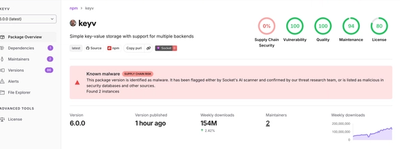
Popular npm packages keyv and cacheable compromised.

Security News
A misconfiguration gave three Anthropic models internet access, and one, believing it was in a simulation, shipped a credential-stealing package to PyPI.