
Research
/Security News
Popular npm Packages in the keyv and Cacheable Namespaces Compromised in Active Supply Chain Attack
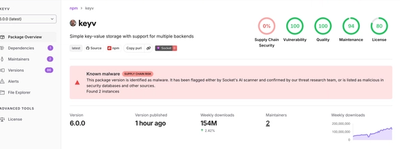
Popular npm packages keyv and cacheable compromised.
By Socket Research Team - Aug 04, 2026
sharedoc-mcp
Advanced tools
Share agent-generated Markdown as links — GitHub gists today, your own server tomorrow. An MCP server.
Agent-generated Markdown → a link you can hand to anyone. GitHub gists today, your own server tomorrow.
English | 繁體中文





An MCP stdio server — works in Claude Code, Codex CLI, and any MCP client — that gives your agent 8 tools to publish, update, search, and revoke shareable documents. Two pluggable backends behind one interface: gist (zero setup, rides your logged-in gh CLI) and selfhost (SQLite on your machine, passwords, enforced expiry).
When a backend can't honor a parameter (e.g.
passwordon gist), it returns a clear error instead of silently ignoring it.
AI agents produce Markdown constantly — reports, research digests, meeting notes. Getting that to another human usually means copy-pasting walls of text into a chat window.
Without sharedoc-mcp                  With sharedoc-mcp
────────────────────                  ─────────────────
copy a wall of text into chat         "share this as a doc"
paste again for each person           one link for everyone
content lives in chat scroll          revoke / extend / append later
"can you password it?"  …no           selfhost backend: bcrypt + expiry
sharedoc-mcp serve daemon mode — selfhost links keep working after your MCP client closesGET /healthz — identity-aware health probe for external monitoring / restart automationgh CLI — no tokens to manage, nothing new to hostnode:sqlite — zero native modules)marked + sanitize-html — scripts, event handlers, and javascript: URLs in shared content are strippeddefault-src 'none', nosniff, DENY framing, no-referrer, no-store) — exposure is a tunnel you control (recipes below)search_shared_docs + create dedup (identical unprotected retries within 5 min return the same URL; a retry that adds a password/expiry always creates a new doc)npm test passes on a clean checkoutRequires Node.js ≥ 22.13.0. Gist backend additionally needs GitHub CLI logged in (gh auth login).
Option A — Claude Code (one line):
claude mcp add sharedoc --scope user -- npx -y sharedoc-mcp
Option B — Codex CLI (~/.codex/config.toml):
[mcp_servers.sharedoc]
command = "npx"
args = ["-y", "sharedoc-mcp"]
Option C — any other MCP client: run npx -y sharedoc-mcp as a stdio server.
🅰 gist (default) | 🅱 selfhost | |
|---|---|---|
| Setup | none — uses your logged-in gh CLI | none extra — data stays on your machine |
| Doc lives on | GitHub (secret gist) | your machine (SQLite) |
| Link reachable | anywhere, immediately | localhost — add a tunnel to share externally |
| Password | ✗ (the secret URL is the protection) | ✓ server-verified (bcrypt), rate-limited |
| Expiry | lazy — expired gists deleted on next use | enforced — expired links return 410 |
| Revoke | gist deleted immediately, irreversibly | immediate 410, content purged after 7-day grace |
Ask your agent to "share this as a doc" — it calls create_shared_doc and returns a secret gist URL. Secret gists are not listed publicly and the URL is unguessable, but anyone who has the link can read it — that's the whole security model of this backend. Need passwords? Use selfhost.
A local index (~/.config/sharedoc-mcp/index.json) tracks what you've shared, powering search and expiry cleanup. Expiry here is lazy: expired gists are deleted the next time any tool runs, not at the exact expiry moment.
claude mcp add sharedoc --scope user --env SHAREDOC_BACKEND=selfhost -- npx -y sharedoc-mcp
Docs live in SQLite at ~/.local/share/sharedoc-mcp/; a viewer serves them at http://127.0.0.1:8377. To share beyond your machine, put a tunnel in front and set SHAREDOC_PUBLIC_URL:
Links that outlive your editor: in MCP mode the viewer dies with the MCP client — close Claude Code and selfhost links stop answering until the next session (data is safe in SQLite). Run the standalone daemon to keep links alive around the clock:
npx -y sharedoc-mcp serve # viewer only, same DB — keep it running via launchd/systemd/tmuxMCP clients detect the daemon already owns the port and simply use it.
When to set this up: the moment you first hand a link to someone else — do it together with your tunnel (both should be long-running, e.g. under launchd/systemd). Until then the MCP-mode viewer is enough, and gist-backend users never need it.
| Recipe | Fits you if | Setup |
|---|---|---|
| Tailscale private (recommended) | recipients are your own devices / people you can invite to your tailnet | tailscale serve --bg 8377 → https://<machine>.<tailnet>.ts.net, reachable only inside your tailnet — nothing is exposed to the public internet |
| Tailscale Funnel | share with anyone, no domain | tailscale funnel 8377 → same stable URL, but public |
| Cloudflare named tunnel | you own a domain | domain on Cloudflare, cloudflared tunnel create + route a hostname to http://127.0.0.1:8377 |
| cloudflared quick tunnel | one-off sharing | cloudflared tunnel --url http://127.0.0.1:8377 → random URL, changes every restart |
A branded, stable share URL like https://docs.example.com/docs/<uuid> — TLS handled by Cloudflare, works from behind NAT:
# one-time setup (domain already added to Cloudflare — the free plan is enough)
cloudflared tunnel login
cloudflared tunnel create sharedoc
cloudflared tunnel route dns sharedoc docs.example.com
~/.cloudflared/config.yml:
tunnel: sharedoc
credentials-file: ~/.cloudflared/<tunnel-id>.json
ingress:
  - hostname: docs.example.com
    service: http://127.0.0.1:8377
  - service: http_status:404
Run cloudflared tunnel run sharedoc (or install it as a service for always-on), and register the MCP server with the public URL:
claude mcp add sharedoc --scope user \
  --env SHAREDOC_BACKEND=selfhost \
  --env SHAREDOC_PUBLIC_URL=https://docs.example.com \
  -- npx -y sharedoc-mcp
Extras this unlocks: Cloudflare's DDoS protection comes free; you can layer WAF rules, or put Cloudflare Access (SSO) in front of everything except the share paths — an "SSO inside, password-protected shares outside" split.
Alternative — always-on without a home machine: run sharedoc-mcp on a VPS (where your agent also runs) and point nginx/caddy at 127.0.0.1:8377 with your domain and auto-TLS; no tunnel needed.
Environment variables:
| Variable | Default | Meaning |
|---|---|---|
SHAREDOC_BACKEND | gist | gist or selfhost |
SHAREDOC_PORT | 8377 | viewer port (selfhost) |
SHAREDOC_PUBLIC_URL | http://127.0.0.1:<port> | URL prefix in share links — set to your tunnel hostname |
SHAREDOC_DATA_DIR | ~/.local/share/sharedoc-mcp | SQLite location (selfhost) |
SHAREDOC_INDEX_PATH | ~/.config/sharedoc-mcp/index.json | local index (gist) |
MCP_CALLER | — | default author attribution for created docs |
| Tool | Does |
|---|---|
create_shared_doc | title + Markdown (+ optional password / expires_in_hours / author) → share URL |
append_to_shared_doc | append Markdown (not idempotent — a retry appends twice) |
extend_shared_doc | extend expiry by N hours |
reset_shared_doc_password | set / change / remove (null) the password (selfhost only) |
update_shared_doc_title | rename |
revoke_shared_doc | kill the link, keep the record (see backend table for semantics) |
delete_shared_doc | kill the link AND erase the record — irreversible |
search_shared_docs | no args = list newest links; title substring, body-text search (selfhost: full content; gist: opening excerpt), status filter |
Data flow, by backend:
~/.config/sharedoc-mcp/. Nothing is sent anywhere except GitHub via your own gh CLI..env, keys) — a hijacked agent could publish secrets. Removed rather than allowlisted.git clone https://github.com/AugustusW/sharedoc-mcp.git
cd sharedoc-mcp
npm install
npm test # builds, then runs 60 offline tests — gh CLI is mocked, HTTP tests hit 127.0.0.1 only
Versioning: every release bumps version in package.json, adds a CHANGELOG entry, and is published as a git tag + GitHub Release + npm.
To get update notifications: Watch this repo (Custom → Releases). npx -y fetches the latest published version on each cold run; your index and docs DB live outside the package — updating never touches them.
v2.0.0 (CHANGELOG) — core logic is covered by 60 offline unit/integration tests (the gh CLI is mocked; HTTP tests run against 127.0.0.1 only; no network needed). The full flows have been manually verified (2026-07-25: real secret-gist create/index/delete via the built server over stdio JSON-RPC, and the selfhost password flow end-to-end — form → wrong password 401 → correct password 200 → rate-limit 429 → revoke 410 — plus lsof confirmation of the 127.0.0.1-only bind) on:
Tunnel recipes are documented from the tools' standard behavior; Windows/Linux and real-tunnel end-to-end runs have not yet been verified — reports welcome.
MIT © AugustusW
FAQs
Did you know?

Socket for GitHub automatically highlights issues in each pull request and monitors the health of all your open source dependencies. Discover the contents of your packages and block harmful activity before you install or update your dependencies.
Research
/Security News
Popular npm packages keyv and cacheable compromised.

Security News
A misconfiguration gave three Anthropic models internet access, and one, believing it was in a simulation, shipped a credential-stealing package to PyPI.

Security News
/Company News
Socket has joined the new Composer and Packagist sponsorship program as a launch sponsor, supporting the team that keeps PHP's package ecosystem secure.