


Company News
AWS Security Hub Adds Socket for Supply Chain Security
Socket is now in the AWS Security Hub Extended plan. Adopt it through AWS, apply committed spend, and block malicious open source packages.
By Feross Aboukhadijeh - Aug 04, 2026
Sip your tokens, don't gulp them. Keep Claude Code's context clean: drift detection, re-read dedup, integrity scoring, AST-aware reads, and 15 MCP tools for Claude Desktop.

Sip your tokens, don't gulp them. Keep Claude Code's context clean: fewer tokens spent, sharper answers, and the savings measured so you can trust them.




| Operation | How often | Without Sipcode | With Sipcode | Savings |
|---|---|---|---|---|
git status | 10× | 8,000 | 1,500 | −81% |
git log | 5× | 12,500 | 2,000 | −84% |
git diff / git show | 4× | 16,000 | 6,000 | −62% |
grep -r | 6× | 12,000 | 2,400 | −80% |
ls / find | 8× | 12,000 | 3,200 | −73% |
cat (large files) | 5× | 15,000 | 6,000 | −60% |
npm ls | 2× | 10,000 | 1,600 | −84% |
| Grep tool | 4× | 10,000 | 2,000 | −80% |
| Glob tool | 3× | 4,500 | 1,500 | −67% |
| Total | ~100,000 | ~26,200 | ~−74% |
⚠️ These are illustrative estimates for a tool-heavy session, not a promise about yours — savings depend entirely on how many commands your session runs. Two numbers you can trust instead: the reproducible benchmark below (
npx sipcode benchmark→ 62.6% median on a locked corpus), and your own real number after using it (sipcode proxy --stats).
Sipcode is two things, and it matters which surface you're on:
| Claude Code (terminal / VS Code / JetBrains) | Claude Desktop (the chat app) | |
|---|---|---|
| The valve — actually reduces tokens by rewriting commands | ✅ Yes — this is where it works | ❌ No (chat has no shell commands to optimize) |
| The meter — audit, cost prediction, savings proof, score | ✅ via CLI and MCP tools | ✅ via MCP tools |
Plain-English version: if you use Claude Code in your terminal, install the valve and it quietly saves you tokens. If you only use the Claude Desktop chat app, you get the meter (analytics + cost tools) inside chat, and you can use it to turn on the valve for whenever you do use Claude Code.
A bloated, redundant context doesn't only cost more tokens — it makes the model worse. As stale junk piles up, Claude starts hedging, forgetting fixes you already made, and mixing up files. People call it context rot. Keeping context lean is both a measured token win and — per Anthropic's own published research — a quality win (leaner context ≈ 29% better outcomes; well-maintained context ≈ 40% fewer agent errors).
So "sip, don't gulp" cuts two ways: a gulp is a bloated context that's expensive and makes your agent sloppy; a sip is clean, measured context that's cheaper and sharper. Sipcode cleans context automatically (the valve), measures it (the meter), and warns you when it starts to rot (drift, below). The token savings are your proof the cleaning is real.
We cite the reliability numbers above from published research — we don't claim them as Sipcode's own measurement. The part Sipcode measures and proves is the token/context reduction.
Copy-paste this one block. That's the whole setup:
npm install -g sipcode      # 1. install the toolkit
sipcode proxy --install     # 2. turn ON the optimizer (writes a Claude Code hook)
Then restart Claude Code and work exactly as you normally do. Done.
🔑 Important: step 1 alone does nothing to your tokens — it just puts the tool on your machine. The optimizer only turns on after step 2 (
sipcode proxy --install). To turn it off at any time:sipcode proxy --uninstall.
Don't have Node.js? Install it once from nodejs.org (the LTS button). That's the only prerequisite.
Install the toolkit: npm install -g sipcode
Open your Claude Desktop config file:
| Your OS | File to open |
|---|---|
| Windows | %APPDATA%\Claude\claude_desktop_config.json |
| macOS | ~/Library/Application Support/Claude/claude_desktop_config.json |
| Linux | ~/.config/Claude/claude_desktop_config.json |
Add the sipcode block inside "mcpServers" (if the file is empty, paste the whole thing):
Windows:
{
  "mcpServers": {
    "sipcode": { "command": "cmd", "args": ["/c", "sipcode-mcp"] }
  }
}
macOS / Linux:
{
  "mcpServers": {
    "sipcode": { "command": "sipcode-mcp" }
  }
}
💡 Windows needs the
cmd /cpart because of how Windows runs the program. Copy the Windows block exactly.
Fully quit and reopen Claude Desktop. Then just ask Claude things like "use sipcode to show my token stats" or "turn on the sipcode proxy" — it will call the right tool.
Claude Code asks to run a command. Before it runs, Sipcode's hook swaps it for a leaner equivalent that returns the same information in fewer tokens. Because that output sits in Claude's context for the rest of the conversation, the saving compounds on every later turn.
WITHOUT Sipcode                          WITH Sipcode (proxy installed)

Claude ── "git status" ──▶ shell         Claude ── "git status" ──▶ [Sipcode hook]
       ◀── ~800 tokens ────                                              │ rewrites to
           (full output)                                                 ▼ "git status -s"
                                                            shell ──▶ runs the short form
                                                 Claude ◀── ~150 tokens (same info, compact)
Every rewrite is safe and reversible — Claude can always re-run the full command with explicit flags. Sipcode never touches commands that are already compact, already limited, or chained with &&, ||, ;, or |.
Git
git status        →  git status -s              # short format
git log           →  git log --oneline -n 20    # 20 one-liners, not full history
git diff / show   →  … | head -200              # caps huge diffs
Files & search
ls, find          →  … | head -50 / -100        # caps long listings
grep -r           →  grep -c -r                 # per-file match counts
cat <file>        →  size-aware: full file if small, head+tail only if >300 lines
Package & build tools
npm ls / list     →  --depth=0                  # top-level deps only
cargo build/test  →  --quiet                    # drops "Compiling…" noise
Claude Code's built-in tools (an edge RTK doesn't have — these go through our hook too)
Grep tool         →  head_limit=50              # Claude Code's default is 250
Glob tool         →  head_limit=100             # caps path floods
There is intentionally no
Read-tool rewrite: Claude Code'sReadalready caps at 2000 lines, so adding a limit would save nothing. We don't book savings we don't deliver.
sipcode proxy --diff      # preview exactly what the install will change (writes nothing)
sipcode proxy --stats     # after using Claude Code for a bit: shows what it rewrote + tokens saved
Quick manual proof: with the proxy installed, run git log in any repo with more than 20 commits — you'll get exactly 20 one-line entries instead of the full history. That's the rewrite firing.
In a Claude Desktop chat, ask: "What sipcode tools do you have?" Claude will call get_sipcode_info and list them — if you see the version and tool list, the MCP server is wired up correctly. Then try "use sipcode to check the proxy status."
| Symptom | Fix |
|---|---|
| Installed the proxy but tokens look the same | Did you restart Claude Code after sipcode proxy --install? Hooks load at startup. Then run sipcode proxy --stats after some use to confirm rewrites are happening. |
sipcode: command not found | The global install didn't land on your PATH. Re-run npm install -g sipcode; if it persists, reopen your terminal. No Node.js? Install it from nodejs.org. |
| Claude Desktop says the sipcode server "is down" / won't start | 99% of the time it's the config. On Windows you must use "command": "cmd", "args": ["/c", "sipcode-mcp"]. Confirm npm install -g sipcode succeeded, then fully quit and reopen Claude Desktop (not just close the window). |
| A command's output got cut off and I needed the rest | That's by design — re-run it with an explicit flag (e.g. git diff <file>, grep -rn …). If a rewrite ever hides something it shouldn't, that's a bug — please file it. |
| Want to turn it all off | sipcode proxy --uninstall (removes the hook, fully reversible). |
Works in your terminal (CLI) and inside Claude Desktop (MCP tool, in parentheses):
sipcode why          # where your last session burned tokens   (audit_latest_session)
sipcode impact       # your spend before vs after Sipcode       (verify_sipcode_impact)
sipcode stats        # cross-session totals + top spenders      (get_session_stats)
sipcode estimate "…" # predict a task's cost per model          (estimate_task_cost)
sipcode score        # 24-check agent-friendliness audit        (get_agent_score)
sipcode proxy --stats# what the valve has rewritten             (get_proxy_stats)
The meter reads only the transcripts Claude Code already writes to ~/.claude/projects/. Zero network calls — your code never leaves your machine (Privacy).
sipcode drift watches whether your recent Claude Code sessions are quietly getting more expensive or context-bloated — and stays silent unless something actually regressed. A smoke alarm, not a dashboard you have to babysit.
sipcode drift          # e.g. ⚠ cost/turn up ~34%; cache hit rate 71% → 48%
sipcode drift --json   # machine-readable   (also the get_drift_report MCP tool)
It compares your latest session against the median of your recent ones — conservative thresholds, so no false alarms — and names what moved: cost/turn up, cache-hit-rate down, or re-read waste up. These cost tokens and degrade answer quality (context rot), so catching them early keeps your agent both cheap and sharp.
npx sipcode benchmark
62.6% median token reduction across a locked 20-task corpus (range 37.4%–80.6%). This is the optimization methodology measured on captured transcripts — anyone can reproduce it in under 90 seconds, no signup. It is not a promise about your sessions (use sipcode impact for that) and not a measurement of the live proxy. Full method: benchmark/METHODOLOGY.md.
Meter (read-only): get_sipcode_info, verify_sipcode_impact, list_recent_sessions, audit_latest_session, get_project_manifest, estimate_task_cost, get_agent_score, get_session_stats, get_proxy_stats, get_proxy_status, get_drift_report, get_today_summary, forecast_monthly_spend
Valve control (writes settings.json): install_proxy, uninstall_proxy
So a Desktop user never has to touch a terminal: ask Claude to install the proxy, check savings, audit a project, or predict a cost — all from chat. Full docs: docs/MCP.md.
Stating this plainly because trust is the product:
sipcode proxy --install to turn on the valve.Local-first by engineering, not by promise. A CI test fails the build if node:http/https/net/dns is ever imported into a core path, and the proxy's rewriter functions are guarded to import no filesystem or network modules at all. Nothing is uploaded or phoned home.
| Command | What it does |
|---|---|
sipcode proxy --install / --uninstall / --diff / --stats | The valve — runtime command optimizer |
sipcode why | Where your last session burned tokens |
sipcode impact | Before/after your own spend |
sipcode stats | Cross-session analytics |
sipcode today | Daily dashboard: spend so far + comparison to your adaptive 30/14/7/3 day median |
sipcode forecast | Projected month-end spend with confidence band + last-month comparison |
sipcode trend <metric> --since <NNd> | Single-metric time series: output-ratio, cost-per-session, or recoverable-tokens-per-session |
sipcode estimate "<task>" | Per-model cost prediction |
sipcode score | Agent-friendliness audit + badge |
sipcode drift | Flag context/cost regressions vs your baseline (silent unless it regressed) |
sipcode benchmark | Reproducible corpus (--hardest, --vs-rtk, --live) |
sipcode receipt | Shareable PNG of a session's savings |
sipcode hygiene | Read-once rules + context-pressure hooks |
sipcode rules | Output-compression rules in CLAUDE.md |
sipcode manifest / init | Project manifest; multi-agent (--agent cursor) |
npm install -g sipcode@latest
No auto-updater. Monthly is plenty unless a security note is pinned here or on Releases. The proxy hook points at your global install, so it picks up updates automatically — no need to re-run proxy --install.
Bugs, edge cases, or a rewrite that hides something it shouldn't → open an issue. Built by Anuj Ojha — solo dev, also author of Answerable. MIT licensed.
FAQs
Sip your tokens, don't gulp them. Keep Claude Code's context clean: drift detection, re-read dedup, integrity scoring, AST-aware reads, and 15 MCP tools for Claude Desktop.
The npm package sipcode receives a total of 62 weekly downloads. As such, sipcode popularity was classified as not popular.
We found that sipcode demonstrated a healthy version release cadence and project activity because the last version was released less than a year ago. It has 1 open source maintainer collaborating on the project.
Did you know?

Socket for GitHub automatically highlights issues in each pull request and monitors the health of all your open source dependencies. Discover the contents of your packages and block harmful activity before you install or update your dependencies.
Company News
Socket is now in the AWS Security Hub Extended plan. Adopt it through AWS, apply committed spend, and block malicious open source packages.
Research
/Security News
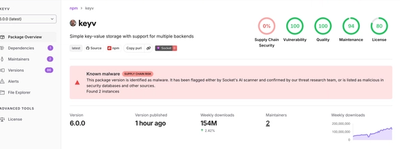
Popular npm packages keyv and cacheable compromised.

Security News
A misconfiguration gave three Anthropic models internet access, and one, believing it was in a simulation, shipped a credential-stealing package to PyPI.