

Security News
Risky Biz Podcast: AI Agents Are Raising the Stakes for Software Supply Chain Security
Open source attacks are accelerating as AI coding agents pull in dependencies faster, with less human review.
By Sarah Gooding - Jun 30, 2026
slush-marklogic-node
Advanced tools
This is a Slush generator that produces a skeleton MarkLogic application with the following components:
Microsoft Windows users should read the additional requirements documentation
npm install -g npm)npm install -g gulp)npm install -g slush) - only needed if you are generating the initial codenpm install -g bower)npm install -g slush-marklogic-node
If you prefer to use the latest code under development:
npm install -g git://github.com/marklogic/slush-marklogic-node.git
Go to the directory where your new project will be created (the parent). Then:
slush marklogic-node <app-name>
This will ask you several questions, with some intelligent defaults.
Go to the generated application directory:
cd {app-name}
Edit deploy/build.properties to set the -port properties to available ports
(defaults: 8040, 8041) and change other properties. The file itself documents
many of those properties. Others are described in the documentation for the
Roxy deployer. Then run the following Roxy
commands to configure your local MarkLogic database (typically, depending on
your configuration, it will create a database, associated forest(s), a REST
server, an app-user, and a role for that user).
./ml local bootstrap
./ml local deploy modules
On Windows, that would be:
ml.bat local bootstrap
ml.bat local deploy modules
Install additional dependencies using the bower package manager:
bower install
Edit the _loginMode variable in ui/app/login/login.service.js to change the login mode of the application. The default is set to full. The other options are top-right or modal.
gulp serve-local # this will watch the .less file for changes, compile them to .css, and run the node server
You can set some settings to match your setup in the Roxy properties files. For example:
gulp serve-local --ml-host=<your-host> --ml-http-port=8234 --app-port=9234 --nosync
Load some sample data, as described in the next section of this README.
The slush generation creates an entire project directory, described in Project folder structure.
Explaining the stack gives a more complete description of the overall architecture.
Learn more about specific components of the generated application on the Components page.
Learn about specific ways of customizing your app on the Customization Recipes page.
The application comes with 3000 JSON documents generated by json-generator.com. You can load them with (MLCP)[https://docs.marklogic.com/guide/ingestion/content-pump] like this:
NOTE: @sample-app-role in import-sample-data.options will change to your app's role
(Alternatively, you can discover that with ./ml local info)
./ml local mlcp -options_file import-sample-data.options
Or on Windows:
ml.bat local mlcp -options_file import-sample-data.options
The application assumes that you're storing JSON data. This shows up in the
default format request for the MLRest service's searchContext, the
detailController's (detail-ctrl.js) request to get a document, and in the
out-of-the-box detail view.
The generator defaults to using a 'rest'-type Roxy app and the 'master' branch of Roxy. If you know what you're doing, and you want to do something different, you can specify those options with this syntax:
slush marklogic-node <appName> appType=mvc branch=dev
FAQs
A slush generator for AngularJS/node.js/MarkLogic
We found that slush-marklogic-node demonstrated a not healthy version release cadence and project activity because the last version was released a year ago. It has 3 open source maintainers collaborating on the project.
Did you know?

Socket for GitHub automatically highlights issues in each pull request and monitors the health of all your open source dependencies. Discover the contents of your packages and block harmful activity before you install or update your dependencies.
Security News
Open source attacks are accelerating as AI coding agents pull in dependencies faster, with less human review.

Research
/Security News
Malicious Chrome and Firefox extensions posed as free VPNs while stealing clipboard data through later extension updates.
Research
/Security News
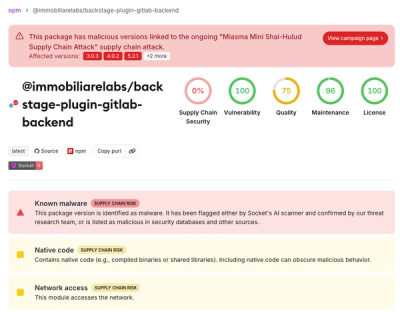
Miasma Mini Shai-Hulud hits @immobiliarelabs Backstage plugins, targeting GitLab and LDAP auth packages on npm.