

Company News
AWS Security Hub Adds Socket for Supply Chain Security
Socket is now in the AWS Security Hub Extended plan. Adopt it through AWS, apply committed spend, and block malicious open source packages.
By Feross Aboukhadijeh - Aug 04, 2026
specky-sdd
Advanced tools
Specky — Spec-Driven Development CLI toolkit. 58 MCP tools, 13 agents, 22 prompts, 14 skills, 16 hooks. Unified `specky` CLI installs to Claude Code, GitHub Copilot, Cursor, or OpenCode on macOS, Linux, and Windows.

13 agents. 58 MCP tools. Explicit use-case contracts. One CLI.
Agentic Spec-Driven Development











Website · Getting Started · Use-Case Contracts · npm · Security
| Section | Description | |
|---|---|---|
| Start | What is Specky? | Overview and ecosystem |
| What's Included | Agents, prompts, skills, hooks, and MCP tools | |
| Why Specifications Matter | Vibe coding vs deterministic development | |
| Getting Started | Complete educational guide | |
| Use | Quick Start | Install via npm CLI |
| Where Specifications Live | File structure and naming conventions | |
| Input Methods | 6 ways to feed Specky | |
| Three Project Types | Greenfield, Brownfield, Modernization | |
| Use-Case Contracts | Lifecycle, workload, mode, capabilities, evidence, migration | |
| How to upgrade | Bump npm + refresh project assets (no --target needed) | |
| Staying up to date | Update notifications and opt-out | |
| Pipeline | Pipeline and LGTM Gates | Feature-specific phase graphs and configured review gates |
| All 58 Tools | Complete tool reference by category | |
| EARS Notation | The 6 requirement patterns | |
| Enterprise | Compliance Frameworks | HIPAA, SOC2, GDPR, PCI-DSS, ISO 27001 |
| Enterprise Ready | Security, audit trail, quality gates | |
| Platform | The SDD Platform | Built on Spec-Kit, everything included |
| Roadmap | v3.12.0 current, future capabilities planned |
Specky is a CLI toolkit for Spec-Driven Development — 13 specialized agents, 58 MCP tools, 22 prompts, 14 skills, and 16 automation hooks. Each feature selects an explicit lifecycle, workload, execution mode, and capability configuration; Specky persists the resolved phase graph and rejects missing identity, hidden defaults, unsupported capabilities, and ungrounded artifact evidence.
Powered by the Spec-Kit methodology. Install the specky CLI and it places agents, prompts, skills, hooks, and the MCP server registration into your project — for GitHub Copilot (VS Code), Claude Code, Cursor, or OpenCode.
Specky is a complete AI development toolkit — not just an MCP server. The specky CLI installs everything your AI IDE needs into a single project:
| Primitive | What it is | Specky includes |
|---|---|---|
| Agents | Specialized AI personas with defined roles, tools, and guardrails | 13 agents — @specky-orchestrator (full pipeline), @specky-onboarding (wizard), @specky-spec-engineer, @specky-design-architect, @specky-task-planner, @specky-quality-reviewer, and 7 more |
| Prompts | Slash commands that activate the right agent for a task | 22 prompts — /specky-greenfield, /specky-specify, /specky-release, /specky-orchestrate, etc. |
| Skills | Domain knowledge files loaded into agent context automatically | 14 skills — SDD pipeline rules, phase playbooks, EARS patterns, implementation patterns, test criteria, release gate protocol |
| Hooks | Scripts that run before/after every tool call for validation | 16 hooks — specky-artifact-validator, specky-branch-validator, specky-phase-gate, specky-lgtm-gate, specky-security-scan, etc. |
| MCP Server | The tool engine that validates, generates, and enforces | 58 tools via Model Context Protocol (the runtime underneath) |
An MCP server gives you tools. The CLI toolkit gives you the experience:
@specky-orchestrator; it loads the feature's signed contract, follows its persisted graph, delegates to lean agents that read rich skills, and applies configured gates.The MCP engine is the runtime. The agents + hooks + skills are the product.
Specky ships as a single npm package with a unified specky CLI. Works on macOS, Linux, Windows, and WSL.
# 1. Install the CLI globally (once per machine)
npm install -g specky-sdd@latest

# 2. Bootstrap your project — choose your target harness:
cd your-project
specky install --target=copilot      # VS Code + GitHub Copilot (recommended)
specky install --target=claude       # Claude Code
specky install --target=cursor       # Cursor
specky install --target=opencode     # OpenCode
specky install --target=agent-skills # Skills-only shared .agents/skills bundle
Important: Prefer
--target=.... The legacy--ideflag still works forcopilot,claude,both, andauto, but it is deprecated in favor of APM-style targets. Copilot + Claude in the same workspace is supported (--target=bothorall); Specky strips Claude hooks from.claude/settings.jsonso Copilot cannot cross-read them. Prefer a single target if you need Claude lifecycle hooks. See docs/INSTALL.md for details.
Or per-project (for teams — pins version in package.json, run via npx):
cd your-project
npm install --save-dev specky-sdd@latest
npx specky install --target=copilot
The CLI installs 13 agents, 22 prompts, 14 skills, 16 hooks, and target-local MCP registration pinned to the installed version. Canonical agent capabilities compile to the selected harness's native tools; they are not inferred from workflow prose. Use --permission-profile=scoped (default) for narrow Claude pre-authorization, or --permission-profile=prompt to leave every approval with the host. Specky does not pre-authorize arbitrary shell, rm, network access, or credentials. Add --integration=github only when GitHub MCP routing is required. Run specky doctor anytime to validate integrity and configuration.
Generated assets are platform-native. specky install --target=copilot writes GitHub Copilot agents/prompts with VS Code tool names such as search, agent, and specky/sdd_get_status, plus prompt agent: agent frontmatter. specky install --target=claude writes Claude Code agents/commands with Read, Glob, Grep, Task, and mcp__specky__sdd_get_status, with Copilot-only prompt metadata removed. Cursor and OpenCode receive their own native vocabulary. agent-skills is intentionally skills-only. See Target Capabilities for the full capability matrix, GitHub MCP opt-in, and host approval boundaries.
Specky also has an APM governance layer for enterprise package control. apm.yml declares the package primitives, targets, and MCP runtime; apm.lock.yaml pins primitive hashes; apm-policy.yml enforces MCP and tool-name policy. Maintainers and CI can run specky apm validate, specky apm policy, specky apm verify-lock, and specky apm sbom before publishing or installing. See Uso do APM pelo Specky for the detailed model, including why APM is not a runtime proxy and why users do not need to install the Microsoft APM CLI.
Full walkthroughs per OS, offline install, and CLI reference: docs/INSTALL.md · docs/CLI.md.
When a new Specky version is out (banner from specky doctor / specky status, or GitHub Releases):
# Global CLI (most users)
npm install -g specky-sdd@latest
cd your-project
specky upgrade
# Per-project pin (teams)
npm install --save-dev specky-sdd@latest
npx specky upgrade
You do not need --target on upgrade. specky upgrade reads the harness you already installed from .specky/install.json and refreshes the same targets — agents, prompts, skills, hooks, and MCP registration (.mcp.json, .vscode/mcp.json, .cursor/mcp.json, or opencode.json). It preserves .specs/ (pipeline artifacts) and .specky/profile.json (onboarding answers).
Updating only the npm package is not enough: without specky upgrade, MCP pins can still point at the old server version.
Use --target only for a first install or when switching harness (e.g. Copilot → Cursor):
specky install --target=cursor          # new target set
specky install --force --target=copilot   # reinstall / repair one target
See also Staying up to date for update notifications and opt-out.
%%{init: {"theme":"base","themeVariables":{"background":"#ffffff","primaryColor":"#f8fafc","primaryBorderColor":"#9ca3af","primaryTextColor":"#111827","secondaryColor":"#f3f4f6","tertiaryColor":"#e5e7eb","lineColor":"#6b7280","fontFamily":"Segoe UI, Arial, sans-serif"}}}%%
flowchart LR
  A["Raw intent"] --> B["Vibe coding<br/>direct prompt to code"]
  B --> C["Guessing<br/>implicit requirements"]
  C --> D["Rework<br/>drift and missing acceptance criteria"]

  A --> E["Specky SDD<br/>validated specification first"]
  E --> F["EARS requirements<br/>measurable acceptance criteria"]
  F --> G["Deterministic delivery<br/>traceable design, tasks, tests, release"]

  classDef node fill:#f8fafc,stroke:#9ca3af,color:#111827,stroke-width:1px;
  classDef risk fill:#f3f4f6,stroke:#6b7280,color:#111827,stroke-width:1px;
  class A,E,F,G node;
  class B,C,D risk;
AI coding assistants are fast but chaotic. You say "build me a login system" and the AI generates code immediately, skipping requirements, guessing architecture, and producing something that works but doesn't match what anyone actually needed. This is vibe coding: generating code based on vibes instead of validated specifications.
The result is avoidable rework: requirements, acceptance criteria, design decisions, tasks, tests, and release evidence cannot be traced to one reviewed contract.
Specifications are structured documents that describe what the system must do before anyone writes code. They've existed for decades in engineering, but AI development mostly ignores them. Specky brings them back, with AI enforcement.
Key concepts you should know:
| Concept | What it is | Why it matters |
|---|---|---|
| Markdown | The universal language that both humans and AI read fluently | All spec artifacts are .md files in your repo, versioned with Git |
| MCP | Model Context Protocol — an open standard that lets AI assistants call external tools | Specky is an MCP server; any AI IDE can connect to it |
| EARS Notation | A method for writing requirements that forces precision with 6 patterns | Eliminates vague statements like "the system should be fast" |
| Agents and Skills | Specialized AI roles that invoke Specky tools with domain expertise | 13 agents + 14 skills orchestrate the full pipeline |
| CLI Toolkit | A complete AI development package: agents + prompts + skills + hooks + MCP server | Installed via npm: npm install -g specky-sdd |
Specky adds a deterministic engine between your intent and your code:
The AI is the operator; Specky is the engine. The AI's creativity is channeled through a validated pipeline instead of producing unstructured guesswork. For a complete educational walkthrough, see GETTING-STARTED.md.
| Capability | Specky |
|---|---|
| Complete CLI toolkit | 13 agents, 22 prompts, 14 skills, 16 hooks + 58 MCP tools |
| Pipeline orchestrator | @specky-orchestrator follows the selected feature's signed phase graph |
| Onboarding wizard | @specky-onboarding detects context and guides setup |
| Explicit input contracts | Document, transcript, and Figma tools require enabled capabilities and complete parameters |
| EARS validation (programmatic, not AI guessing) | 6 patterns enforced at schema level |
| Enforced pipeline (not suggestions) | Contract-specific phases, central analysis gate, optional configured LGTM blocking |
| Pre/post hooks on every phase | specky-artifact-validator, specky-branch-validator, specky-phase-gate, specky-lgtm-gate |
| Workload-specific diagrams | Explicit evidence validation or deterministic auto-generation from specification/design content |
| Infrastructure as Code | DESIGN.md-driven Terraform with exact resource templates and fail-fast preflight |
| Work item export | GitHub Issues, Azure Boards, Jira via MCP-to-MCP routing |
| 5 compliance frameworks | HIPAA, SOC2, GDPR, PCI-DSS, ISO 27001 with explicit control-ID evidence |
| Cross-artifact traceability | Requirement to design to task to test to code |
| Explicit release policy | Branch prefix, base, draft, and checkpoint choices persisted per feature |
| Unified CLI distribution | npm install -g specky-sdd && specky install --target=copilot — one binary, multi-OS (macOS/Linux/Windows/WSL) |
| First-class harness targets | VS Code + Copilot, Claude Code, Cursor, OpenCode, plus shared .agents/skills |
| Zero outbound calls from the MCP server | Air-gap friendly; code never leaves your machine. The CLI's once-daily update check is opt-out |
| MIT open source | Fork it, extend it, audit it. No vendor lock, no seat pricing |
One-time CLI install:
npm install -g specky-sdd@latest
Bootstrap each project:
cd your-project
specky install
That's it. The CLI auto-detects supported harnesses or uses the explicit target and installs the 13 agents, 22 prompts, 14 skills, 16 hooks, and MCP server registration with least-privilege tool scope for the selected harness.
Other install modes:
# Per-project (teams — pins version in package.json)
cd your-project
npm install --save-dev specky-sdd@latest
npx specky install

# Zero-install (one command, no persistent CLI)
cd your-project
npx -y specky-sdd@latest install
Full per-OS walkthrough: docs/INSTALL.md · CLI reference: docs/CLI.md.
specky doctor          # validates integrity + configuration
specky status          # shows active features and pipeline phase
Then open your IDE and type:
@specky-onboarding
The onboarding wizard detects your project context (greenfield/brownfield/modernization) and guides you through setup.
@specky-orchestrator run the pipeline for a todo API
The orchestrator resolves the selected feature contract and follows its full, rapid, or emergency phase graph. Specify, Design, and Tasks require lgtm: true only when workspace configuration enables LGTM enforcement.
| Your situation | Guide |
|---|---|
| Building something new | Greenfield |
| Adding features to existing code | Brownfield |
| Upgrading a legacy system | Modernization |
Tip: New to Spec-Driven Development? Specky already includes all the SDD methodology from Spec-Kit. Just install Specky and the pipeline guides you through every phase with educative outputs that explain the concepts as you work.
Every feature gets its own numbered directory inside .specs/. This keeps specifications, design documents, and quality reports together as a self-contained package.
your-project/
├── src/                          ← Your application code
├── .specs/                       ← All Specky specifications
│   ├── 001-user-authentication/  ← Feature #1
│   │   ├── CONSTITUTION.md       ← Project principles and governance
│   │   ├── SPECIFICATION.md      ← EARS requirements with acceptance criteria
│   │   ├── DESIGN.md             ← Architecture, data model, API contracts
│   │   ├── RESEARCH.md           ← Resolved unknowns and technical decisions
│   │   ├── TASKS.md              ← Implementation breakdown with dependencies
│   │   ├── ANALYSIS.md           ← Quality gate report
│   │   ├── CHECKLIST.md          ← Domain-specific quality checklist
│   │   ├── CROSS_ANALYSIS.md     ← Spec-design-tasks alignment score
│   │   ├── COMPLIANCE.md         ← Regulatory framework validation
│   │   ├── VERIFICATION.md       ← Drift and phantom task detection
│   │   └── .sdd-state.json       ← Pipeline state (current phase, history)
│   ├── 002-payment-gateway/      ← Feature #2
│   └── 003-notification-system/  ← Feature #3
├── reports/                      ← Cross-feature analysis reports
└── .specky/config.yml            ← Optional project-level configuration
Naming convention: NNN-feature-name, zero-padded number + kebab-case name. Each directory is independent; you can work on multiple features simultaneously.
%%{init: {"theme":"base","themeVariables":{"background":"#ffffff","primaryColor":"#f8fafc","primaryBorderColor":"#9ca3af","primaryTextColor":"#111827","secondaryColor":"#f3f4f6","tertiaryColor":"#e5e7eb","lineColor":"#6b7280","fontFamily":"Segoe UI, Arial, sans-serif"}}}%%
flowchart TB
  P["Natural language prompt"] --> I["Specky input layer"]
  T["Meeting transcript"] --> I
  D["Documents<br/>PDF, DOCX, PPTX, MD"] --> I
  F["Figma or FigJam"] --> I
  C["Existing codebase"] --> I
  R["Raw pasted text"] --> I
  I --> S["sdd_init + sdd_discover"]
  S --> A[".specs/NNN-feature<br/>research, requirements, design, tasks"]

  classDef input fill:#ffffff,stroke:#9ca3af,color:#111827,stroke-width:1px;
  classDef engine fill:#f3f4f6,stroke:#6b7280,color:#111827,stroke-width:1px;
  classDef output fill:#f8fafc,stroke:#374151,color:#111827,stroke-width:1px;
  class P,T,D,F,C,R input;
  class I,S engine;
  class A output;
Specky accepts multiple input types. Choose the one that matches your starting point:
Type your idea directly into the AI chat. No files needed.
> I need a feature for user authentication with email/password login,
  password reset via email, and JWT session management
The AI calls sdd_init + sdd_discover to structure your idea into a spec project.
Best for: Quick prototyping, brainstorming, greenfield projects.
Import a transcript from Teams, Zoom, or Google Meet. Specky extracts topics, decisions, action items, and requirements automatically.
> Import the requirements meeting transcript and create a specification
The AI calls sdd_import_transcript → extracts:
Supported formats: .vtt (WebVTT), .srt (SubRip), .txt, .md
Pro tip: Use sdd_auto_pipeline to go from transcript to complete spec in one step:
> Run the auto pipeline from this meeting transcript: /path/to/meeting.vtt
Got multiple transcripts? Use batch processing:
> Batch import all transcripts from the meetings/ folder
The AI calls sdd_batch_transcripts → processes every .vtt, .srt, .txt, and .md file in the folder.
Import requirements documents, RFPs, architecture decks, or any existing documentation.
> Import this requirements document and create a specification:
  /path/to/requirements.pdf
The AI calls sdd_import_document → converts to Markdown, extracts sections, and feeds into the spec pipeline.
Supported formats: .pdf, .docx, .pptx, .txt, .md
Batch import from a folder:
> Import all documents from the docs/ folder into specs
The AI calls sdd_batch_import → processes every supported file in the directory.
Honest note on binary formats: the built-in extractor fully handles
md/txtand simple uncompressed files. Real-world (compressed) PDF/DOCX/PPTX need one of: the optionalmammoth/pdfjs-distpackages, or the recommended MarkItDown MCP integration. Since 3.6, unsupported binaries fail with clear guidance instead of silently importing garbage.
Convert Figma designs into requirements specifications. Works with the Figma MCP server.
> Convert this Figma design into a specification:
  https://figma.com/design/abc123/my-app
The AI calls sdd_figma_to_spec → extracts components, layouts, and interactions, then routes to the Figma MCP server for design context.
Best for: Design-first workflows, UI-driven projects.
Scan an existing codebase to detect tech stack, frameworks, structure, and patterns before writing specs.
> Scan this codebase and tell me what we're working with
The AI calls sdd_scan_codebase → detects:
| Detected | Examples |
|---|---|
| Language | TypeScript, Python, Go, Rust, Java |
| Framework | Next.js, Express, React, Django, FastAPI, Gin |
| Package Manager | npm, pip, poetry, cargo, maven, gradle |
| Runtime | Node.js, Python, Go, JVM |
| Directory Tree | Full project structure with file counts |
Best for: Understanding an existing project before adding features or modernizing.
No file? Just paste the content directly. Every import tool accepts a raw_text parameter as an alternative to a file path.
> Here's the raw requirements from the client email:

  The system needs to handle 10,000 concurrent users...
  Authentication must support SSO via Azure AD...
  All data must be encrypted at rest and in transit...

  Import this and create a specification.
%%{init: {"theme":"base","themeVariables":{"background":"#ffffff","primaryColor":"#f8fafc","primaryBorderColor":"#9ca3af","primaryTextColor":"#111827","secondaryColor":"#f3f4f6","tertiaryColor":"#e5e7eb","lineColor":"#6b7280","fontFamily":"Segoe UI, Arial, sans-serif"}}}%%
flowchart LR
  G["Greenfield<br/>new product idea"] --> D["Discover"]
  B["Brownfield<br/>existing codebase"] --> D
  M["Modernization<br/>legacy migration"] --> D
  D --> S["Specify"] --> A["Analyze"] --> I["Implement"] --> V["Verify"] --> R["Release"]

  classDef start fill:#ffffff,stroke:#9ca3af,color:#111827,stroke-width:1px;
  classDef phase fill:#f8fafc,stroke:#6b7280,color:#111827,stroke-width:1px;
  class G,B,M start;
  class D,S,A,I,V,R phase;
Specky adapts to any project type. The pipeline is the same; the starting point is what changes.
Scenario: You're building a new application with no existing code.
> I'm building a task management API. Initialize a Specky project and help
  me define the scope.
The AI calls sdd_init → creates .specs/001-task-management/CONSTITUTION.md
Then calls sdd_discover → asks you 7 structured questions:
Answer each question. Your answers feed directly into the specification.
> Write the specification based on my discovery answers
The AI calls sdd_write_spec → creates SPECIFICATION.md with EARS requirements:
## Requirements

REQ-001 [Ubiquitous]: The system shall provide a REST API for task CRUD operations.

REQ-002 [Event-driven]: When a user creates a task, the system shall assign
a unique identifier and return it in the response.

REQ-003 [State-driven]: While a task is in "in-progress" state, the system
shall prevent deletion without explicit force confirmation.

REQ-004 [Unwanted]: If the API receives a malformed request body, then the
system shall return a 400 status with a descriptive error message.
The AI pauses here. Review .specs/001-task-management/SPECIFICATION.md and reply LGTM when satisfied.
> LGTM.proceed to design
The AI calls sdd_write_design → creates DESIGN.md with:
Review and reply LGTM.
> LGTM.create the task breakdown
The AI calls sdd_write_tasks → creates TASKS.md with implementation tasks mapped to acceptance criteria, dependencies, and estimated complexity.
> Run analysis, submit SOC2 control evidence, and validate the workload-required diagram set
The AI calls:
sdd_run_analysis → completeness audit, orphaned criteria detectionsdd_compliance_check → evaluates the persisted SOC2 pack using evidence keyed by control IDsdd_generate_all_diagrams → validates explicit Mermaid payloads or uses mode: "auto" to derive the complete supported set from source evidence before an atomic write> Generate the persisted Azure Terraform resources, Docker environment, and executable Vitest bindings
The AI calls:
sdd_generate_iac → Terraform for the exact cloud/resources grounded in the relevant DESIGN.md sections; excluded or unsupported resources fail before files are writtensdd_generate_dockerfile → Dockerfile/compose from the persisted development stacksdd_generate_tests → executable tests from fingerprinted requirement bindings> Export tasks to GitHub Issues and create a PR
The AI calls sdd_export_work_items + sdd_create_pr → generates work item payloads and PR body with full spec traceability.
Next: Learn about EARS notation to understand the requirement patterns, or see All 58 Tools for a complete reference.
Scenario: You have a running application and need to add a new feature with proper specifications.
> Scan this codebase so Specky understands what we're working with
The AI calls sdd_scan_codebase → detects tech stack, framework, directory structure. This context informs all subsequent tools.
Detected: TypeScript + Next.js + npm + Node.js
Files: 247 across 32 directories
> Initialize a feature for adding real-time notifications to this Next.js app.
  Use the codebase scan results as context.
The AI calls sdd_init → creates .specs/001-real-time-notifications/CONSTITUTION.md
Then calls sdd_discover with the codebase summary → the 7 discovery questions now include context about your existing tech stack:
"What technical constraints exist? Note: This project already uses TypeScript, Next.js, npm, Node.js. Consider compatibility with the existing stack."
If you have existing PRDs, architecture docs, or meeting notes:
> Import the PRD for notifications: /docs/notifications-prd.pdf
The AI calls sdd_import_document → converts to Markdown and adds to the spec directory. The content is used as input when writing the specification.
> Write the specification for real-time notifications. Consider the existing
  Next.js architecture and any patterns already in the codebase.
The specification references existing components, APIs, and patterns from the codebase scan.
After implementation, verify specs match the code:
> Check if the implementation matches the specification
The AI calls sdd_check_sync → generates a drift report flagging any divergence between spec and code.
If you have multiple features specified:
> Run cross-analysis across all features to find conflicts
The AI calls sdd_cross_analyze → checks for contradictions, shared dependencies, and consistency issues across .specs/001-*, .specs/002-*, etc.
Next: Next: See compliance frameworks for regulatory validation, or MCP integration for routing to external tools.
Scenario: You have a legacy system that needs assessment, documentation, and incremental modernization.
> Scan this legacy codebase and help me understand what we have
The AI calls sdd_scan_codebase → maps the technology stack, directory tree, and file counts.
Gather everything you have.architecture documents, runbooks, meeting notes about the system:
> Batch import all documents from /docs/legacy-system/ into specs
The AI calls sdd_batch_import → processes PDFs, DOCX, PPTX, and text files. Each becomes a Markdown reference in the spec directory.
If you have recorded meetings with stakeholders discussing the modernization:
> Batch import all meeting transcripts from /recordings/
The AI calls sdd_batch_transcripts → extracts decisions, requirements, constraints, and open questions from every transcript.
> Write a specification for modernizing the authentication module.
  Consider the legacy constraints from the imported documents and
  meeting transcripts.
The specification accounts for:
Legacy systems often need compliance validation during modernization:
> Run compliance checks against HIPAA and SOC2 for the modernized auth module
The AI calls sdd_compliance_check → validates the specification against regulatory controls and flags gaps.
> Generate the implementation plan, Terraform for the new infrastructure,
  and a runbook for the migration
The AI calls:
sdd_implement → phased implementation plan with checkpointssdd_generate_iac → infrastructure configuration for the target environmentsdd_generate_runbook → operational runbook with rollback procedures> Generate an onboarding guide for developers joining the modernization project
The AI calls sdd_generate_onboarding → creates a guide covering architecture decisions, codebase navigation, development workflow, and testing strategy.
Next: See compliance frameworks for regulatory validation during modernization, or project configuration to customize Specky for your team.
%%{init: {"theme":"base","themeVariables":{"background":"#ffffff","primaryColor":"#f8fafc","primaryBorderColor":"#9ca3af","primaryTextColor":"#111827","secondaryColor":"#f3f4f6","tertiaryColor":"#e5e7eb","lineColor":"#6b7280","fontFamily":"Segoe UI, Arial, sans-serif"}}}%%
flowchart LR
  I["Init"] --> D["Discover"] --> S["Specify"] --> G1{"LGTM gate"}
  G1 -->|approved| C["Clarify"] --> A["Design"] --> G2{"LGTM gate"}
  G2 -->|approved| T["Tasks"] --> G3{"LGTM gate"}
  G3 -->|approved| N["Analyze"] --> P["Implement"] --> V["Verify"] --> R["Release"]
  G1 -->|changes requested| S
  G2 -->|changes requested| A
  G3 -->|changes requested| T
  V -->|drift detected| S

  classDef phase fill:#f8fafc,stroke:#6b7280,color:#111827,stroke-width:1px;
  classDef gate fill:#f3f4f6,stroke:#374151,color:#111827,stroke-width:1px;
  class I,D,S,C,A,T,N,P,V,R phase;
  class G1,G2,G3 gate;
This diagram is the full execution-mode graph. Rapid and emergency contracts persist smaller ordered graphs. The state machine blocks transitions outside the selected feature's graph.
LGTM gates: Specify, Design, and Tasks can require lgtm: true when .specky/config.yml enables LGTM enforcement. When disabled, review remains useful but is not a hidden blocking default.
Feedback loop: If sdd_verify_tasks detects drift between specification and implementation, Specky routes you back to the Specify phase to correct the divergence before proceeding.
Advancing phases: If you need to manually advance:
> Advance to the next phase
The AI calls sdd_advance_phase → moves the pipeline forward if all prerequisites are met.
%%{init: {"theme":"base","themeVariables":{"background":"#ffffff","primaryColor":"#f8fafc","primaryBorderColor":"#9ca3af","primaryTextColor":"#111827","secondaryColor":"#f3f4f6","tertiaryColor":"#e5e7eb","lineColor":"#6b7280","fontFamily":"Segoe UI, Arial, sans-serif"}}}%%
flowchart LR
  P0["0 Init"] --> P1["1 Discover"] --> P2["2 Specify"] --> P3["3 Clarify"] --> P4["4 Design"] --> P5["5 Tasks"] --> P6["6 Analyze"] --> P7["7 Implement"] --> P8["8 Verify"] --> P9["9 Release"]

  classDef phase fill:#ffffff,stroke:#9ca3af,color:#111827,stroke-width:1px;
  class P0,P1,P2,P3,P4,P5,P6,P7,P8,P9 phase;
| Phase | What Happens | Required Output |
|---|---|---|
| Init | Create project structure, constitution, scan codebase | CONSTITUTION.md |
| Discover | Interactive discovery: 7 structured questions about scope, users, constraints | Discovery answers |
| Specify | Write EARS requirements with acceptance criteria | SPECIFICATION.md |
| Clarify | Resolve ambiguities, generate decision tree | Updated SPECIFICATION.md |
| Design | Architecture, data model, API contracts, research unknowns | DESIGN.md, RESEARCH.md |
| Tasks | Implementation breakdown by user story, dependency graph | TASKS.md |
| Analyze | Cross-artifact analysis, quality checklist, compliance check | ANALYSIS.md, CHECKLIST.md, CROSS_ANALYSIS.md |
| Implement | Ordered execution with checkpoints per user story | Implementation progress |
| Verify | Drift detection, phantom task detection | VERIFICATION.md |
| Release | PR generation, work item export, documentation | Complete package |
All artifacts are saved in .specs/NNN-feature/. See Input Methods for how to feed data into the pipeline.
| Tool | Description |
|---|---|
sdd_import_document | Convert PDF, DOCX, PPTX, TXT, MD to Markdown |
sdd_import_transcript | Parse meeting transcripts (Teams, Zoom, Google Meet) |
sdd_auto_pipeline | Any input to complete spec pipeline (all documents) |
sdd_batch_import | Process folder of mixed documents |
sdd_batch_transcripts | Scan folder of transcripts and run full auto-pipeline for each |
sdd_figma_to_spec | Figma design to requirements specification |
| Tool | Description |
|---|---|
sdd_init | Initialize project with constitution and scope diagram |
sdd_discover | Interactive discovery with stakeholder mapping |
sdd_write_spec | Write EARS requirements with flow diagrams |
sdd_clarify | Resolve ambiguities with decision tree |
sdd_write_design | 12-section system design (C4 model) with sequence diagrams, ERD, API flow |
sdd_write_tasks | Task breakdown with dependency graph |
sdd_run_analysis | Quality gate analysis with coverage heatmap |
sdd_advance_phase | Move to next pipeline phase |
| Tool | Description |
|---|---|
sdd_checklist | Mandatory quality checklist (security, accessibility, etc.) |
sdd_verify_tasks | Detect phantom completions |
sdd_compliance_check | HIPAA, SOC2, GDPR, PCI-DSS, ISO 27001 validation |
sdd_cross_analyze | Spec-design-tasks alignment with consistency score |
sdd_validate_ears | Batch EARS requirement validation |
sdd_check_sync | Spec-vs-implementation drift detection report |
| Tool | Description |
|---|---|
sdd_generate_diagram | Explicit Mermaid validation by default, or evidence-grounded auto-generation for supported types |
sdd_generate_all_diagrams | Explicit validation or atomic auto-generation of the complete supported contracted set |
sdd_generate_user_stories | User stories with flow diagrams (web-application workload) |
sdd_figma_diagram | FigJam-ready diagram via Figma MCP |
mode: "explicit" remains the compatibility default and requires caller-supplied Mermaid plus evidence references. mode: "auto" derives C4 context, sequence, ER, and deployment diagrams from SPECIFICATION.md and DESIGN.md; unsupported contracted types fail before any file is written.
| Tool | Description |
|---|---|
sdd_generate_iac | Terraform from canonical module:service resources grounded in relevant DESIGN.md sections; unsupported templates fail preflight |
sdd_validate_iac | Validation via Terraform MCP + Azure MCP |
sdd_generate_dockerfile | Dockerfile + docker-compose from tech stack |
| Tool | Description |
|---|---|
sdd_setup_local_env | Docker-based local dev environment |
sdd_setup_codespaces | GitHub Codespaces configuration |
sdd_generate_devcontainer | .devcontainer/devcontainer.json generation |
| Tool | Description |
|---|---|
sdd_create_branch | Git branch naming convention |
sdd_export_work_items | Tasks to GitHub Issues, Azure Boards, or Jira |
sdd_create_pr | PR payload with spec summary |
sdd_implement | Ordered implementation plan with checkpoints |
sdd_research | Resolve unknowns in RESEARCH.md |
| Tool | Description |
|---|---|
sdd_generate_docs | Complete auto-documentation |
sdd_generate_api_docs | API documentation from design |
sdd_generate_runbook | Operational runbook |
sdd_generate_onboarding | Developer onboarding guide |
sdd_generate_all_docs | Generate all documentation types in parallel (docs, API, runbook, onboarding, journey) |
| Tool | Description |
|---|---|
sdd_get_status | Pipeline status with guided next action |
sdd_get_template | Get any template |
sdd_scan_codebase | Detect tech stack and structure |
sdd_metrics | Project metrics dashboard |
sdd_amend | Amend project constitution |
sdd_write_bugfix | Generate bugfix spec with root cause analysis and test plan |
| Tool | Description |
|---|---|
sdd_generate_tests | Assemble executable tests from persisted requirement bindings (vitest/jest/playwright/pytest/junit/xunit) |
sdd_verify_tests | Verify test results against requirements, report traceability coverage |
sdd_generate_pbt | Assemble executable fast-check or Hypothesis properties from persisted requirement bindings; no generated model stubs |
| Tool | Description |
|---|---|
sdd_turnkey_spec | Assemble caller-authored EARS requirements, criteria, evidence, discovery context, and clarification responses for an initialized feature; never infers requirements or creates state |
| Tool | Description |
|---|---|
sdd_checkpoint | Create a named snapshot of all spec artifacts and pipeline state |
sdd_restore | Restore spec artifacts from a previous checkpoint (auto-creates backup before restoring) |
sdd_list_checkpoints | List all available checkpoints for a feature with labels, dates, and phases |
| Tool | Description |
|---|---|
sdd_check_ecosystem | Report recommended MCP servers with install commands |
| Tool | Description |
|---|---|
sdd_model_routing | Capability-class routing guidance for the phase vocabulary; the selected feature graph controls applicable phases |
sdd_context_status | Context tier assignment (Hot/Domain/Cold) for spec artifacts with token savings |
sdd_check_access | RBAC access check for current role with per-tool permissions summary |
| Tool | Description |
|---|---|
sdd_verify_audit | Verify the hash-chained audit trail (.audit.jsonl) for tamper evidence and report chain integrity |
%%{init: {"theme":"base","themeVariables":{"background":"#ffffff","primaryColor":"#f8fafc","primaryBorderColor":"#9ca3af","primaryTextColor":"#111827","secondaryColor":"#f3f4f6","tertiaryColor":"#e5e7eb","lineColor":"#6b7280","fontFamily":"Segoe UI, Arial, sans-serif"}}}%%
C4Context
title Specky C4 Context
Person(dev, "Developer / AI operator", "Uses an AI IDE to deliver features through SDD")
System_Boundary(specky, "Specky SDD Platform") {
  System(cli, "specky CLI", "Installs target-native agents, prompts, skills, hooks, and MCP registration")
  System(mcp, "Specky MCP Server", "Executes 58 validated SDD tools and the 10-phase state machine")
  System(apm, "APM Primitive Source", "Canonical .apm agents, prompts, skills, instructions, and hooks")
}
System_Ext(specKit, "Spec-Kit", "Methodology and prompt patterns")
System_Ext(aiIde, "AI IDE", "GitHub Copilot, Claude Code, Cursor, OpenCode")
System_Ext(externalMcp, "External MCP ecosystem", "GitHub, Azure DevOps, Jira, Terraform, Figma, Docker")

Rel(dev, aiIde, "asks for feature delivery")
Rel(aiIde, cli, "installs assets with")
Rel(cli, apm, "compiles from")
Rel(aiIde, mcp, "calls SDD tools through MCP")
Rel(mcp, externalMcp, "returns routing payloads for")
Rel(specKit, apm, "informs methodology encoded in")
UpdateLayoutConfig($c4ShapeInRow="3", $c4BoundaryInRow="1")
Spec-Kit — the open-source SDD methodology from github/spec-kit, extended in paulasilvatech/spec-kit — provides a constitution model, gated workflow phases expressed as prompt templates, and broad coding-assistant support. It defines what to do. (Upstream Spec-Kit's phases are advisory prompts; the EARS requirements notation and programmatic enforcement below are Specky's additions — EARS was popularized for AI specs by AWS Kiro and originates in the Mavin/Rolls-Royce EARS approach.)
Specky is the CLI toolkit that reimplements that methodology as 58 enforceable MCP tools with 13 agents, 22 prompts, 14 skills, and 16 hooks. It enforces how to do it.
| Spec-Kit (Methodology) | Specky (Plugin) | |
|---|---|---|
| What it is | Prompt templates + agent definitions | CLI toolkit: 13 agents + 58 MCP tools + 22 prompts + 14 skills + 16 hooks |
| How it works | AI reads .md templates and follows instructions | AI calls agents that orchestrate tools with hook validation |
| Validation | AI tries to follow the prompts | State machine, EARS regex, Zod schemas, pre/post hooks |
| Install | Copy .github/agents/ and .claude/commands/ | npm install -g specky-sdd && specky install |
| Works standalone | Yes, in any AI IDE | Yes, includes all Spec-Kit patterns |
| Best for | Learning SDD, lightweight adoption | Production enforcement, enterprise, compliance |
When you install Specky, you get the full Spec-Kit methodology reimplemented as validated MCP tools. No separate installation of Spec-Kit needed. But Spec-Kit remains available as a standalone learning tool for teams that want to adopt SDD concepts before using the engine.
Together they form the SDD layer of the GitHub + Microsoft enterprise platform. Specky reimplements the Spec-Kit methodology as enforceable MCP tools with compliance, traceability, and automation built in.
{
  "servers": {
    "specky": {
      "command": "specky-sdd"
    }
  }
}
Note: This example assumes Specky is installed via
specky install --target=copilot(afternpm install -g specky-sdd@latest). See Quick Start for details.
Create .specky/config.yml in your project root to customize Specky:
# .specky/config.yml
profile: standard                    # standard | enterprise (flips security defaults ON)
templates_path: ./my-templates       # Override built-in templates
default_framework: vitest            # Default test framework
compliance_frameworks: [hipaa, soc2] # Frameworks to check
audit_enabled: true                  # Enable audit trail
update_check: true                   # Once-daily CLI update check (set false to disable)
rbac:
  enabled: false                     # Role checks (viewer/contributor/admin)
  default_role: contributor
rate_limit:
  enabled: false                     # HTTP token bucket (60 rpm, burst 10)
pipeline:
  require_lgtm: false                # Server-side LGTM: sdd_advance_phase refuses to pass
                                     # the Specify/Design/Tasks gates unless lgtm: true
When templates_path is set, Specky uses your custom templates instead of the built-in ones. When audit_enabled is true, tool invocations are logged locally. profile: enterprise turns audit, RBAC, rate limiting, and fail-closed auditing on by default (explicit values win) — see docs/ENTERPRISE-DEPLOYMENT.md. With pipeline.require_lgtm: true, the LGTM quality gates become server-enforced instead of an agent convention: advancing past Specify/Design/Tasks requires the explicit lgtm: true input on sdd_advance_phase.
Specky tells you about new versions in two ways:
specky doctor and specky status warn when the assets installed in your project differ from the version of the CLI running them, and suggest specky upgrade. The MCP server prints the same warning at startup. This is a local file comparison — no network involved.install, doctor, status, upgrade, or --version, the CLI checks the npm registry at most once per day and prints Update available: vX → vY when a newer release exists. This is a single GET to registry.npmjs.org — no telemetry, nothing sent beyond the request itself. It fails silently offline, is disabled in CI (CI=true), and never runs in specky serve — the MCP server itself never phones home.Upgrading is two steps — bump the package, then refresh the project:
npm install -g specky-sdd@latest && cd your-project && specky upgrade
Per-project installs: npm install --save-dev specky-sdd@latest && npx specky upgrade.
No --target on upgrade — Specky reuses the targets recorded in .specky/install.json. See How to upgrade for the full flow and when --target is still required (first install or harness switch).
specky upgrade matters: it refreshes the installed agents, prompts, skills, and hooks and re-pins .mcp.json / .vscode/mcp.json to the new version — updating the npm package alone leaves the MCP registration pointing at the old pinned server.
Teams pinning per-project (npm install --save-dev specky-sdd) should let Renovate or Dependabot propose the package.json bump. For release emails, use Watch → Custom → Releases on the GitHub repo.
Opt out of the registry check with SPECKY_NO_UPDATE_CHECK=1 in the environment or update_check: false in .specky/config.yml. The drift warning stays on — it never touches the network.
%%{init: {"theme":"base","themeVariables":{"background":"#ffffff","primaryColor":"#f8fafc","primaryBorderColor":"#9ca3af","primaryTextColor":"#111827","secondaryColor":"#f3f4f6","tertiaryColor":"#e5e7eb","lineColor":"#6b7280","fontFamily":"Segoe UI, Arial, sans-serif"}}}%%
flowchart TB
  User["Developer / AI operator"] --> Client["AI client<br/>Copilot, Claude, Cursor, OpenCode"]
  Client --> Specky["Specky MCP Server<br/>58 SDD tools"]
  Specky --> Payload["Structured routing payload<br/>JSON, artifacts, next actions"]
  Payload --> Client

  Client --> GitHub["GitHub MCP<br/>issues, PRs, repos"]
  Client --> AzureBoards["Azure DevOps MCP<br/>work items, boards"]
  Client --> Jira["Jira MCP<br/>issues, projects"]
  Client --> Terraform["Terraform MCP<br/>plan, validate, apply"]
  Client --> Figma["Figma MCP<br/>design context"]
  Client --> Docker["Docker MCP<br/>local dev environments"]

  classDef core fill:#f8fafc,stroke:#374151,color:#111827,stroke-width:1px;
  classDef mcp fill:#ffffff,stroke:#9ca3af,color:#111827,stroke-width:1px;
  classDef payload fill:#f3f4f6,stroke:#6b7280,color:#111827,stroke-width:1px;
  class User,Client,Specky core;
  class Payload payload;
  class GitHub,AzureBoards,Jira,Terraform,Figma,Docker mcp;
Specky outputs structured JSON with routing instructions. Your AI client calls the appropriate external MCP server:
Specky --> sdd_export_work_items(platform: "azure_boards") --> JSON payload
  --> AI Client --> Azure DevOps MCP --> create_work_item()

Specky --> sdd_validate_iac(provider: "terraform") --> validation payload
  --> AI Client --> Terraform MCP --> plan/validate

Specky --> sdd_figma_to_spec(file_key: "abc123") --> Figma request
  --> AI Client --> Figma MCP --> get_design_context()
| MCP Server | Integration |
|---|---|
| GitHub MCP | Issues, PRs, Codespaces |
| Azure DevOps MCP | Work Items, Boards |
| Jira MCP | Issues, Projects |
| Terraform MCP | Plan, Validate, Apply |
| Azure MCP | Template validation |
| Figma MCP | Design context, FigJam diagrams |
| Docker MCP | Local dev environments |
Every requirement in Specky follows EARS (Easy Approach to Requirements Syntax):
| Pattern | Format | Example |
|---|---|---|
| Ubiquitous | The system shall... | The system shall encrypt all data at rest |
| Event-driven | When [event], the system shall... | When a user submits login, the system shall validate credentials |
| State-driven | While [state], the system shall... | While offline, the system shall queue requests |
| Optional | Where [condition], the system shall... | Where 2FA is enabled, the system shall require OTP |
| Unwanted | If [condition], then the system shall... | If session expires, the system shall redirect to login |
| Complex | While [state], when [event]... | While in maintenance, when request arrives, queue it |
The EARS validator programmatically checks every requirement against these 6 patterns. Vague terms like "fast", "good", "easy" are flagged automatically.
Built-in compliance checking against:
Every tool response includes structured guidance:
{
  "explanation": "What was done and why",
  "next_steps": "Guided next action with command suggestion",
  "learning_note": "Educational context about the concept",
  "diagram": "Mermaid diagram relevant to the output"
}
%%{init: {"theme":"base","themeVariables":{"background":"#ffffff","primaryColor":"#f8fafc","primaryBorderColor":"#9ca3af","primaryTextColor":"#111827","secondaryColor":"#f3f4f6","tertiaryColor":"#e5e7eb","lineColor":"#6b7280","fontFamily":"Segoe UI, Arial, sans-serif"}}}%%
flowchart LR
  Input["Any input"] --> Research["Discover<br/>research and constraints"]
  Research --> Spec["Specify<br/>EARS requirements"]
  Spec --> Design["Design<br/>architecture, APIs, data"]
  Design --> Tasks["Tasks<br/>dependency-ordered work"]
  Tasks --> Build["Implement<br/>code, IaC, tests"]
  Build --> Verify["Verify<br/>drift and phantom task checks"]
  Verify --> Release["Release<br/>PR, work items, runbook"]
  Release --> Ops["Production-ready package"]
  Verify -->|drift found| Spec

  classDef step fill:#ffffff,stroke:#9ca3af,color:#111827,stroke-width:1px;
  classDef terminal fill:#f3f4f6,stroke:#374151,color:#111827,stroke-width:1px;
  class Input,Research,Spec,Design,Tasks,Build,Verify,Release step;
  class Ops terminal;
From any input to production -- fully automated, MCP-orchestrated, with artifacts and diagrams generated at every step. All artifacts are saved in .specs/NNN-feature/.
Specky is built with enterprise adoption in mind.
Specky is 100% open source (MIT) — enterprise mode is just an opt-in configuration profile of the same package: profile: enterprise (or SPECKY_PROFILE=enterprise, or specky serve --profile=enterprise) flips the governance defaults ON — hash-chained audit trail (fail-closed), RBAC, and HTTP rate limiting — while explicit config values still win. Add SDD_HTTP_TOKENS_FILE for identity-based roles (each bearer token maps to a named principal + role; audit entries record who did what) and SDD_AUDIT_HMAC_KEY[_FILE] for a tamper-evident audit log signed with a key the workspace never sees. The standard profile is untouched — all of this stays off unless you opt in.
→ Full guide: docs/ENTERPRISE-DEPLOYMENT.md (hosted HTTP, tokens, HMAC audit, air-gapped installs, containers, CI gates)
@modelcontextprotocol/sdk, zod, yaml)TemplateRenderError; no TODO substitution or dynamic template execution.. sequences.strict() validation — every tool input is schema-validated; unknown fields rejectedWhen using Specky, follow these practices to protect your data:
| Practice | Why | How |
|---|---|---|
| Use stdio mode for local development | No network exposure | npx specky-sdd (default) |
| Never expose HTTP mode to public networks without TLS | HTTP has optional bearer-token auth but no TLS | --http binds to 127.0.0.1 by default; set SDD_HTTP_TOKEN (shared) or SDD_HTTP_TOKENS_FILE (per-user identity + role) for bearer auth. For remote access, add a reverse proxy (nginx, Caddy) terminating TLS |
Protect the .specs/ directory | Contains your specification artifacts (architecture, API contracts, business logic) | Add .specs/ to .gitignore if specs contain sensitive IP, or use a private repo |
| Protect checkpoints | .specs/{feature}/.checkpoints/ stores full artifact snapshots | Same as above — treat checkpoints like source code |
| Review source-backed artifacts before committing | Transcript/document inputs and explicit source quotes may contain sensitive details | Review SPECIFICATION.md, DESIGN.md, and TRANSCRIPT.md before git add |
| Keep the specky-security-scan hook enabled | Detects API keys, passwords, tokens in staged files | Comes pre-configured; don't disable .claude/hooks/specky-security-scan.sh |
| Use environment variables for secrets | Specky never stores credentials, but your specs might reference them | Write $DATABASE_URL in specs, never the actual connection string |
Run npm audit regularly | Catches dependency vulnerabilities | npm audit — CI runs this automatically on every PR |
| What Specky creates | Contains | Sensitivity | Recommendation |
|---|---|---|---|
CONSTITUTION.md | Project scope, principles | Low | Safe to commit |
SPECIFICATION.md | Requirements, acceptance criteria | Medium | Review before committing — may contain business logic details |
DESIGN.md | Architecture, API contracts, security model | High | May contain infrastructure details, auth flows, data schemas |
TASKS.md | Implementation plan, effort estimates | Low | Safe to commit |
ANALYSIS.md | Quality gate results, coverage | Low | Safe to commit |
.sdd-state.json | Pipeline phase timestamps | Low | Safe to commit |
.checkpoints/*.json | Full copies of all artifacts | High | Protect like source code — contains everything above |
docs/journey-*.md | Complete SDD audit trail with timestamps | Medium | Review before sharing externally |
| Routing payloads | Branch names, PR bodies, work items | Transient (memory only) | Never persisted by Specky; forwarded to external MCPs by the AI client |
Key principle: Specky creates files only on your local filesystem. Nothing is sent to any cloud service unless you push to git or the AI client routes a payload to an external MCP server. You are always in control.
Built-in compliance checking validates your specifications against industry frameworks:
| Framework | Controls | Use Case |
|---|---|---|
| HIPAA | 6 controls | Healthcare applications |
| SOC 2 | 6 controls | SaaS and cloud services |
| GDPR | 6 controls | EU data processing |
| PCI-DSS | 6 controls | Payment card handling |
| ISO 27001 | 6 controls | Enterprise security management |
Every pipeline phase produces a traceable artifact in .specs/NNN-feature/. The complete specification-to-code journey is documented in the SDD Journey document (docs/journey-{feature}.md) with phase timestamps, gate decisions, and traceability metrics.
advancePhase() blocks if gate decision is BLOCK or CHANGES_NEEDED# Clone and setup
git clone https://github.com/paulasilvatech/specky.git
cd specky
npm install
# Build
npm run build
# Run the full test suite
npm test
# Run tests with coverage report
npm run test:coverage
# Lint and format with Biome
npm run lint
npm run format
# Development mode (auto-reload on file changes)
npm run dev
# Verify MCP handshake (quick smoke test)
echo '{"jsonrpc":"2.0","id":1,"method":"initialize","params":{"protocolVersion":"2025-03-26","capabilities":{},"clientInfo":{"name":"test","version":"1.0"}}}' | node dist/index.js 2>/dev/null
# Run the published image from GHCR (multi-arch: linux/amd64 + linux/arm64)
docker pull ghcr.io/paulasilvatech/specky:latest # or pin a release: :3.12.0
docker run --rm -p 3200:3200 ghcr.io/paulasilvatech/specky:latest
curl http://localhost:3200/health # -> {"status":"ok","version":"3.12.0"}
# Or build and run locally from source
docker build -t specky-sdd:dev .
docker run -p 3200:3200 -v $(pwd):/workspace specky-sdd:dev
curl http://localhost:3200/health
The published image binds 0.0.0.0:3200 inside the container (so -p works)
and serves an unauthenticated GET /health. For hardened/authenticated
deployments (enterprise profile, token auth, TLS proxy, private packages) see
docs/ENTERPRISE-DEPLOYMENT.md.
| Capability | Status |
|---|---|
| 58 MCP tools driven by signed per-feature use-case contracts | Stable |
Unified specky CLI: install, doctor, status, upgrade, hooks, serve | Stable |
Target-specific install: --target=copilot, claude, cursor, opencode, or agent-skills | Stable |
| Copilot-safe hook manifests (no lifecycle event cross-read) | Stable |
| Phase validation on every tool with gate enforcement | Stable |
| Evidence-grounded diagram generation with explicit and auto modes | Stable |
| DESIGN.md-driven Terraform with unsupported-resource preflight | Stable |
| 12-section system design template (C4 model, security, infrastructure) | Stable |
| Enriched interactive responses on all tools (progress, handoff, education) | Stable |
| Parallel documentation generation (5 types via Promise.all) | Stable |
Explicit turnkey specification assembly (sdd_turnkey_spec) | Stable |
Property-based testing with fast-check and Hypothesis (sdd_generate_pbt) | Stable |
| Checkpoint/restore for spec artifacts | Stable |
| Intelligence layer: model routing hints on all tools | Stable |
| Context tiering: Hot/Domain/Cold with token savings | Stable |
| Cognitive debt metrics at LGTM gates | Stable |
| Test traceability: REQ-ID → test coverage mapping | Stable |
| Intent drift detection with amendment suggestions | Stable |
| 16 automation hooks (advisory-default, strict opt-in via SPECKY_GUARD) | Stable |
| 13 specialized agents + 22 prompts + 14 skills | Stable |
| 5 compliance frameworks (HIPAA, SOC2, GDPR, PCI-DSS, ISO 27001) with explicit control evidence | Stable |
| 6 input types (transcript, PDF, DOCX, Figma, codebase, raw text) | Stable |
| Test generation for 6 frameworks (vitest, jest, playwright, pytest, junit, xunit) | Stable |
| MCP-to-MCP routing (GitHub, Azure DevOps, Jira, Terraform, Figma, Docker) | Stable |
| CycloneDX SBOM artifact + optional Cosign signing on Docker image | Stable |
| JSONL audit logger (optional) | Stable |
| RBAC foundation (opt-in role-based access control) | Stable |
| Rate limiting for HTTP transport (opt-in) | Stable |
HTTP transport: loopback bind by default, bearer-token auth (SDD_HTTP_TOKEN), DNS-rebinding protection | Stable |
Enterprise profile (profile: enterprise — audit/RBAC/rate-limit defaults ON, opt-in) | Stable |
Identity-based RBAC over HTTP (SDD_HTTP_TOKENS_FILE: token → principal + role) | Stable |
Tamper-evident audit trail (HMAC-signed entries, fail-closed mode, sdd_verify_audit) | Stable |
| Server-enforced analysis gate on implement tools | Stable |
Strict phase bookkeeping (ensurePhasesThrough) | Stable |
| Stale gate invalidation on artifact rewrite | Stable |
| Strict multi-feature resolution | Stable |
OpenCode two-step bootstrap (install + compile) | Stable |
VS Code MCP dual schema (servers + mcpServers) | Stable |
| Feature | Description |
|---|---|
| Observability | OpenTelemetry metrics and structured logging |
| Internationalization | Spec templates in PT-BR, ES, FR, DE, JA |
| Automated shrinking | fast-check/Hypothesis shrinking feedback into spec refinement |
| Centralized audit log | SIEM export (syslog shipping, OTLP) of the tamper-evident audit trail |
| Multi-tenant | Isolated workspaces for multiple teams |
| SSO / SAML | Federated identity for enterprise auth (beyond the static token table) |
Have a feature request? Open an issue.
See examples/ for a complete, real spec package generated by
running the pipeline end-to-end — examples/todo-api/
is a greenfield REST API taken from sdd_init all the way to an APPROVE
quality gate at 100% traceability. examples/specky-verify.example.yml is a
drop-in GitHub Action that verifies EARS + the quality gate on every PR.
See CONTRIBUTING.md for architecture details and how to add tools, templates, or services.
specky-sdd on npmMIT. Created by Paula Silva | Americas Software GBB, Microsoft
FAQs
Specky — Spec-Driven Development CLI toolkit. 58 MCP tools, 13 agents, 22 prompts, 14 skills, 16 hooks. Unified `specky` CLI installs to Claude Code, GitHub Copilot, Cursor, or OpenCode on macOS, Linux, and Windows.
We found that specky-sdd demonstrated a healthy version release cadence and project activity because the last version was released less than a year ago. It has 1 open source maintainer collaborating on the project.
Did you know?

Socket for GitHub automatically highlights issues in each pull request and monitors the health of all your open source dependencies. Discover the contents of your packages and block harmful activity before you install or update your dependencies.
Company News
Socket is now in the AWS Security Hub Extended plan. Adopt it through AWS, apply committed spend, and block malicious open source packages.
Research
/Security News
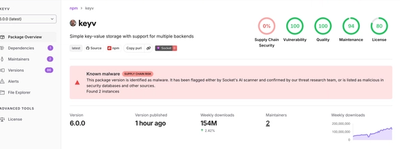
Popular npm packages keyv and cacheable compromised.

Security News
A misconfiguration gave three Anthropic models internet access, and one, believing it was in a simulation, shipped a credential-stealing package to PyPI.