

Product
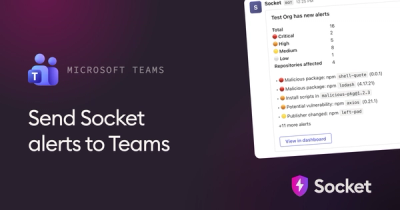
Microsoft Teams Notifications Are Now Available in Socket
Socket can now send alerts and supply chain attack notifications to Microsoft Teams, with filters that route the right updates to each channel.
By Jeppe Hasseriis - Sep 01, 2026
ssh-session-mcp
Advanced tools
Persistent SSH PTY session manager for MCP clients with actor-aware input tracking, terminal-style dashboard rendering, and automatic session cleanup.
中文 | English



ssh-session-mcp is a persistent SSH PTY session manager for MCP clients. It gives the user and the AI the same terminal session, adds a browser viewer, tracks who typed what, and keeps long-running SSH work manageable instead of stateless.

Most SSH-oriented MCP servers can execute commands, but they do not manage terminal state well enough for real collaboration.
ssh-session-mcp focuses on the missing runtime layer:
If the goal is to let Claude Code, Codex, or OpenCode install the server automatically, prefer npx -y ssh-session-mcp in the MCP command instead of a prior global install.
For Cline Marketplace and other agent installers, see llms-install.md. This repo is structured to be one-click installable through an npx -y ssh-session-mcp --viewerPort=auto command.
claude mcp add --transport stdio ssh-session-mcp -- npx -y ssh-session-mcp --viewerPort=auto
Windows note from the Claude Code docs: native Windows users should wrap npx with cmd /c for stdio MCP servers.
claude mcp add --transport stdio ssh-session-mcp -- cmd /c npx -y ssh-session-mcp --viewerPort=auto
codex mcp add ssh-session-mcp -- npx -y ssh-session-mcp --viewerPort=auto
OpenCode's opencode mcp add flow is interactive. Choose a local MCP server and use this command:
npx -y ssh-session-mcp --viewerPort=auto
If you prefer config instead of the interactive flow:
{
  "$schema": "https://opencode.ai/config.json",
  "mcp": {
    "ssh-session-mcp": {
      "type": "local",
      "command": ["npx", "-y", "ssh-session-mcp", "--viewerPort=auto"]
    }
  }
}
This is the closest thing to "automatic installation" for stdio MCP servers today: the MCP client stores the command, and npx -y downloads the package automatically the first time it runs.
npm install -g ssh-session-mcp
ssh-session-mcp-ctl launch --local --viewerPort=auto
This starts a local shell instead of SSH and opens the browser terminal, which is the easiest way to test the MCP runtime before touching a real server.
Use the MCP server binary directly when wiring a client:
# Global install
npm install -g ssh-session-mcp

# Server command used by MCP clients
ssh-session-mcp --viewerPort=auto
# Claude Code
claude mcp add --transport stdio ssh-session-mcp -- ssh-session-mcp --viewerPort=auto

# Codex CLI
codex mcp add ssh-session-mcp -- ssh-session-mcp --viewerPort=auto
If you prefer npx instead of a global install:
npx -y ssh-session-mcp --viewerPort=auto
Create .env from .env.example:
cp .env.example .env
SSH_HOST=192.168.1.100
SSH_PORT=22
SSH_USER=username
SSH_PASSWORD=
SSH_KEY=
VIEWER_PORT=auto
AUTO_OPEN_TERMINAL=false
SSH_MCP_MODE=safe
Then launch:
ssh-session-mcp-ctl launch --viewerPort=auto
For multiple boards or named targets, create ssh-session-mcp.config.json:
{
  "defaultDevice": "board-a",
  "devices": [
    {
      "id": "board-a",
      "host": "192.168.10.58",
      "port": 22,
      "user": "orangepi",
      "auth": { "passwordEnv": "BOARD_A_PASSWORD" },
      "defaults": {
        "term": "xterm-256color",
        "cols": 120,
        "rows": 40,
        "autoOpenViewer": true,
        "viewerMode": "browser"
      }
    }
  ]
}
Discovery order:
--config=/path/to/config.jsonssh-session-mcp.config.json.env fallbackImportant:
auth.password is intentionally unsupported. Use auth.passwordEnv or auth.keyPath..env or the parent environment, not in repo-tracked JSON.The browser viewer is not decorative. It is part of the workflow:
For users:
install -> launch viewer -> connect once -> keep the session alive -> let the AI help
For agents:
ssh-quick-connect -> ssh-run -> inspect output -> ssh-command-status if needed -> ssh-run again
Use AGENT.md when you want the AI to install, inspect config, connect devices, and help the user end-to-end. Compatibility notes for older agent setups remain in AI_AGENT_GUIDE.md.
--local for offline testing| Mode | Behavior |
|---|---|
safe | Default. Blocks obviously dangerous, interactive, or streaming commands when they are a poor fit for autonomous execution. |
full | Allows broader control and warns less, while still blocking extreme cases such as obvious destructive abuse. |
| Mode | Who can type |
|---|---|
common | User and AI |
user | Only the user |
claude / codex | Only the selected agent |
If the terminal is locked by the user, ssh-run, ssh-session-send, and ssh-session-control return a blocked response instead of forcing input into the PTY.
| Tool | Purpose |
|---|---|
ssh-quick-connect | Connect or reuse the default target and optionally open the viewer |
ssh-run | Execute a command with completion detection and exit-code capture |
ssh-status | Inspect sessions, viewer state, and operation mode |
ssh-command-status | Poll async command progress |
ssh-retry | Retry flaky commands with backoff |
ssh-session-policy-list | Inspect inherited defaults and current session custom policy rules |
ssh-session-policy-upsert | Add or update a session-level custom policy rule |
ssh-session-policy-remove | Remove a session-level custom policy rule |
ssh-session-policy-reset | Reset session custom rules back to inherited defaults |
| Tool | Purpose |
|---|---|
ssh-session-open | Open a session with explicit SSH parameters |
ssh-session-send | Send raw PTY input |
ssh-device-list | List configured devices and defaults |
ssh-session-read | Read buffered terminal output by offset |
ssh-session-watch | Long-poll for output and dashboard changes |
ssh-session-history | Read line-numbered mixed terminal history |
ssh-session-control | Send control keys such as ctrl_c, arrows, or tab |
ssh-session-resize | Resize the PTY |
ssh-session-list | List tracked sessions |
ssh-session-diagnostics | Inspect lock state, warnings, running command state, and viewer health |
ssh-session-policy-list | Show inherited policy defaults and the current session rule set |
ssh-session-policy-upsert | Add or update a session-specific custom policy rule |
ssh-session-policy-remove | Remove a session-specific custom policy rule |
ssh-session-policy-reset | Restore inherited rules for the current session |
ssh-session-set-active | Choose the default session |
ssh-viewer-ensure | Open or reuse the local viewer |
ssh-viewer-list | List tracked viewer processes |
ssh-session-close | Close a session cleanly |
ssh-quick-connect | One-step connect flow for agents |
ssh-run | Main command execution tool |
ssh-status | Runtime overview |
ssh-command-status | Async poller |
ssh-retry | Retry executor |
These helpers are for humans on the workstation that owns the viewer:
ssh-session-mcp-ctl status
ssh-session-mcp-ctl devices
ssh-session-mcp-ctl launch --viewerPort=auto
ssh-session-mcp-ctl launch --local --viewerPort=auto
ssh-session-mcp-ctl logs --tail=60
ssh-session-mcp-ctl cleanup
Default rule library management for operators:
ssh-session-mcp-config policy list --scope=merged
ssh-session-mcp-config policy set block-kubectl-delete --pattern="\\bkubectl\\s+delete\\b" --category=dangerous --action=block --message="kubectl delete is blocked in safe mode"
ssh-session-mcp-config policy remove block-kubectl-delete
Equivalent repo-local commands also exist:
npm run launch
npm run status
npm run devices
npm run logs
npm run cleanup
Key environment variables:
| Variable | Meaning | Default |
|---|---|---|
SSH_HOST | Legacy single-target SSH host | required in legacy mode |
SSH_PORT | Legacy single-target SSH port | 22 |
SSH_USER | Legacy single-target SSH user | required in legacy mode |
SSH_PASSWORD | Password auth | empty |
SSH_KEY | Local private key path | empty |
SSH_MCP_INSTANCE | Runtime isolation key | proc-<pid> or helper-selected |
SSH_MCP_CONFIG | Explicit config file path | auto-discovery |
VIEWER_HOST | Viewer bind host | 127.0.0.1 |
VIEWER_PORT | Viewer port or auto | 0 unless configured |
SSH_MCP_MODE | safe or full | safe |
SSH_MCP_LOCAL | Launch a local shell instead of SSH | false |
SSH_MCP_DEBUG | Enable debug browser actions | false |
AUTO_OPEN_TERMINAL | Auto-open browser terminal | false |
SSH_MCP_LOG_MODE | off or meta JSONL logging | off |
Example config file: docs/examples/ssh-session-mcp.config.example.json
.env is ignored by git and npm.See SECURITY.md for the full policy.
More detail: docs/platform-compatibility.md
npm install
npm run build
npm run test
npm run validate:repo
npm run build:site
GitHub Actions included in this repo can:
dist/Apache-2.0. See LICENSE.
FAQs
Persistent SSH PTY session manager for MCP clients with actor-aware input tracking, terminal-style dashboard rendering, and automatic session cleanup.
The npm package ssh-session-mcp receives a total of 38 weekly downloads. As such, ssh-session-mcp popularity was classified as not popular.
We found that ssh-session-mcp demonstrated a healthy version release cadence and project activity because the last version was released less than a year ago. It has 1 open source maintainer collaborating on the project.
Product
Socket can now send alerts and supply chain attack notifications to Microsoft Teams, with filters that route the right updates to each channel.

Security News
pnpm 12 rewrites the package manager in Rust, cutting install times by up to 90% while preserving pnpm 11 workflows and lockfiles.

Security News
Socket CTO Ahmad Nassri joins AppSec leaders at Black Hat to discuss active malware, package manager risks, and software supply chain defense.