
Product
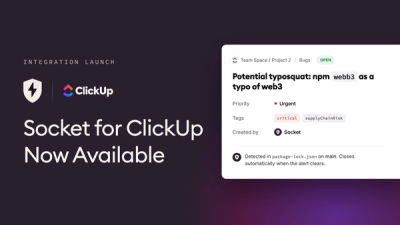
Socket for ClickUp Is Now Available
Create ClickUp tasks from Socket alerts, automate ticketing with custom rules, and keep alert and task status synchronized.
By Jeppe Hasseriis - Aug 26, 2026
stitch-design-cli
Advanced tools
Agent-first CLI for Google's official Stitch SDK.
This package is meant for the workflow where active MCP wiring is overkill, but a stable local command surface is still useful for agents and operators.
Google Stitch officially exposes:
@google/stitch-sdkWhat it does not currently expose is a standalone generic local CLI with:
This package fills that gap without leaving the official platform surface.
npm install -g stitch-design-cli
Or run it without installing:
npx -y stitch-design-cli doctor --json
Install the agent skill from the canonical nested skill path:
npx -y skills add -g danielgwilson/stitch-design-cli --skill stitch
The skill lives at skills/stitch/SKILL.md; the package does not ship a duplicate root SKILL.md.
The CLI supports both auth modes exposed by the official Stitch SDK:
For repeated use, save credentials locally. The API key path can prompt interactively:
stitch auth set
Pipe a key from stdin:
printf '%s' "$STITCH_API_KEY" | stitch auth set --stdin
Or use env directly:
export STITCH_API_KEY=...
stitch doctor --json
For OAuth, prefer env vars for ephemeral use so the access token does not appear in shell history or process arguments:
export STITCH_ACCESS_TOKEN=...
export GOOGLE_CLOUD_PROJECT=...
stitch doctor --json
For local OAuth config, use the CLI only in a private shell and avoid writing tokens into logs, docs, or chat.
If tool list works but project list fails with AUTH_FAILED, the configured credentials reached Stitch but were rejected for project access. In that case, rotate the API key or switch to OAuth.
Optional env/config knobs:
STITCH_API_KEYSTITCH_HOSTSTITCH_TIMEOUT_MSSTITCH_ACCESS_TOKENGOOGLE_CLOUD_PROJECTstitch auth status --json
stitch doctor --json
stitch tool list --json
stitch project list --json
stitch project create --title "Design Sandbox" --json
stitch project get <project-id> --json
stitch screen list --project-id <project-id> --json
stitch screen get --project-id <project-id> --screen-id <screen-id> --include-image --json
stitch screen get --project-id <project-id> --screen-id <screen-id-a> --screen-id <screen-id-b> --include-image --include-html --json
stitch screen generate --project-id <project-id> --prompt "A landing page for a healthcare startup" --device-type DESKTOP --include-image --json
stitch screen edit --project-id <project-id> --screen-id <screen-id> --prompt "Make the hero more editorial" --json
stitch screen variants --project-id <project-id> --screen-id <screen-id> --prompt "Explore three lighter brand directions" --variant-count 3 --creative-range EXPLORE --aspect COLOR_SCHEME --aspect LAYOUT --json
project get calls the official get_project tool directly.screen get can optionally include HTML and screenshot artifact URLs, and accepts repeated --screen-id flags for batch retrieval.screen edit and screen variants accept repeated --screen-id flags or comma-separated values.screen variants now returns explicit follow-up screen IDs plus a ready-to-run screen get command, which is useful when project inventory lags behind fresh variants.Stable machine-readable behavior is documented in docs/CONTRACT_V1.md.
.github/workflows/ci.yml.github/workflows/publish.ymlnpm run check:releasestitch-trusted-publishing-notes.mdFAQs
Agent-first CLI + skill for Google's official Stitch SDK
The npm package stitch-design-cli receives a total of 5 weekly downloads. As such, stitch-design-cli popularity was classified as not popular.
We found that stitch-design-cli demonstrated a healthy version release cadence and project activity because the last version was released less than a year ago. It has 1 open source maintainer collaborating on the project.
Product
Create ClickUp tasks from Socket alerts, automate ticketing with custom rules, and keep alert and task status synchronized.
Product
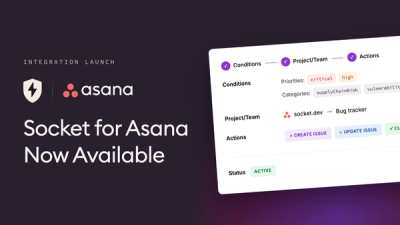
Create and manage Asana tasks directly from Socket alerts, with manual task creation, automated ticketing rules, and two-way sync.

Security News
Open VSX has removed three extension IDs from its malicious-extension list as the legitimate publishers they impersonated move to claim the names for themselves.