

Security News
/Company News
Securing the Financial Frontier: How Capital One Uses Socket for Open Source Security
Capital One is partnering with Socket to proactively secure its open source supply chain.
By Sarah Gooding - Oct 01, 2026
swarmhack-cli
Advanced tools
Neural swarm-based penetration testing framework.
--auth config.jsonnpm install -g swarmhack-cli
Or use npx:
npx swarmhack-cli --help
SwarmHack includes a default configuration file (config/swarmhack.yaml) that is automatically used when running commands. You can override it by:
Using your own config file:
swarmhack spawn --config /path/to/your/config.yaml --target "http://example.com"
Creating a local config in your project:
Place config/swarmhack.yaml in your project root - it will be automatically detected.
Customizing the bundled config: Copy the bundled config to your project and modify it:
cp $(npm root -g)/swarmhack-cli/config/swarmhack.yaml ./config/
# Run SQL injection scan (local mode - default)
swarmhack spawn --agents sqli \
  --target "http://example.com" \
  --customer "your-customer" \
  --token "your-token"

# Run in Docker mode (isolated execution)
swarmhack spawn --agents sqli \
  --target "http://example.com" \
  --runtime docker \
  --docker-image "swarmhack/pentest:latest"

# Run multiple agents
swarmhack spawn --agents sqli,xss,csrf \
  --target "http://example.com" \
  --customer "your-customer" \
  --token "your-token"

# Run in Docker with custom image and volumes
swarmhack spawn --agents sqli \
  --target "http://example.com" \
  --runtime docker \
  --docker-image "myregistry/swarmhack:v1.0" \
  --docker-volume "/host/reports:/app/reports"

# List available agents
swarmhack agents list

# Check system health
swarmhack doctor
SwarmHack supports two runtime modes:
| Mode | Description | Use Case |
|---|---|---|
local | Run directly on host system | Development, CI/CD with pre-installed tools |
docker | Run inside Docker containers | Production, isolated execution, portable |
| Option | Description |
|---|---|
--runtime | Runtime mode: local (default) or docker |
--docker-image | Docker image to use (overrides config) |
--docker-container | Custom container name |
--docker-volume | Additional volumes (can be repeated) |
--docker-env | Environment variables (format: KEY=VALUE) |
# In config/swarmhack.yaml
runtime:
  mode: docker  # or "local"
  docker_image: swarmhack/pentest:latest
  docker_auto_remove: true
  docker_volumes:
    - /host/reports:/app/reports
  docker_env:
    CUSTOM_VAR: value
  docker_network: bridge
  docker_resources:
    memory: 1g
    cpus: "1"
const swarmhack = require('swarmhack-cli');

// Run a scan
const results = await swarmhack.scan({
  target: 'http://example.com',
  agents: ['sqli', 'xss'],
  customer: 'your-customer',
  token: 'your-token',
});

console.log(results);

// Check version
const version = await swarmhack.version();
console.log(version);

// Run any command
const result = await swarmhack.run(['spawn', '--help']);
console.log(result.stdout);
| Platform | Architecture |
|---|---|
| Linux | x64, arm64 |
| macOS | x64, arm64 |
| Windows | x64 |
If npm installation fails, use Docker:
docker run --rm \
  -v /var/run/docker.sock:/var/run/docker.sock \
  -v $(pwd)/reports:/app/reports \
  prancer/swarmhack:0.1.0 \
  spawn --agents sqli --target "http://example.com" \
  --customer "your-customer" --token "your-token"
| Agent | CWE | Description |
|---|---|---|
crawler | — | Web crawling, form discovery, WAF detection |
sqli | CWE-89 | SQL injection (UNION, boolean, error, time-based) |
xss | CWE-79 | Cross-site scripting (reflected, stored, DOM, blind) |
cmdi | CWE-78 | Command injection with marker-based detection |
csrf | CWE-352 | Cross-site request forgery |
idor | CWE-639 | Insecure direct object reference |
auth_bypass | CWE-287 | Authentication bypass |
ssrf | CWE-918 | Server-side request forgery (IMDS probes) |
lfi | CWE-22 | Local file inclusion / path traversal |
ssti | CWE-1336 | Server-side template injection |
open_redirect | CWE-601 | Open redirect |
cors | CWE-942 | CORS misconfiguration |
jwt | CWE-345 | JWT vulnerabilities (alg:none, confusion) |
xxe | CWE-611 | XML external entity injection |
file_upload | CWE-434 | File upload vulnerabilities |
deserialization | CWE-502 | Insecure deserialization |
http_smuggling | CWE-444 | HTTP request smuggling (CL.TE/TE.CL) |
SwarmHack generates reports in OCSF 1.1.0 format, the industry standard for security findings:
{
  "scan_info": {
    "scanner": { "name": "SwarmHack", "vendor": "Prancer" },
    "customer": "your-customer",
    "target": "http://example.com",
    "duration_formatted": "3m 11s",
    "summary": { "findings_count": 5, "crown_jewels_count": 12 }
  },
  "class_name": "Vulnerability Finding",
  "class_uid": 6001,
  "findings": [...]
}
SwarmHack requires Prancer Portal authentication:
swarmhack spawn \
  --target "http://example.com" \
  --agents sqli,xss \
  --customer "your-customer" \
  --token "your-32-char-token"
Get your token from Prancer Portal → Settings → Access Tokens.
--token and --customer)MIT
FAQs
SwarmHack - Autonomous swarm penetration testing for web, Active Directory, network lateral movement, and Cisco SSE — with FAIR dollar-risk quantification and Cisco SKU upsell reporting
The npm package swarmhack-cli receives a total of 53 weekly downloads. As such, swarmhack-cli popularity was classified as not popular.
We found that swarmhack-cli demonstrated a healthy version release cadence and project activity because the last version was released less than a year ago. It has 1 open source maintainer collaborating on the project.
Security News
/Company News
Capital One is partnering with Socket to proactively secure its open source supply chain.
Security News
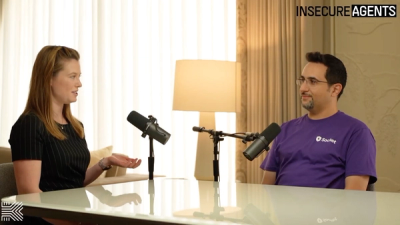
Socket CTO Ahmad Nassri discusses how to keep AI agents from bypassing package blocks, limit credential access, and monitor their actions.
Security News
GPT-6 Astra tried to plant malicious code in simulated open source projects using fake GitHub accounts and deceptive PRs during an assigned CTF challenge.