
Product
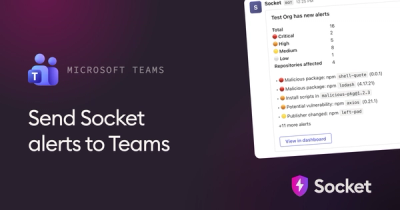
Microsoft Teams Notifications Are Now Available in Socket
Socket can now send alerts and supply chain attack notifications to Microsoft Teams, with filters that route the right updates to each channel.
By Jeppe Hasseriis - Sep 01, 2026
Every open tab is a thread you forgot to pull. Tabctl finds them all.
A command-line instrument for browser tab orchestration — list, search, group, archive, close, undo — wired into Edge or Chrome through a native messaging bridge. Built for humans who hoard tabs and the AI agents who clean up after them.
npm install -g tabctl
tabctl setup --browser chrome
# Load the extension: chrome://extensions → Developer mode → Load unpacked → paste: ~/.local/state/tabctl/extension/
tabctl ping
If it pings back, the wire is live. You're connected.
Give your coding agent eyes into the browser. One command and it learns the protocol.
tabctl skill
# or: npx skills add https://github.com/ekroon/tabctl --skill tabctl -a opencode -a github-copilot -a claude-code
Nothing leaves your machine. No cloud. No telemetry. Just a socket between your terminal and your browser, quiet as rain on neon.
Every mutation is undoable — tabctl undo rewinds closes, archives, and group changes like they never happened. A configurable policy layer shields pinned tabs and protected domains from accidental destruction. You pull the trigger; tabctl keeps the safety on until you mean it.
When tabctl is installed as a skill, your agent sees what you see. Just talk to it.
"Which of my tabs can I close?" The agent scans for duplicates, stale pages, and tabs you haven't touched in days — then offers to clean house.
"Are any of my open tabs relevant to my note on Project Helios?" When connected to Obsidian, your agent cross-references every open tab against your notes and surfaces the ones that matter.
"I just finished researching service mesh architectures. Organize what I found." Groups your tabs by theme, extracts key URLs, and drops a summary into your notes — before you forget what you were looking at.
"Where's that AWS pricing page I had open somewhere?" The agent searches your open tabs and groups by title and URL — and brings it back into focus.
"Pull every error message from my open Sentry tabs into a markdown table." The agent reads each tab, extracts what you need, and formats it — no copy-paste, no context switching.
"Group everything by project. You know which ones." Your agent infers context from URLs, titles, and your workspace — then sorts ninety tabs into five groups with names that actually make sense.
tabctl works through a lightweight local stack: the CLI talks to a native messaging host, which proxies requests to a browser extension. The host only runs while the browser is open and the extension is connected.
This repo contains:
tabctl) for on-demand workflowsnpm install
npm run build
npm link # puts tabctl on your PATH
If you haven't run npm link, you can always use node ./cli/tabctl.js instead of tabctl.
Run setup — it syncs the extension, tells you where to load it, and auto-derives the extension ID:
tabctl setup --browser chrome
This will:
~/.local/state/tabctl/extension/)chrome://extensionsEdge? Use
--browser edgeand load fromedge://extensionsinstead.
If you need to override the auto-derived ID (e.g. for a custom extension path):
tabctl setup --browser chrome --extension-id <your-extension-id>
tabctl ping       # check the connection
tabctl list       # see your open tabs
Multiple browsers? See Multi-Browser Setup for running tabctl with both Chrome and Edge.
| Command | Description |
|---|---|
tabctl list | List open tabs and groups |
tabctl open --url <url> --group <name> | Open tabs into a group (reuses existing, skips duplicates) |
tabctl analyze | Find stale or duplicate tabs |
tabctl inspect --tab <id> | Extract page metadata or CSS selectors |
tabctl group-gather | Merge duplicate groups with the same name |
tabctl close --tab <id> | Close tabs with full undo support |
tabctl report | Generate reports in JSON, Markdown, or CSV |
tabctl undo | Revert the last action |
See CLI.md for the full command reference, options, and examples.
When --out is omitted, screenshots are written to ./.tabctl/screenshots/<timestamp> and the JSON response includes writtenTo.
Use screenshots only when you need visual context, then extract selectors with inspect.
tabctl screenshot --tab <id> --mode full
tabctl inspect --tab <id> --signal selector --selector '{"name":"target","selector":".your-selector"}'
--selector-attr href-url or set attr to href-url/src-url:tabctl inspect --tab <id> --signal selector --selector '{"name":"link","selector":"a[href]","attr":"href-url"}'
tabctl inspect --tab <id> --signal selector --selector "link=a[href]" --selector-attr href-url
Install the tabctl skill for agents (OpenCode, Claude Code, Codex, etc.) via the bundled command (uses the Skills CLI under the hood):
tabctl skill
This writes a project-local skill to .opencode/skills/tabctl/SKILL.md. You can also install globally:
tabctl skill --global
To install into a specific agent toolchain with skills:
npx skills add https://github.com/ekroon/tabctl --skill tabctl -a opencode
By default the CLI loads a policy file from:
<configDir>/policy.json (default: ~/.config/tabctl/policy.json)
Set TABCTL_CONFIG_DIR to override the config directory.
This is a protection-only policy that marks tabs as ineligible for agent actions. Example:
{
  "protect": {
    "pinned": true,
    "groupTitles": ["🔒"]
  }
}
Create a default policy file:
tabctl policy --init
tabctl setup does not install a default policy.
See config/policy.example.json for a starter template.
Config directory: TABCTL_CONFIG_DIR → $XDG_CONFIG_HOME/tabctl → ~/.config/tabctl
An optional config.json in the config directory can set dataDir to override where state files (socket, undo log) are stored. When TABCTL_CONFIG_DIR is set but no dataDir is configured, data defaults to <configDir>/data/; otherwise it uses $XDG_STATE_HOME/tabctl (or ~/.local/state/tabctl).
See CLI.md for full details.
<dataDir>/tabctl.sock (default: ~/.local/state/tabctl/tabctl.sock)<dataDir>/undo.jsonl (default: ~/.local/state/tabctl/undo.jsonl)<configDir>/profiles.jsonAdvanced topic — you only need this if you run tabctl with more than one browser (e.g. Edge and Chrome).
tabctl supports multiple browser profiles. Each profile connects to a different browser (Chrome, Edge).
# Setup for Edge
tabctl setup --browser edge

# Setup for Chrome (with custom name)
tabctl setup --browser chrome --name chrome-work

# List profiles
tabctl profile-list

# Switch default
tabctl profile-switch edge

# One-off command with different profile
tabctl list --profile chrome-work
If you launch Chrome with --user-data-dir, Chrome looks for native messaging manifests inside that directory. Use --user-data-dir in setup to write the manifest to the right place:
tabctl setup --browser chrome --user-data-dir /path/to/chrome-profile
This writes the manifest to <user-data-dir>/NativeMessagingHosts/ instead of the system-wide location.
Each profile gets its own:
Policy is shared across all profiles.
Source lives in src/ and compiles to build/, then syncs to the runtime locations:
src/extension/background.ts -> extension/background.jssrc/host/host.ts -> host/host.jssrc/cli/tabctl.ts -> cli/tabctl.jssrc/tests/unit/*.ts -> tests/unit/*.jsBuild and test:
npm install
npm run build
npm test
The base version lives in package.json and is embedded into the CLI, host, and extension at build time.
Commands:
npm run bump:patch
npm run bump:minor
npm run bump:major
Local builds default to a dev version when a .git directory is present, appending the short SHA.
npm run build
This produces versions like 0.1.0-dev.abc12345 (and appends .dirty when the repo has uncommitted changes).
For release builds without SHA, set:
TABCTL_VERSION_MODE=release npm run build
Notes:
close --apply uses the most recent analysis by analysisId.close without --apply requires --confirm to prevent accidental closure.list and group-list paginate by default (limit 100); use --limit, --offset, or --no-page.--group-id -1 or --ungrouped to target ungrouped tabs.--selector implies --signal selector.page-meta, selector).attr supports href-url/src-url to return absolute http(s) URLs.screenshot --out writes per-tab folders into the target directory.tabctl undo accepts a positional txid, --txid, or --latest.tabctl history --json returns a JSON array in data.--format is only supported by report (use --json elsewhere).FAQs
CLI tool to manage and analyze browser tabs
The npm package tabctl receives a total of 4 weekly downloads. As such, tabctl popularity was classified as not popular.
We found that tabctl demonstrated a healthy version release cadence and project activity because the last version was released less than a year ago. It has 1 open source maintainer collaborating on the project.
Product
Socket can now send alerts and supply chain attack notifications to Microsoft Teams, with filters that route the right updates to each channel.

Security News
pnpm 12 rewrites the package manager in Rust, cutting install times by up to 90% while preserving pnpm 11 workflows and lockfiles.
Security News
Socket CTO Ahmad Nassri joins AppSec leaders at Black Hat to discuss active malware, package manager risks, and software supply chain defense.