
Product
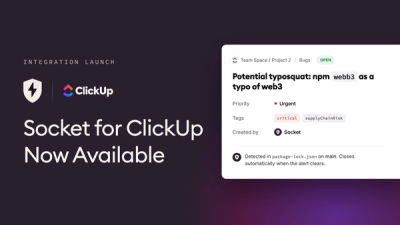
Socket for ClickUp Is Now Available
Create ClickUp tasks from Socket alerts, automate ticketing with custom rules, and keep alert and task status synchronized.
By Jeppe Hasseriis - Aug 26, 2026
teach-koa-setup-cli
Advanced tools





Generator based control flow goodness for nodejs and the browser, using promises, letting you write non-blocking code in a nice-ish way.
co@4.0.0 has been released, which now relies on promises.
It is a stepping stone towards ES7 async/await.
The primary API change is how co() is invoked.
Before, co returned a "thunk", which you then called with a callback and optional arguments.
Now, co() returns a promise.
co(function* () {
  var result = yield Promise.resolve(true);
  return result;
}).then(function (value) {
  console.log(value);
}, function (err) {
  console.error(err.stack);
});
If you want to convert a co-generator-function into a regular function that returns a promise,
you now use co.wrap(fn*).
var fn = co.wrap(function* (val) {
  return yield Promise.resolve(val);
});

fn(true).then(function (val) {

});
co@4+ requires a Promise implementation.
For versions of node < 0.11 and for many older browsers,
you should/must include your own Promise polyfill.
When using node 0.11.x or greater, you must use the --harmony-generators
flag or just --harmony to get access to generators.
When using node 0.10.x and lower or browsers without generator support, you must use gnode and/or regenerator.
io.js is supported out of the box, you can use co without flags or polyfills.
$ npm install co
Any library that returns promises work well with co.
View the wiki for more libraries.
var co = require('co');

co(function *(){
  // yield any promise
  var result = yield Promise.resolve(true);
}).catch(onerror);

co(function *(){
  // resolve multiple promises in parallel
  var a = Promise.resolve(1);
  var b = Promise.resolve(2);
  var c = Promise.resolve(3);
  var res = yield [a, b, c];
  console.log(res);
  // => [1, 2, 3]
}).catch(onerror);

// errors can be try/catched
co(function *(){
  try {
    yield Promise.reject(new Error('boom'));
  } catch (err) {
    console.error(err.message); // "boom"
 }
}).catch(onerror);

function onerror(err) {
  // log any uncaught errors
  // co will not throw any errors you do not handle!!!
  // HANDLE ALL YOUR ERRORS!!!
  console.error(err.stack);
}
The yieldable objects currently supported are:
Nested yieldable objects are supported, meaning you can nest
promises within objects within arrays, and so on!
Thunks are functions that only have a single argument, a callback.
Thunk support only remains for backwards compatibility and may
be removed in future versions of co.
yielding an array will resolve all the yieldables in parallel.
co(function* () {
  var res = yield [
    Promise.resolve(1),
    Promise.resolve(2),
    Promise.resolve(3),
  ];
  console.log(res); // => [1, 2, 3]
}).catch(onerror);
Just like arrays, objects resolve all yieldables in parallel.
co(function* () {
  var res = yield {
    1: Promise.resolve(1),
    2: Promise.resolve(2),
  };
  console.log(res); // => { 1: 1, 2: 2 }
}).catch(onerror);
Any generator or generator function you can pass into co
can be yielded as well. This should generally be avoided
as we should be moving towards spec-compliant Promises instead.
Returns a promise that resolves a generator, generator function, or any function that returns a generator.
co(function* () {
  return yield Promise.resolve(true);
}).then(function (val) {
  console.log(val);
}, function (err) {
  console.error(err.stack);
});
Convert a generator into a regular function that returns a Promise.
var fn = co.wrap(function* (val) {
  return yield Promise.resolve(val);
});

fn(true).then(function (val) {

});
MIT
FAQs
Unknown package
The npm package teach-koa-setup-cli receives a total of 7 weekly downloads. As such, teach-koa-setup-cli popularity was classified as not popular.
We found that teach-koa-setup-cli demonstrated a not healthy version release cadence and project activity because the last version was released a year ago. It has 1 open source maintainer collaborating on the project.
Product
Create ClickUp tasks from Socket alerts, automate ticketing with custom rules, and keep alert and task status synchronized.
Product
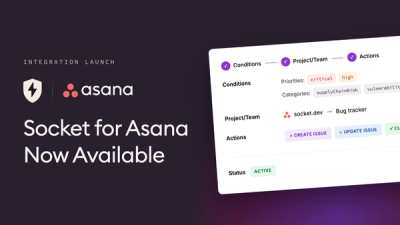
Create and manage Asana tasks directly from Socket alerts, with manual task creation, automated ticketing rules, and two-way sync.

Security News
Open VSX has removed three extension IDs from its malicious-extension list as the legitimate publishers they impersonated move to claim the names for themselves.