
Research
/Security News
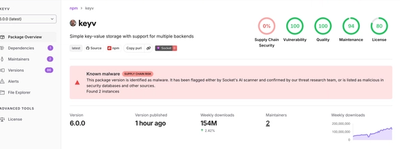
Popular npm Packages in the keyv and Cacheable Namespaces Compromised in Active Supply Chain Attack
Popular npm packages keyv and cacheable compromised.
By Socket Research Team - Aug 04, 2026
threejs-devtools-mcp
Advanced tools
Three.js MCP server — inspect and edit scenes, materials, shaders, lights in real time from any AI agent


MCP server for inspecting and modifying Three.js scenes in real time — 47 tools for objects, materials, shaders, textures, animations, performance, memory diagnostics, and code generation.
Zero changes to your project. Works with vanilla Three.js, React Three Fiber, and any framework.
claude mcp add threejs-devtools-mcp -- npx threejs-devtools-mcp
Add to claude_desktop_config.json:
{
  "mcpServers": {
    "threejs-devtools-mcp": {
      "command": "npx",
      "args": ["-y", "threejs-devtools-mcp"]
    }
  }
}
Add to .cursor/mcp.json in your project:
{
  "mcpServers": {
    "threejs-devtools-mcp": {
      "command": "npx",
      "args": ["-y", "threejs-devtools-mcp"]
    }
  }
}
Or use the HTTP transport — see Cursor setup guide.
Add to ~/.codeium/windsurf/mcp_config.json:
{
  "mcpServers": {
    "threejs-devtools-mcp": {
      "command": "npx",
      "args": ["-y", "threejs-devtools-mcp"]
    }
  }
}
Add to .vscode/mcp.json:
{
  "servers": {
    "threejs-devtools-mcp": {
      "command": "npx",
      "args": ["-y", "threejs-devtools-mcp"]
    }
  }
}
Start your Three.js dev server as usual (npm run dev). The MCP server auto-detects the port from package.json (Next.js → 3000, Vite → 5173, etc.) and opens a browser at localhost:9222 with the devtools bridge injected.
⚠️ Keep the browser tab open. The MCP server talks to your scene through a WebSocket bridge in the browser. Close the tab → connection drops → tools stop working. Reopen
localhost:9222to reconnect.
That's it. The AI sees the tools automatically and uses them when relevant. Just ask:
"use threejs-devtools-mcp to show me the scene tree"
"why is my model invisible? check with threejs-devtools"
"what materials are in the scene?"
"make the car red"
"find all transparent meshes"
"check for memory leaks"
"generate a React component from my model.glb"
Tip: Some AI clients (like Claude Code) pick up MCP tools automatically. Others (like Cursor) may need a nudge — mention
threejs-devtools-mcpin your first prompt, after that the AI will keep using it.
Inspect the scene:
> "what's in the scene?"

The AI calls scene_tree and gets:
  Scene
    player [Mesh]
    ground [Mesh]
    lights [Group]
      sunLight [DirectionalLight] intensity=2
      ambientLight [AmbientLight] intensity=0.5
    trees [Group]
      tree_0 [InstancedMesh] instances=42
Debug a problem:
> "why is my player invisible?"

The AI checks object_details("player"):
  - visible: true, position: [0, 0, 0] ✓
  - material: MeshStandardMaterial, opacity: 0 ← found it!

> "fix it"
  → set_material_property(name="player", property="opacity", value=1)
Search and diagnose:
> "find all invisible meshes"
  → find_objects(type="Mesh", visible=false)
  → 3 hidden meshes found: oldPlayer, debugCube, unusedTerrain

> "check for memory leaks"
  → dispose_check
  → 12 orphaned geometries, 4 orphaned textures (not in scene but tracked by renderer)

> "how much VRAM am I using?"
  → memory_stats
  → Textures: 48.2 MB (top: skybox 16MB, terrain 8MB), Geometry: 3.1 MB

> "what changed in the scene?"
  → scene_diff (first call: saves snapshot)
  → scene_diff (second call: shows 5 objects moved, 2 materials changed color)
Generate React components from 3D models:
> "convert my character.glb to a React component"
  → gltf_to_r3f(filePath="public/character.glb")
  → Generated CharacterModel.tsx with useGLTF, useAnimations (Walk, Run, Idle)
Modify the scene live:
> "make the ground blue"
  → set_material_property(name="ground", property="color", value="#4488ff")

> "move the sun higher"
  → set_object_transform(name="sunLight", position=[0, 20, 0])

> "show me render stats"
  → renderer_info → draw calls: 230, triangles: 3.4M, textures: 27
The scene tree uses object names to identify things. Unnamed objects show as (unnamed), making debugging harder. Always set .name:
// Three.js
const mesh = new THREE.Mesh(geometry, material);
mesh.name = "player";
// React Three Fiber
<mesh name="player" geometry={geometry} material={material} />
AI Agent ←stdio/http→ MCP Server ←proxy :9222→ Dev Server (:3000)
                           ↕ WebSocket
                      Bridge (auto-injected into HTML)
                           ↕
                      Three.js scene
The proxy injects a bridge script into <head> before Three.js loads. The bridge captures Scene and Renderer via the official __THREE_DEVTOOLS__ API and exposes 47 tools to the AI agent.
| Transport | Command | Use case |
|---|---|---|
| stdio (default) | npx threejs-devtools-mcp | Claude Code, Claude Desktop, Cursor, Windsurf, VS Code |
| Streamable HTTP | npx threejs-devtools-mcp-http | Cursor, Windsurf, or any HTTP MCP client |
The HTTP transport runs on http://localhost:9223/mcp (configurable via HTTP_PORT).
All settings are optional. The defaults work out of the box.
| Env Variable | Default | Description |
|---|---|---|
DEV_PORT | auto-detected | Dev server port to proxy |
BRIDGE_PORT | 9222 | Port the proxy listens on |
HTTP_PORT | 9223 | Streamable HTTP server port (http transport only) |
BROWSER | auto-open | Set to none to disable auto-opening the browser |
PUPPETEER | false | Set to true to launch via puppeteer instead of system browser |
HEADLESS | false | Set to true for headless Chrome (implies PUPPETEER=true, for CI) |
CHROME_PATH | auto-detected | Path to Chrome/Edge/Chromium executable |
Example — custom dev port, no browser auto-open:
{
  "mcpServers": {
    "threejs-devtools-mcp": {
      "command": "npx",
      "args": ["-y", "threejs-devtools-mcp"],
      "env": {
        "DEV_PORT": "5173",
        "BROWSER": "none"
      }
    }
  }
}
Example — headless mode for CI:
{
  "env": {
    "HEADLESS": "true",
    "DEV_PORT": "3000"
  }
}
MIT
FAQs
Three.js MCP server — inspect and edit scenes, materials, shaders, lights in real time from any AI agent
The npm package threejs-devtools-mcp receives a total of 130 weekly downloads. As such, threejs-devtools-mcp popularity was classified as not popular.
We found that threejs-devtools-mcp demonstrated a healthy version release cadence and project activity because the last version was released less than a year ago. It has 1 open source maintainer collaborating on the project.
Did you know?

Socket for GitHub automatically highlights issues in each pull request and monitors the health of all your open source dependencies. Discover the contents of your packages and block harmful activity before you install or update your dependencies.
Research
/Security News
Popular npm packages keyv and cacheable compromised.

Security News
A misconfiguration gave three Anthropic models internet access, and one, believing it was in a simulation, shipped a credential-stealing package to PyPI.

Security News
/Company News
Socket has joined the new Composer and Packagist sponsorship program as a launch sponsor, supporting the team that keeps PHP's package ecosystem secure.