
Research
/Security News
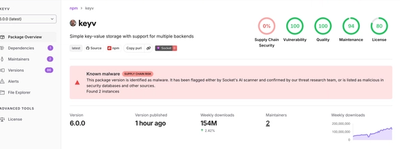
Popular npm Packages in the keyv and Cacheable Namespaces Compromised in Active Supply Chain Attack
Popular npm packages keyv and cacheable compromised.
By Socket Research Team - Aug 04, 2026
Local HTTP bridge and OpenClaw tool integration for TraeCN powered by CDP and DOM automation.
Local HTTP bridge, OpenClaw tool integration, and AI Skill module for TraeCN desktop automation. TRAECNclaw connects OpenClaw to TraeCN through a local REST gateway, Chrome DevTools Protocol (CDP), and DOM automation so tools can create chats, delegate tasks, switch modes, inspect readiness, and read TraeCN responses.
--remote-debugging-port=9222 or a quickstart port such as 9334integrations/openclaw-traecn-pluginnpm install
cp .env.example .env
Edit .env for your TraeCN installation path, CDP port, gateway token, and selectors if TraeCN DOM discovery reports custom values.
Important environment variables:
HOST and PORT: local gateway bind address. Use 127.0.0.1 for local-only operation.TRAECN_GATEWAY_TOKEN: optional bearer token required by protected endpoints.TRAECN_ALLOWED_ORIGINS: comma-separated browser origins allowed by CORS.TRAECN_REMOTE_DEBUGGING_PORT: TraeCN CDP port.TRAECN_QUICKSTART_PROFILE_MODE: existing by default so live automation reuses your logged-in Trae CN profile instead of a fresh isolated one. Set isolated only for disposable test profiles.TRAECN_TRAE_RECOVERY_NEW_INSTANCE: defaults to 0; keep it disabled to avoid opening a new unauthenticated Trae window during gateway recovery.TRAECN_AUTO_START_TRAE: defaults to 0; set it to 1 only when the gateway should relaunch Trae CN after CDP disappears.TRAECN_QUEUE_MAX_WAIT_MS: optional. Leave unset to let external TraeCN model queues wait indefinitely in the local gateway; set it only when you want a local queue timeout.TRAECN_ACTIVE_QUEUE_PERSISTENCE_PATH: optional path for persisted async queue state. By default macOS uses ~/Library/Application Support/TRAECNclaw/active-queue.json.TRAECN_ENABLE_MOCK_BRIDGE: set to 1 for local system tests without TraeCN.TRAECN_*_SELECTORS: optional DOM selector overrides discovered with npm run inspect:traecn.Start TraeCN and the gateway:
npm run quickstart
If CDP is unavailable because Trae CN is already running without a debug port, use the confirmed recovery command. It quits Trae CN, then starts it again with the existing logged-in profile and CDP enabled:
curl -s -X POST http://127.0.0.1:8788/api/trae/restart-debug \
  -H 'Content-Type: application/json' \
  -d '{"confirmationPhrase":"restart-trae-cn-with-debug-existing-profile"}'
For manual startup after quitting Trae CN yourself, start a debug-enabled instance against the existing logged-in profile:
TRAECN_QUICKSTART_PROFILE_MODE=existing npm run start:traecn -- --use-existing-profile
Start only the gateway:
npm run start:gateway
For unattended queue waiting on macOS, prefer the LaunchAgent wrapper. It persists background queued tasks and reloads them after the gateway restarts:
TRAECN_ENABLE_MOCK_BRIDGE=0 TRAECN_REMOTE_DEBUGGING_PORT=9334 TRAECN_QUICKSTART_PROFILE_MODE=existing npm run service:start
npm run service:status
Open the built-in chat UI at:
http://127.0.0.1:8788/
The chat UI includes a Dev Console panel for gateway status, CDP ownership, mode/readiness, queue/dialog state, recent task history, and OpenAPI contract checks.
Diagnose local setup:
npm run doctor
Verify TraeCN DOM selector compatibility when TraeCN is running with remote debugging enabled:
npm run inspect:verify
Export the OpenAPI document:
node scripts/export-openapi.js
const { preflight, runTask, reviewCode, switchModel } = require('traecnclaw');

const pf = await preflight({ command: 'delegate_async', params: { task: '分析项目代码' } });
await switchModel('glm');
const result = await runTask('分析项目代码');

const review = await reviewCode({
  instruction: '审查登录模块改动',
  files: ['src/auth.js'],
  diff: '...'
});
Any MCP-capable agent can connect through the bundled stdio server:
{
  "mcpServers": {
    "traecn": {
      "command": "node",
      "args": ["/absolute/path/to/TRAECNclaw/mcp-server.js"],
      "env": {
        "TRAECN_HOST": "127.0.0.1",
        "TRAECN_PORT": "8788",
        "TRAECN_GATEWAY_TOKEN": "",
        "TRAECN_MCP_TOOL_PROFILE": "public"
      }
    }
  }
}
The MCP server exposes a profile-scoped tool surface. By default,
TRAECN_MCP_TOOL_PROFILE=public lists the 20 common tools:
traecn_preflight, traecn_run_task, traecn_queue_task,
traecn_poll_task, traecn_review_code, settings/dialog/model controls,
traecn_run_unattended_workflow, and the generic traecn_run_command catalog
for full command coverage. Use TRAECN_MCP_TOOL_PROFILE=ops for recovery,
cleanup, Solo conversation control, and long-queue proof tools; use full for
compatibility audits and every explicit shortcut.
The portable cross-agent skill lives at .codex/skills/traecnclaw-mcp. It
teaches agents how to configure the stdio MCP server, choose the right profile,
and prefer MCP tools over GUI control.
Install the skill globally for Codex-compatible clients:
mkdir -p "${CODEX_HOME:-$HOME/.codex}/skills"
cp -R .codex/skills/traecnclaw-mcp "${CODEX_HOME:-$HOME/.codex}/skills/"
Build release artifacts for direct download:
npm run pack:skill
This writes dist/traecnclaw-mcp-skill.tgz, a zip artifact when zip is
available, and dist/traecnclaw-mcp-release.json with checksums. See
Distribution for catalog submission fields and
Launch Kit for public announcement copy.
TraeCNSkill uses a 5-layer architecture for selective loading and minimal context:
reviewCodeComplete skill documentation:
The OpenAPI schema is served at /openapi.json. Primary endpoints:
GET /api/capabilitiesGET /api/statusPOST /api/preflightPOST /api/sessionsPOST /api/sessions/{sessionId}/delegatePOST /api/delegatePOST /api/delegate-asyncPOST /api/confirm/planPOST /api/new-chatPOST /api/switch-modePOST /api/switch-modelGET /api/queue-statusGET /api/settings/readGET /api/settings/read-allPOST /api/settings/setPOST /api/settings/switch-tabPOST /api/settings/back-to-chatGET /openapi.jsonmcp-server.jsAgents should call GET /api/capabilities or MCP traecn_get_capabilities first for a compact command, endpoint, token strategy, model, settings, and confirmation catalog. Before side-effecting operations, call POST /api/preflight or MCP traecn_preflight once to combine status, current surface (setup vs workspace), readiness, queue, dialog, and optional command-plan state. For a dry confirmation-only check, call POST /api/confirm/plan or MCP traecn_plan_operation. Fetch /openapi.json only when full request/response schemas are needed.
For unattended local waiting on macOS, start the gateway as a LaunchAgent:
npm run service:start
npm run service:status
With delegate-async, use waitForQueue=true to keep tasks in the gateway's own
background queue while TraeCN is visibly queued, and add reviewRequired=true
when you want the result to pause for user review before any follow-up tasks run.
Add fallbackModels or autoModelFallback=true when the gateway should actively
probe alternate models while the task waits. The agent can then release its
context after receiving taskId; the local gateway persists the queue, refreshes
modelProbeResults, and sends webhook/OpenClaw notifications when the task
reaches review or completion.
For a single local process that waits quietly until completion, use MCP
traecn_wait_task, OpenClaw traecn_delegate, or the CLI. Add --detach when the wait should continue under a
local screen session after the calling agent releases context:
traecnclaw wait task_123 --poll-ms 30000 --timeout-ms 0 --log queue-evidence.jsonl --quiet -o json
traecnclaw wait task_123 --detach --log queue-evidence.jsonl
By default, external TraeCN model queues do not expire locally; set
maxQueueWaitMs (or queueMaxWaitMs) only when a caller explicitly wants a
queue timeout.
For the guarded GLM-5.2 acceptance proof, agents can use the same control flow through MCP/OpenClaw commands or the CLI:
traecnclaw proof status
traecnclaw proof start --marker TRAECN_GLM52_CLEAN_1
traecnclaw proof start --execute --detach --allow-quota-spend --marker TRAECN_GLM52_CLEAN_1
traecnclaw proof cancel --marker TRAECN_GLM52_CLEAN_1
proof status only reads local proof files and detached watcher state.
proof start is a dry-run unless --execute is passed, and new real TraeCN
submissions still require --allow-quota-spend; use the dry-run first to verify
cleanup, preflight readiness, evidence paths, and that no local task is active
before a quota-consuming TraeCN submission.
Use traecnclaw cleanup-queue --status --json, MCP
traecn_get_cleanup_watch_status, or OpenClaw traecn_cleanup_watch_status to
inspect the local queue-probe cleanup watcher without touching TraeCN. The
watcher is singleton-locked, so repeat detached starts return
alreadyRunning: true instead of creating extra background cleanup processes.
{
  "task": "审查当前项目并输出 findings-first 结果",
  "waitForQueue": true,
  "reviewRequired": true,
  "autoModelFallback": true,
  "modelProbeIntervalMs": 60000
}
npm run lint
npm test
npm run test:system
npm run test:uat
npm run test:live
npm run audit:prod
npm test runs unit and integration tests. test:system starts the gateway in mock mode and verifies the HTTP flow. test:uat verifies documentation, OpenAPI coverage, and the machine-readable acceptance audit required for release acceptance. npm run acceptance:audit prints the current requirement-by-requirement status; add -- --require-complete before declaring the full unattended TraeCN goal complete.
test:live runs safe real Trae CN/CDP smoke checks when a live remote-debugging endpoint is available; otherwise it reports SKIP and exits successfully. Use node scripts/live-uat.js --strict when a live desktop instance is required, --require-ready when the UI must be logged in and automation-ready, and --cleanup-queue-probes when accidental wait for Trae queue Solo chats should be stopped, deleted, and rechecked to matched: 0. --strict fails if those queue-probe chats remain. Add --delegate only when sending a real test prompt is acceptable. --delegate is readiness-gated and fails with diagnostics instead of sending a prompt to an unready UI.
npm run proof:long-queue is the guarded GLM-5.2 proof runner. It defaults to dry-run, verifies preflight readiness, refuses to start when queue-probe Solo chats or local tasks remain, and prints the exact evidence paths. Add -- --execute --detach --allow-quota-spend only when a real long-queue TraeCN submission is explicitly approved; execute mode automatically stops/deletes accidental queue-probe Solo chats and requires consecutive clean dry-runs before submitting. Tune that gate with -- --cleanup-stabilize-checks <n> --cleanup-stabilize-delay-ms <ms> --cleanup-max-attempts <n>. Re-running with the same marker resumes the existing task from the evidence log instead of submitting again; add -- --force-new only when an intentional new submission is acceptable. Use npm run proof:status, MCP traecn_get_long_queue_proof_status, OpenClaw traecn_long_queue_proof_status, CLI traecnclaw proof status, or npm run proof:cancel -- --marker <id> to inspect or stop detached proof runs without creating another TraeCN conversation.
Bind the gateway to 127.0.0.1, set TRAECN_GATEWAY_TOKEN before exposing protected endpoints to browser or tool clients, and configure TRAECN_ALLOWED_ORIGINS when using the chat UI from a browser origin other than the gateway. Set TRAECN_ENFORCE_OPERATION_CONFIRMATION=1 in production to require a matching confirmation plan ID for high-risk settings and dialog operations. Logs redact common sensitive keys such as tokens, passwords, secrets, credentials, and authorization values.
Before public distribution, make the repository or release artifact public,
verify the skill with quick_validate.py, run the maintained test suite, and
scan the current tree and git history for secrets. Public catalog submissions
should point to .codex/skills/traecnclaw-mcp for the skill and mcp-server.js
or traecnclaw-mcp for the server entrypoint.
Repository maintainers for firerlAGI/TRAECNclaw.
MIT
FAQs
Local HTTP bridge and OpenClaw tool integration for TraeCN powered by CDP and DOM automation.
The npm package traecnclaw receives a total of 37 weekly downloads. As such, traecnclaw popularity was classified as not popular.
We found that traecnclaw demonstrated a healthy version release cadence and project activity because the last version was released less than a year ago. It has 1 open source maintainer collaborating on the project.
Did you know?

Socket for GitHub automatically highlights issues in each pull request and monitors the health of all your open source dependencies. Discover the contents of your packages and block harmful activity before you install or update your dependencies.
Research
/Security News
Popular npm packages keyv and cacheable compromised.

Security News
A misconfiguration gave three Anthropic models internet access, and one, believing it was in a simulation, shipped a credential-stealing package to PyPI.

Security News
/Company News
Socket has joined the new Composer and Packagist sponsorship program as a launch sponsor, supporting the team that keeps PHP's package ecosystem secure.