TypeSea









TypeSea is a zero-runtime-dependency TypeScript runtime narrowing library
built around immutable guards, optimized Sea-of-Nodes validation plans,
runtime compilation, and AOT source generation.
Try It In Existing Code
For Zod 4 migration experiments, keep the schema shape and swap the import to
TypeSea's facade subpath. The facade is a best-effort compatibility layer over
TypeSea guards, not a clone of Zod's parser internals, so start with ordinary
object, string, number, enum, array, tuple, union, and modifier-heavy schemas.
import { z } from "zod";
import { z } from "typesea/v4";
const User = z.object({
id: z.string().uuid(),
email: z.string().email()
}).strict();
const user = User.parse(input);
TypeSea guards also expose Standard Schema V1, so ecosystem tools that accept
Standard Schema can receive the guard directly. Hono supports this through
@hono/standard-validator, and tRPC can consume Standard Schema validators or
the explicit TypeSea parser adapter.
import { sValidator } from "@hono/standard-validator";
import { compile, t, toTrpcParser } from "typesea";
const User = t.strictObject({
id: t.string.uuid(),
email: t.string.email()
});
app.post("/users", sValidator("json", User), (c) => {
const body = c.req.valid("json");
return c.json(body);
});
const FastUser = compile(User);
const userInput = toTrpcParser(FastUser);
publicProcedure.input(userInput).mutation(({ input }) => {
return createUser(input);
});
Benchmark Headline
Last clean committed local benchmark on 2026-07-06 KST:
npm run bench:record, median of 3 full runs, strict-object contract,
operations per second on one machine. The chart is generated from
bench/results/latest.json.
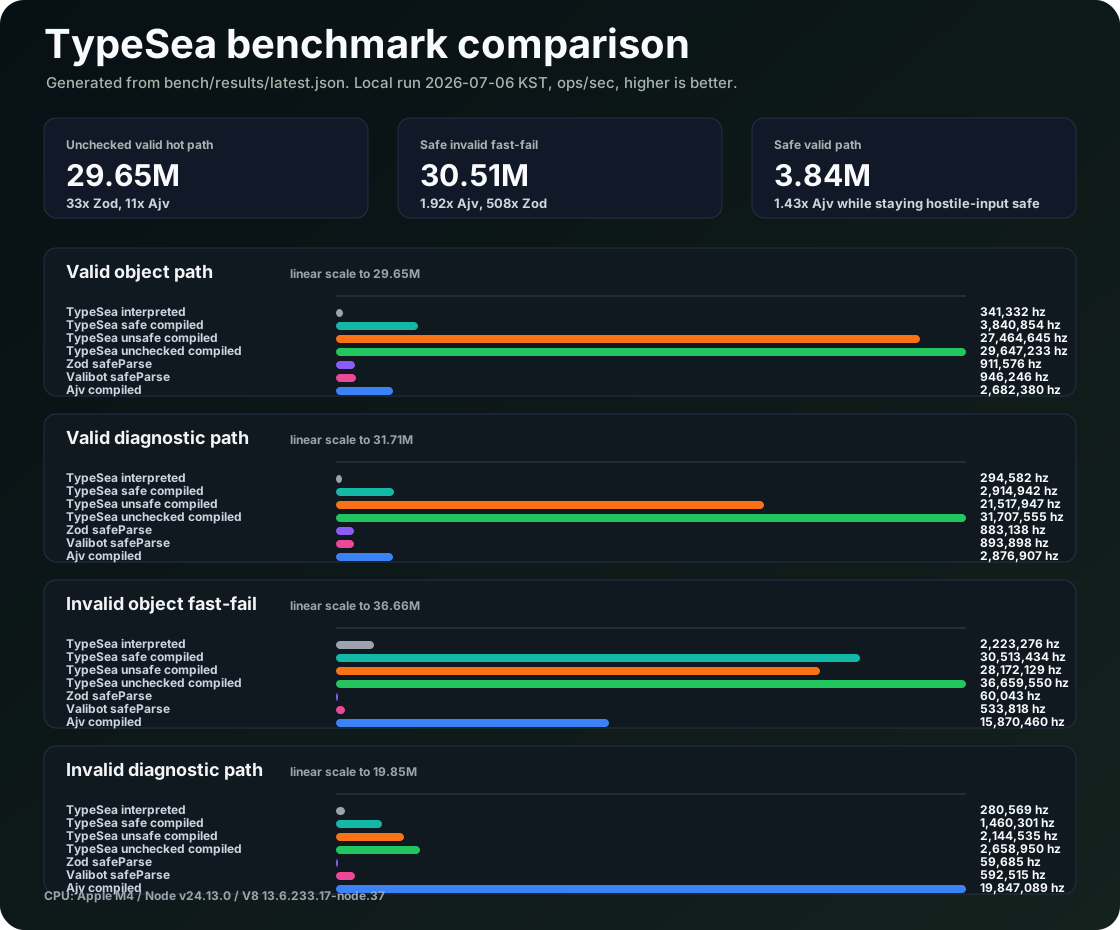
TypeSea safe compiled validators are already in Ajv's boolean hot-path class
while keeping descriptor-based hostile-input semantics. Unsafe and unchecked
FastMode are the bragging-rights path for trusted normalized data: direct field
loads, allocation-light strict-key loops, and V8-friendly monomorphic codegen.
Goal: not "probably valid", but provably parity-tested validation that
never executes user code, never throws on expected failures, and never leaks
mutable state across a public boundary.
[!IMPORTANT]
TypeSea is designed for hostile boundary data: property reads go through
descriptors so user getters never execute, __proto__/constructor keys
are handled with null-prototype lookups, user regexes are cloned and
lastIndex-reset, and cyclic inputs validate finitely. Expected failures
return frozen Result values — any, try, and catch are banned from the
entire codebase and enforced by policy gates.
[!WARNING]
unsafe and unchecked are not public-boundary modes. They are for
trusted, already-normalized data where the caller accepts getter execution,
prototype-backed values, and weaker strict-extra-key guarantees. Use the
default safe mode for external input.
Why
Many validation libraries fall short when you care about:
- untrusted input that fights back (getters with side effects, prototype
pollution keys, forged schema objects, revoked proxies)
- identical verdicts across execution strategies (runtime plan vs compiled
vs AOT-generated validators)
- diagnostics without exceptions (
Result values instead of throw)
- immutability at every public boundary
TypeSea focuses on:
- no user-code execution during validation
- runtime plan / compiled / AOT parity, enforced by a seeded generative fuzzer
- injection-safe code generation (side tables, never string interpolation)
- explicit presence semantics (
optional vs undefinedable)
Key Properties
- Zero dependencies: no runtime, peer, optional, or bundled dependencies —
mechanically enforced by package policy before every release.
- Three engines, one semantics:
is()/check() execute a cached validation
plan, compile() emits runtime predicates from optimized IR, and
emitAotModule() emits standalone validator source. The runtime plan owns
both the graph and a schema-specialized kernel, so the graph is the source of
truth for generated validators without forcing ordinary is() through a
per-node interpreter. Parity is fuzz-tested with sparse arrays, accessor
properties, symbol keys, and non-enumerable extras included.
- Frozen public surface: guards, schemas, graphs, diagnostics, and JSON
Schema payloads are frozen before they cross an API boundary.
- Lossless-only export: JSON Schema and AOT export succeed only when no
semantics would be lost; runtime-only contracts return typed issues instead
of silently weakening the schema.
[!NOTE]
TypeSea is ESM-only: the package ships "type": "module" with no
CommonJS build. Node.js >= 20.19 can also load it via require(esm)
through the default export condition.
Quick Start
import { compile, t, toJsonSchema, type Infer } from "typesea";
const User = t.strictObject({
id: t.string.uuid(),
email: t.string.email(),
age: t.number.int().nonnegative(),
role: t.enum(["admin", "user"]),
tags: t.array(t.string.min(1)).max(8)
});
type User = Infer<typeof User>;
if (User.is(input)) {
input.id;
}
const checked = User.check(input);
if (!checked.ok) {
console.log(checked.error);
}
const FastUser = compile(User, { name: "isUser" });
const schema = toJsonSchema(User);
const SharedName = t.string.min(1).meta({ id: "SharedName" });
const referencedSchema = toJsonSchema(t.object({
first: SharedName,
last: SharedName
}), { reused: "ref" });
Use is() for the allocation-light boolean path. Use check() when callers
need the full immutable diagnostic list, or checkFirst() when a hot rejection
path only needs one machine-readable issue. Use compile() or emitAotModule()
when a stable schema is hot enough to deserve generated validator code.
Compiled and AOT checkFirst() use a dedicated first-fault collector instead
of building the full issue list and slicing it afterward.
[!CAUTION]
compile() builds the validator with new Function, which throws under a
Content-Security-Policy that forbids unsafe-eval. In CSP-restricted
environments, generate validator source ahead of time with
emitAotModule() instead.
Mini Entry Point
Bundle-sensitive callers can import the functional subpath:
import * as mini from "typesea/mini";

const User = mini.object({
  id: mini.string().uuid(),
  name: mini.optional(
    mini.apply(mini.string(), mini.minLength(1), mini.maxLength(80))
  )
});

type User = mini.Infer<typeof User>;
typesea/mini follows the same direction as Zod Mini: top-level functional
builders, no broad t/z namespace import, and no runtime dependencies. It
keeps the same immutable guards, decoders, messages, JSON Schema helpers, and
Standard Schema helpers as the root package, but avoids exporting the root
compatibility barrel. Use mini.apply(schema, ...helpers) or call helpers
directly as mini.minLength(1)(mini.string()) when you want method-chain-free
schemas. The first helper set covers length, size, numeric bounds, string
patterns, and string decode transforms such as mini.trim().
SeaFlow Symbolic Fuzzer
import { fuzzCases } from "typesea/seaflow";
import { t } from "typesea";

const User = t.strictObject({
  id: t.string.uuid(),
  age: t.number.int().gte(0),
  role: t.enum(["admin", "user"])
});

for (const item of fuzzCases(User, { intensity: "high", maxYields: 64 })) {
  console.log(item.kind, item.valid, item.reason, item.value);
}
SeaFlow is the dev/test fuzzer for TypeSea schemas. It walks the immutable
schema tree backward and emits valid samples, invalid boundaries, and
security-oriented probes such as deleted required keys, strict-object extras,
__proto__ keys, accessor properties, sparse arrays, and union hybrids. It is
published as typesea/seaflow so production validators do not pay for the
fuzzer unless you import it. maxYields is a hard upper bound, not a target:
small schemas may naturally emit fewer cases when the solver has exhausted its
finite edge set.
Cold Starts, Fail-Fast, And Large Payloads
import {
  compileAsync,
  compileBoolean,
  compileCached,
  createTypeSeaVitePlugin,
  warmup
} from "typesea";

const FastUser = compileCached("user:v1", () => User, { name: "isUser" });
const BooleanUser = compileBoolean(User, { name: "isUserBoolean" });
const AsyncUsers = compileAsync(t.array(User), {
  name: "isUsersAsync",
  yieldEvery: 4096,
  yieldTimeout: 5
});

warmup([User, { key: "user:v1", guard: User, options: { name: "isUser" } }]);

export default createTypeSeaVitePlugin({
  entries: [{ id: "user:v1", guard: User, options: { name: "isUser" } }],
  transformCompileCached: true
});
Use compileCached() when schema construction might otherwise happen inside a
request handler. It caches by caller-owned semantic keys, so cold-start work can
be paid once and reused deliberately. compile() also caches repeated calls for
the same guard instance, and development builds warn when repeated codegen comes
from the same callsite.
Use warmup() in Lambda/serverless module scope or service startup to prefill
compiled guards before the first request. Use compileBoolean() when a hot
path only needs true/false; it emits no diagnostic collectors at all. Use
compileAsync() or isAsync() for huge arrays, records, maps, sets, or object
graphs that should yield back to the Node.js event loop between validation
chunks.
The zero-dependency AOT plugin helpers expose Rollup, Vite, and esbuild
compatible plugin objects. All three can rewrite static
compileCached("id", ...) calls into imports from typesea:aot/<id> when the
entry is listed in the plugin config. esbuild reads source through an optional
readFile hook or a dynamic node:fs/promises import inside setup().
Unsafe FastMode
const FastButLooseUser = compile(User, {
  name: "isUserFast",
  mode: "unsafe"
});

const FastTrustedShapeUser = compile(User, {
  name: "isUserTrustedShape",
  mode: "unchecked"
});
compile(..., { mode: "unsafe" }) and
emitAotModule(..., { mode: "unsafe" }) emit the V8-friendliest predicate
TypeSea can generate: required object fields are read with direct bracket
access, arrays and tuples use direct indexed loads, discriminants avoid
descriptor reads, and strict-object extras are checked with an allocation-free
for...in loop. This mode is for trusted, already-normalized data on extremely
hot paths.
The default is still mode: "safe". Unsafe mode may execute getters, may accept
prototype-backed values, and strict objects do not reject symbol or
non-enumerable extras. Use it only when the caller owns the object graph or has
already normalized input into plain data records. Unsafe generated predicates
may also embed escaped static property keys directly in source so V8 can use
ordinary property-load inline caches.
mode: "unchecked" goes one step further: it trusts the object shape and skips
strict extra-key loops entirely. That is the fastest path for already-owned DTOs,
but strict objects no longer reject any extra keys.
In unsafe and unchecked modes, successful compiled check() calls return a raw
{ ok: true, value } object instead of freezing the success result. Failed
diagnostics are still frozen. Safe mode keeps the fully frozen Result contract.
FastMode diagnostic collectors also use the same trusted direct-read object
shape where possible, so their issue codes can be less hostile-input-specific
than safe mode for missing/accessor-backed fields and sparse/accessor-backed
array or record slots. Discriminant diagnostics also read tags directly.
| Executes user getters | no | possible | possible |
| Accepts prototype-backed fields | no | possible | possible |
| Rejects enumerable extra keys in strict objects | yes | yes | no |
| Rejects symbol or non-enumerable strict extras | yes | no | no |
Freezes successful compiled check() result | yes | no | no |
| Intended input | hostile boundary data | trusted normalized records | trusted fixed-shape DTOs |
Use safe at every public boundary. Use unsafe only after data has already
been normalized into ordinary records. Use unchecked only when the caller owns
the shape and treats extra-key rejection as unnecessary work.
Presence Semantics
Object presence is explicit — two different wrappers express two different
contracts:
t.optional(inner) / guard.optional() | yes | no | key?: T |
t.exactOptional(inner) / z.exactOptional(inner) | yes | no, and standalone undefined fails | key?: T |
t.undefinedable(inner) / guard.undefinedable() | no | yes | key: T | undefined |
t.nullable(inner) / guard.nullable() | — | value may be null | key: T | null |
t.nullish(inner) / guard.nullish() | yes | value may be null | key?: T | null |
guard.nonoptional() / t.nonoptional(inner) | no | no | key: T |
[!NOTE]
Presence survives wrapper composition: t.nullable(t.optional(x)) still
means "the key may be absent" — inference and runtime agree on this under
exactOptionalPropertyTypes.
Use guard.unwrap() or t.unwrap(guard) to recover the inner guard from
optional, nullable, undefinedable, or array schemas. Metadata, message, brand,
readonly, and refinement shells are skipped so annotations do not hide the
payload schema.
Execution Model
TypeSea keeps the public schema tree for builder validation and diagnostics,
then lowers each schema identity into a cached validation plan. The plan owns an
optimized Sea-of-Nodes graph and a schema-specialized predicate kernel.
Guard.is() uses the kernel to avoid per-node interpreter dispatch, while
compile() and emitAotModule() emit predicates from the optimized graph.
check() first asks the same plan for the verdict; failed values then replay
the schema-aware diagnostic collector to produce issue paths and codes.
builder -> frozen schema -> lower -> Sea-of-Nodes IR -> optimize
optimize -> ValidationPlan { graph, schema kernel }
schema kernel -> Guard.is() / check() preflight
graph -> compile() predicate / emitAotModule() predicate / Guard.graph()
failed check() -> schema-aware diagnostic collector
[!IMPORTANT]
Generated validators keep user-controlled values out of source text:
literals, regexps, object keys, keysets, and dynamic schema fallbacks live in
side tables referenced by numeric index. Hostile property names cannot
escape into generated code — this is pinned by dedicated injection-audit
tests.
Performance Snapshot
Last clean local benchmark on 2026-07-06 KST, using npm run bench:record with the
median of 3 full Vitest runs over the benchmark strict-object contract. The raw
Vitest JSON is stored in
bench/results/raw.json,
and the stable summary used by the README graph is stored in
bench/results/latest.json.
These are operations per second on one machine, not release guarantees.
TypeSea interpreted is() | 341,332 |
TypeSea compiled safe is() | 3,840,854 |
TypeSea compiled unsafe is() | 27,464,645 |
TypeSea compiled unchecked is() | 29,647,233 |
Zod safeParse | 911,576 |
Valibot safeParse | 946,246 |
| Ajv compiled | 2,682,380 |
TypeSea interpreted check() | 294,582 |
TypeSea compiled safe check() | 2,914,942 |
TypeSea compiled unsafe check() | 21,517,947 |
TypeSea compiled unchecked check() | 31,707,555 |
Zod safeParse | 883,138 |
Valibot safeParse | 893,898 |
| Ajv compiled | 2,876,907 |
TypeSea interpreted is() | 2,223,276 |
TypeSea compiled safe is() | 30,513,434 |
TypeSea compiled unsafe is() | 28,172,129 |
TypeSea compiled unchecked is() | 36,659,550 |
Zod safeParse | 60,043 |
Valibot safeParse | 533,818 |
| Ajv compiled | 15,870,460 |
TypeSea interpreted check() | 280,569 |
TypeSea compiled safe check() | 1,460,301 |
TypeSea compiled unsafe check() | 2,144,535 |
TypeSea compiled unchecked check() | 2,658,950 |
Zod safeParse | 59,685 |
Valibot safeParse | 592,515 |
| Ajv compiled | 19,847,089 |
| TypeSea interpreted logical branch | 893,483 |
| TypeSea compiled safe logical branch | 3,671,517 |
| TypeSea compiled unsafe logical branch | 31,475,593 |
| TypeSea interpreted fallback record branch | 355,598 |
| TypeSea compiled safe fallback record branch | 4,724,044 |
| TypeSea compiled unsafe fallback record branch | 9,841,223 |
| TypeSea interpreted invalid branch | 520,812 |
| TypeSea compiled safe invalid branch | 11,309,279 |
| TypeSea compiled unsafe invalid branch | 14,484,249 |
The safe compiled path stays close to Ajv while retaining TypeSea hostile-input
semantics: descriptor-based property reads, symbol/non-enumerable strict-key
rejection, presence semantics, immutable diagnostics, and TypeScript guard
inference. Unsafe and unchecked compiled modes are faster because they
deliberately give up parts of that hostile-input contract.
API Reference
All public entry points are exported from the package root; builders are also
grouped under the t table. Zod migration code can import the compatibility
builder namespace as z; it keeps TypeSea builders while supporting nullary
calls such as z.null() and z.undefined(). Namespace imports can use
Zod-style type aliases:
import { z } from "typesea";
import * as typesea from "typesea";

const User = z.object({ id: z.string.uuid() });
type User = typesea.infer<typeof User>;
type SameUser = typesea.TypeOf<typeof User>;
When you want the migration import itself to look like Zod, use the dedicated
facade subpath:
import * as z from "typesea/zod";

const User = z.strictObject({
  id: z.string().uuid(),
  status: z.union([z.literal("active"), z.literal("disabled")])
});

type User = z.infer<typeof User>;
typesea/zod flattens the compatibility namespace into top-level exports for
import * as z code: primitive constructors such as z.string() and
z.unknown(), tuple-style z.union([a, b]), z.nativeEnum,
z.intersection, z.instanceof, z.keyof(object), and
z.catch(schema, fallback), plus z.exactOptional(schema) for optional object
keys that must reject explicit undefined values. It also provides a default
export for import z from "typesea/zod" migration code. It is still TypeSea
underneath, has no runtime dependency on Zod, and is covered by dev-only Zod
parity tests for representative migration-safe schemas, primitive-safe
coercion, decoder output wrappers, top-level wrappers, and object modifiers.
For 1.x, TypeSea owns these subpath names as stable migration facades, but they
remain best-effort compatibility layers over TypeSea's guard engine rather than
a promise to clone Zod's internal parser engine or every future upstream
feature. Missing Zod APIs should be treated as compatibility gaps, not as part
of TypeSea's core validation contract.
The facade also carries TypeSea's functional helper variants of common
top-level Zod checks and transforms, such as z.minLength(2)(z.string()),
z.trim()(z.string()), z.positive()(z.number()), z.mime("text/plain"),
and z.overwrite(mapper)(schema). The same helpers can be passed to
schema.check(...) when using Zod-style check-object code:
z.string().check(z.minLength(2)) and z.string().check(z.trim()).
Plain guards also expose Zod-style instance decode/encode aliases:
schema.decode(value), schema.safeDecode(value), schema.encode(value),
and schema.safeEncode(value).
Zod 4 package-alias migrations can keep their subpath imports:
import z from "typesea/v4";
import * as zm from "typesea/v4-mini";
import * as nestedMini from "typesea/v4/mini";
import { en, ko } from "typesea/locales";
import { $ZodString } from "typesea/v4/core";
import { en as enLocale } from "typesea/v4/locales/en";

const User = z.object({ id: z.uuid() });
const Name = zm.apply(zm.string(), zm.minLength(1));
const AliasName = nestedMini.apply(nestedMini.string(), nestedMini.maxLength(80));

void en;
void ko;
void $ZodString;
void enLocale;
void User;
void Name;
void AliasName;
typesea/v4/core matches the Zod 4.4.3 named export set for package-alias
migrations and common ecosystem probes. Its low-level $ZodCheck* and
underscore-prefixed exports are compatibility shims over TypeSea's public
builders, not a clone of Zod's internal parser engine.
Legacy zod/v3 imports can resolve typesea/v3. That entry point exposes the
v3 named export set over TypeSea's current guard engine; v3 parser internals
such as ParseStatus are lightweight compatibility shims for migration probes.
Zod-style primitive calls are accepted too: z.string(), z.number(),
z.boolean(), z.bigint(), z.symbol(), and z.date() return the matching
primitive guards. z.any() exists only as a migration alias for z.unknown();
it accepts every input but still infers unknown, never TypeScript any.
Legacy optional shortcuts z.ostring(), z.onumber(), z.oboolean(),
z.obigint(), z.osymbol(), and z.odate() return the matching optional
primitive guard for older Zod-style code.
Migration class names such as ZodString, ZodNumber, ZodObject,
ZodArray, ZodUnion, ZodEnum, and ZodPromise are exported as aliases for
the TypeSea implementation classes. Type-only migration helpers ZodTypeAny
and AnyZodObject are also available for code that names those Zod surfaces.
Format-specific class names such as ZodEmail, ZodURL, ZodUUID,
ZodNumberFormat, and ZodBigIntFormat are migration aliases for the matching
TypeSea guard family rather than separate runtime classes.
Decoder-facing names such as ZodEffects, ZodPipeline, ZodTransform,
ZodDefault, ZodCatch, ZodPrefault, and ZodCodec point at TypeSea's
decoder and codec classes.
Wrapper and container names such as ZodOptional, ZodNullable, ZodTuple,
ZodRecord, ZodMap, ZodIntersection, ZodDiscriminatedUnion,
ZodReadonly, and ZodBranded point at TypeSea's schema-backed guard class.
Guards also expose lazy Zod-style def, _def, and _zod metadata for
migration tools: typeName, type, shape, element, options,
innerType, keyType, and valueType are available where they make sense,
and ZodFirstPartyTypeKind is exported as the matching enum-like constant
table. Guards also expose direct Zod-style metadata probes such as
schema.type, literal.value, literal.values, record.keyType,
record.valueType, bigint.minValue, bigint.maxValue, date.minDate, and
date.maxDate. This facade is read-only and is not used by validation or
generated predicates.
Builders
| Scalar guards | t.unknown, t.never, t.string, t.number, t.int, t.int32, t.uint32, t.float32, t.float64, t.int64, t.uint64, t.nan, t.date, t.bigint, t.symbol, t.boolean, t.null, t.undefined, t.void |
| String checks | .min, .max, .length, .minLength, .maxLength, .nonempty, .regex, .startsWith, .endsWith, .includes, .uppercase, .lowercase, .uuid, .guid, .uuidv4, .uuidv6, .uuidv7, .hash, .email, .url, .httpUrl, .hostname, .e164, .emoji, .base64, .base64url, .hex, .jwt, .nanoid, .cuid, .cuid2, .xid, .ksuid, .mac, .cidrv4, .cidrv6, .isoDate, .isoDateTime, .isoTime, .isoDuration, .date, .datetime, .time, .duration, .ulid, .ipv4, .ipv6 |
| Top-level string formats | t.email, t.uuid, t.guid, t.uuidv4, t.uuidv6, t.uuidv7, t.url, t.httpUrl, t.hostname, t.e164, t.emoji, t.base64, t.base64url, t.hex, t.jwt, t.nanoid, t.cuid, t.cuid2, t.xid, t.ksuid, t.ulid, t.ipv4, t.ipv6, t.mac, t.cidrv4, t.cidrv6, t.isoDate, t.isoDateTime, t.isoTime, t.isoDuration, t.iso.date, t.iso.datetime, t.iso.time, t.iso.duration, t.hash, t.stringFormat |
| Regex presets | regexes, t.regexes, including email, html5Email, rfc5322Email, unicodeEmail, domain, uuid, guid, e164, nanoid, cuid, cuid2, xid, ksuid, ulid, ipv4, ipv6, cidrv4, cidrv6, mac, base64, base64url, hex, jwt |
| Number checks | .int, .int32, .uint32, .float32, .float64, .finite, .isFinite, .isInt, .safe, .gte, .lte, .min, .max, .minValue, .maxValue, .gt, .lt, .multipleOf, .step, .positive, .nonnegative, .negative, .nonpositive |
| BigInt checks | .int64, .uint64, .gte, .lte, .min, .max, .gt, .lt, .multipleOf, .step, .positive, .nonnegative, .negative, .nonpositive |
| Date checks | .min, .max |
| Literal and containers | t.literal(value), literal.value, t.literal([...]).values, t.enum, enum.options, enum.enum, enum.extract, enum.exclude, t.templateLiteral, t.array, array.element, t.tuple, tuple.items, t.tuple([head], rest), tuple.rest, t.record, t.partialRecord, t.looseRecord, t.map, t.set, t.file, t.json |
| Array checks | .min, .max, .length, .nonempty |
| Map checks | .min, .max, .size, .nonempty |
| Set checks | .min, .max, .size, .nonempty |
| File checks | .min, .max, .mime |
| Functional helpers | typesea/mini and typesea/zod: minLength, maxLength, length, regex, startsWith, endsWith, includes, uppercase, lowercase, trim, toLowerCase, toUpperCase, normalize, slugify, minSize, maxSize, size, mime, gt, gte, lt, lte, multipleOf, positive, negative, nonpositive, nonnegative, overwrite, clone |
| Objects | t.object, t.looseObject, t.strictObject, object.shape, extend, safeExtend, merge, pick, omit, t.keyof, keyofObject, partial, partial({ key: true }), deepPartial, required, required({ key: true }), strict, loose, passthrough, nonstrict, nonpassthrough, strip, catchall, atLeastOneKey, exactlyOneKey, oneOfKeys |
| Runtime object contracts | t.instanceOf, t.property(base, key, value), guard.property(key, value) |
| Function contracts | t.function, z.function().args(...).returns(...), functionBuilder, FunctionContract.parameters, FunctionContract.returnType, FunctionContract.implement, FunctionContract.implementAsync |
| Composition | t.union, union.options, t.xor, xor.options, t.discriminatedUnion, t.intersect, guard.intersect, guard.and |
| Presence wrappers | t.optional, guard.optional, t.exactOptional, z.exactOptional, guard.exactOptional, t.undefinedable, guard.undefinedable, t.nullable, guard.nullable, t.nullish, guard.nullish, guard.nonoptional, t.nonoptional |
| Wrapper introspection | guard.unwrap, t.unwrap, guard.apply |
| Output wrappers | guard.readonly, t.readonly |
| Dynamic contracts | t.lazy, t.custom, t.check, t.property(key, value), t.refine, guard.refine, t.superRefine, guard.superRefine, guard.with |
| Schema annotations | guard.metadata, guard.meta, guard.title, guard.describe, guard.example, guard.message, guard.register, t.metadata, t.meta, t.title, t.describe, t.example, t.message, t.registry, t.globalRegistry |
t.iso.date(), t.iso.datetime(), t.iso.time(), and t.iso.duration()
are Zod-compatible aliases for the existing top-level ISO format helpers.
t.looseObject(shape) is an explicit alias for TypeSea's default passthrough
object mode. loose() and nonstrict() switch an object guard to passthrough
mode; nonpassthrough() is a Zod migration alias for strict().
String date(), datetime(), time(), and duration() are fluent aliases for
the matching ISO methods. type, minLength, maxLength, minValue,
maxValue, isInt, isFinite, keyType, and valueType are Zod-style
readonly metadata properties. String and number guards expose Zod-style
format; bigint guards expose format, minValue, and maxValue; Date guards
expose minDate and maxDate.
String format helpers accept Zod-style options where the runtime grammar is
still a regular expression: uuid({ version }), email({ pattern }),
url({ protocol, hostname }), url({ normalize: true }),
iso.datetime({ offset, local, precision }), iso.time({ precision }),
mac({ delimiter }), and jwt({ alg }). URL normalization returns a decoder
because it changes the accepted output value.
guard.refine(predicate, params?) and t.refine(guard, predicate, params?)
support Zod-style refinement diagnostics. params may be omitted, a legacy
label string, or { error, path, abort, when }. error becomes the issue
message, path points at the relative failing field, and
when({ value, issues }) can opt into running the predicate even after the
inner diagnostic pass has reported unrelated issues. superRefine() also
accepts an omitted label and uses "refinement" as the internal expected label.
guard.with(({ value, issues }) => ...) accepts Zod-style callback checks; the
issue sink supports issues.push({ message, path, ...extra }) and ignores
Zod-specific extra fields after copying TypeSea's message and relative path.
t.check(callback) creates a reusable callback-check source for
guard.with(t.check(...)). TypeSea keeps guard.check(value) as the native
Result-returning validation method.
t.property(key, guard) is the Zod-style reusable property check source for
guard.with(...); it reads the public property so examples such as
t.string.with(t.property("length", t.number.gte(3))) work. For hostile-input
boundaries, keep using t.property(base, key, guard) or
base.property(key, guard), which require an own data property and do not invoke
user getters.
Use regexes or t.regexes for Zod-style reusable patterns such as
email({ pattern: regexes.html5Email }) and
url({ hostname: t.regexes.domain }).
t.record(key, value) follows Zod 4 exhaustive semantics for finite string
literal key domains. Numeric key schemas receive finite numeric object keys as
numbers, so t.record(t.number.int(), value) accepts keys like "0" or
"1.5" only when the numeric schema accepts the parsed number. Use
t.partialRecord(key, value) when enum/literal keys are optional.
The z compatibility namespace also exposes z.nativeEnum as an alias for
t.enum, z.intersection as an alias for t.intersect, z.instanceof as an
alias for t.instanceOf, and Zod-style tuple inputs for z.union([a, b]) and
z.xor([a, b]). z.discriminatedUnion("kind", [A, B]) accepts Zod-style case
arrays when each branch structurally requires a literal kind, including
string, number, boolean, null, or undefined literals.
Primitive constructor calls such as z.string() and z.number() are supported,
and z.any() is mapped to TypeSea's unknown semantics for migration safety.
Legacy optional shortcuts such as z.ostring() and z.onumber() are supported
for older Zod-style code.
Decoders
| Sync decoders | guard.decode, guard.safeDecode, guard.encode, guard.safeEncode, guard.transform, guard.overwrite, guard.pipe, guard.default, guard.prefault, guard.catch, t.decoder, t.decode, t.safeDecode, t.encode, t.safeEncode, t.encodeAsync, t.safeEncodeAsync, t.transform, t.success, t.preprocess, t.pipe, t.default, t.defaultValue, t.prefault, t.catch, t.codec, t.invertCodec, t.codecs, built-in codec helpers, t.stringbool, t.coerce, t.string.trim(), t.string.toLowerCase(), t.string.toUpperCase(), t.string.slugify(), t.string.normalize() |
| Async decoders | t.asyncDecoder, t.decodeAsync, t.safeDecodeAsync, t.asyncRefine, t.asyncTransform, t.asyncPipe, t.promise, guard.promise() |
Synchronous decoder and codec instances expose Zod-style parse, safeParse,
parseAsync, safeParseAsync, and spa methods for migration ergonomics.
Async decoder instances expose parseAsync, safeParseAsync, and spa.
The top-level t.decode, t.safeDecode, t.encode, t.safeEncode,
t.decodeAsync, t.safeDecodeAsync, t.encodeAsync, and t.safeEncodeAsync
helpers keep TypeSea's native Result contract. t.promise(source) is
async-only: it awaits native Promise inputs and validates the resolved value
through source. guard.promise() is the same async decoder surface in fluent
form.
t.success(source) and z.success(source) validate source and return a
decoder whose successful output is true, which helps migration code that
expects a parse-capable success marker rather than the original value.
Transform mappers receive a Zod-style context as their second argument.
context.issues.push({ message, path, ...extra }) or
context.addIssue({ message, path }) makes the decoder fail, and returning
z.NEVER aborts the mapper without widening the inferred output type.
t.coerce.string(), t.coerce.number(), t.coerce.bigint(), and
t.coerce.date() expose Zod-style fluent checks after coercion, so migration
code can write t.coerce.number().int().gte(0),
t.coerce.string().trim().min(1), or t.coerce.date().min(start) without a
separate pipe() call. t.coerce.boolean() follows JavaScript truthiness
semantics like Zod's Boolean(value) coercion. For Zod parity, coerce
decoders use JavaScript constructor coercion for objects too, which can execute
caller-owned valueOf, toString, or Symbol.toPrimitive hooks. Use ordinary
guards or explicit codecs at hostile-input boundaries when those hooks must not
run.
Built-in codec builders live under t.codecs: stringToNumber,
stringToInt, stringToBigInt, numberToBigInt, stringToDate,
isoDatetimeToDate, epochSecondsToDate, epochMillisToDate,
utf8ToBytes, bytesToUtf8, base64ToBytes, base64urlToBytes,
hexToBytes, jsonCodec, stringToURL, and stringToHttpURL.
Decoder and codec children can be placed directly inside object, array, tuple,
record, map, and set containers. If the container includes a one-way decoder,
the builder returns a decoder. If every transformed child is bidirectional, the
builder returns a codec that can encode the value back across the same boundary.
const Event = t.strictObject({
  name: t.string.min(1),
  at: t.stringToDate(),
  active: t.stringbool()
});

const decoded = Event.decode({
  name: "launch",
  at: "2026-07-06T00:00:00.000Z",
  active: "true"
});

const encoded = Event.encode({
  name: "launch",
  at: new Date("2026-07-06T00:00:00.000Z"),
  active: false
});

const Dates = t.array(t.stringToDate());
const decodedDates = Dates.decode(["2026-07-06T00:00:00.000Z"]);

const DateRecord = t.record(t.stringToDate());
const decodedRecord = DateRecord.decode({
  created: "2026-07-06T00:00:00.000Z"
});
Execution & Export
| Guard methods | guard.is(), guard.check(), guard.checkFirst(), guard.parse(), guard.safeParse(), guard.parseAsync(), guard.safeParseAsync(), guard.spa(), guard.isOptional(), guard.isNullable(), guard.description, guard.def, guard._def, guard._zod, guard.clone(), guard.with(), guard.graph(), guard.toJSONSchema() |
| Parse helpers | root / t / z / typesea/mini / typesea/zod: parse, safeParse, parseAsync, safeParseAsync, spa |
| Generated validators | compile, emitAotModule |
| JSON Schema | toJsonSchema, toJSONSchema, schemaRegistryToJsonSchema, guard.toJSONSchema, fromJsonSchema, fromJSONSchema, target, unrepresentable, cycles, uri, reused, metadata, override options |
| Standard Schema | guard["~standard"], decoder["~standard"], StandardSchemaV1, StandardSchemaV1InferInput, StandardSchemaV1InferOutput |
| Messages | formatIssue, formatIssues, formatError, prettifyError, treeifyError, treeifyIssues, flattenError, flattenIssues, toZodIssue, toZodIssues, toZodError, withMessages |
| Analysis | analyzeSchema |
| Registries | registry, globalRegistry, SchemaRegistry, SchemaRegistry.entries(), SchemaRegistry.clear(), isSchemaRegistryValue |
Key Rules And Annotations
const Contact = t.object({
  email: t.optional(t.string.email()),
  phone: t.optional(t.string.min(1))
})
  .oneOfKeys(["email", "phone"])
  .title("Contact")
  .describe("Exactly one reachable contact endpoint")
  .message("contact must include exactly one endpoint");

const report = analyzeSchema(Contact);
oneOfKeys() is an alias for exactlyOneKey(). Key-rule validators count
selected own data properties, so accessor-backed keys do not satisfy the rule in
safe mode. Metadata annotations flow into JSON Schema as title,
description, and examples; message() attaches a local issue message
without changing boolean validation.
object.shape exposes a frozen guard map for the declared fields.
ObjectGuard.keyof() and t.keyof(ObjectGuard) produce a literal-union guard
for the declared object keys. Empty object shapes produce never.
Registries attach tool-owned metadata to schema identity without wrapping the
guard or changing validation semantics. String id metadata is unique per
registry; adding a different schema with the same id throws immediately.
SchemaRegistry.clear() removes every live entry.
Every guard, decoder, and codec exposes a Standard Schema V1 ~standard
property with vendor: "typesea", version: 1, and validate(value). Use it
when framework tooling accepts Standard Schema contracts instead of
TypeSea-specific adapters.
Function contracts validate call boundaries without becoming IR schema nodes.
Use them where Zod users would reach for z.function():
const NameLength = t.function({
input: [t.string.trim().pipe(t.string.min(1))],
output: t.number.int().nonnegative()
});
const lengthOfName = NameLength.implement((name) => name.length);
lengthOfName(" Ada ");
Codebases migrating older Zod function wrappers can keep the chain syntax:
const LegacyNameLength = z.function()
.args(t.string.trim().pipe(t.string.min(1)))
.returns(t.number.int().nonnegative());
const legacyLengthOfName = LegacyNameLength.implement((name) => name.length);
LegacyNameLength.parameters();
LegacyNameLength.returnType();
Arguments are decoded before the implementation runs. If an output source is
present, the return value is decoded before being returned. Boundary failures
throw TypeSeaAssertionError with issue paths under the argument index or
"return".
const Docs = t.registry<{ title: string; order: number }>();

User.register(Docs, { title: "User", order: 1 });
t.globalRegistry.add(User, {
  id: "User",
  title: "User",
  description: "Application user payload"
});

const DocsJson = toJSONSchema(t.globalRegistry, {
  uri: (id) => `https://schemas.example/${id}.json`
});
Messages & Adapters
| Messages / i18n | formatIssue, formatIssues, formatError, prettifyError, treeifyError, treeifyIssues, flattenError, flattenIssues, toZodIssue, toZodIssues, toZodError, withMessages, defineMessages, config, locales, setErrorMap, getErrorMap, resetErrorMap |
| tRPC | toTrpcParser, toAsyncTrpcParser |
| Fastify | toFastifyRouteSchema, toFastifyValidatorCompiler |
| React Hook Form | toReactHookFormResolver |
parse, safeParse, parseAsync, safeParseAsync, spa, check,
checkFirst, and assert accept Zod-style { error } options for
call-specific diagnostic messages. The option runs only after validation fails,
so is() and successful hot paths keep message allocation out of the loop.
setErrorMap(mapper), getErrorMap(), and resetErrorMap() provide the
Zod-style process-wide fallback mapper; a per-call { error } option always
overrides the global mapper.
config({ customError }), config({ localeError }), and
config(locales.ko()) mirror Zod 4's global configuration shape on top of that
same mapper slot. The z namespace exposes the same helpers as
z.config(...) and z.locales.en()/ko().
reportInput: true can be passed to parse-like APIs when a migration needs
Zod-style issue input fields. TypeSea keeps this opt-in: by default it does
not publish user input in diagnostics, and when enabled it follows only own
data-property paths so getter-backed hostile inputs are not executed.
The z migration namespace mirrors these helpers too, so Zod-oriented code can
call z.treeifyError, z.flattenError, z.prettifyError, z.formatError,
z.toZodError, z.withMessages, z.defineMessages, z.config,
z.locales, and z.ZodIssueCode without changing import style.
spa() is an alias for safeParseAsync(). isOptional() and isNullable()
probe the schema by checking whether undefined or null is accepted.
Primitive builders can carry a base type message with the Zod-style callable
form, such as t.string({ error }) or t.number("message"). That message is
used only when the value has the wrong primitive type. Built-in checks can also
carry static messages at declaration time. String length checks, string
formats, regex checks, number and bigint formats/bounds, Date bounds, array lengths,
set sizes, and File size/MIME checks accept either a string shorthand or
{ error } / { message }. The message is stored in the schema, survives
interpreted, compiled, and AOT paths, and is copied only when that exact check
emits an issue.
const User = t.object({
  name: t.string({ error: "name must be text" }).min(1, "name is required"),
  age: t.number("age must be numeric").int("age must be an integer").gte(0, {
    error: "age must be non-negative"
  }),
  email: t.string.email({ error: "email is invalid" }),
  tags: t.array(t.string).nonempty({ message: "add at least one tag" }),
  uploaded: t.file().mime("text/plain", "plain text only")
});
Use check-level messages for stable contract text and message() for a wrapper
default. Use per-call { error } for locale- or request-specific rendering of
issues that do not already carry schema-level text.
toZodIssues(errorOrIssues, options) and toZodError(errorOrIssues, options)
project TypeSea diagnostics into Zod v4-style issue objects. Each projected
issue keeps the original TypeSea code as typeseaCode, while TypeSeaZodError
exposes name: "ZodError", a frozen issues array, and Zod-style
flatten() / format() instance methods for migration adapters.
When TypeSea can derive them without reading hostile input again, projected
issues also carry Zod-style detail fields such as minimum, maximum,
inclusive, exact, origin, divisor, and format. The same fields are
visible inside config({ customError }) callbacks.
Native TypeSeaAssertionError values returned by safeParse() expose the same
flatten() / format() methods, so migration code can format parse failures
without first converting them to TypeSeaZodError.
ZodIssueCode is exported as both a type and a frozen value object for code
that imports constants such as ZodIssueCode.invalid_type.
Adapters accept compiled guards too. Compile once at startup, then pass the
compiled guard into parser or validator-compiler adapters so framework hot paths
reuse the generated predicate.
const FastUser = compile(User);
const trpcParser = toTrpcParser(FastUser);
const fastifyCompiler = toFastifyValidatorCompiler(FastUser);
const UnsafeUser = compile(User, { mode: "unsafe" });
const internalParser = toTrpcParser(UnsafeUser);
[!TIP]
Match the inference alias to the source kind: Infer<> for guards,
InferDecoder<> for decoders, InferAsyncDecoder<> for async decoders.
Input<> and Output<> provide Zod-style aliases for guard, decoder, and
codec boundaries.
Applying Infer<> to a decoder resolves to never — if a downstream type
suddenly collapses, this is the first thing to check.
Edge Semantics
Deliberate, documented, and pinned by tests:
NaN, Infinity | rejected by t.number (finite numbers only); t.nan() and t.literal(NaN) match NaN |
| BigInt bounds | t.bigint accepts only JavaScript bigint values; bound checks use bigint arguments and never coerce numbers |
-0 vs 0 | literals match via Object.is; diagnostics format -0 distinctly |
| Getter-backed properties | never executed; treated as missing/invalid data |
__proto__, constructor keys | validated as plain own keys, no pollution |
| Sparse array holes | read as undefined without executing accessors |
| Strict object extras | rejected via Reflect.ownKeys — including symbol keys and non-enumerable properties |
catchall extras | unknown own keys are descriptor-read and validated by the catchall schema |
strip() | is() accepts extras; parse-like success outputs project to declared own data fields without mutating input |
readonly() | is() stays side-effect free; parse-like APIs freeze accepted object-like values after full validation succeeds |
unwrap() | optional, undefinedable, nullable, and array schemas expose their payload guard; non-wrapper schemas throw TypeError |
nonoptional() | removes optional/undefined acceptance while preserving nullable values |
t.date | accepts valid JavaScript Date objects; .min and .max compare epoch milliseconds without reading user-overridable Date methods |
t.map, t.set, t.instanceOf | runtime-only contracts; JSON Schema and AOT export reject them instead of weakening semantics |
t.file | validates JavaScript File objects; JSON Schema export emits OpenAPI-style binary string annotations |
property | validates own data properties only; getter-backed properties are rejected |
| Global-flag regexes | cloned at construction; lastIndex reset before every test |
| UUID | accepts RFC 9562 versions 1–8 plus the nil UUID |
| Cyclic input values | validate finitely via (value × schema) active-pair tracking |
| Nesting depth | capped at 256 recursive frames; deeper input fails instead of overflowing the stack |
Best Practices & Pitfalls
[!WARNING]
Recursive guards need an explicit type annotation. TypeScript cannot
infer a self-referential initializer (TS7022). Use t.lazy for general
recursion, or a Zod-style object getter when one object field points back:
interface ListNode {
  readonly value: string;
  readonly next?: ListNode;
}

const Node: Guard<ListNode> = t.lazy((): Guard<ListNode> =>
  t.object({ value: t.string, next: t.optional(Node) })
);

interface Category {
  readonly name: string;
  readonly subcategories: Category[];
  readonly parent?: Category;
}

const Category: Guard<Category> = t.object({
  name: t.string,
  get subcategories(): Guard<Category[]> {
    return t.array(Category);
  },
  get parent(): Guard<Category, "optional"> {
    return t.optional(Category);
  }
});
- Boundary data enters as
unknown. Do not pre-narrow with as — the
builder API is typed so that narrowing happens through validation.
- Recursive contracts go through
t.lazy or object shape getters. Shape
getters are schema-definition thunks; TypeSea still rejects getter-backed
properties on runtime input in safe mode.
- Choose the engine by schema lifetime. One-off schemas: runtime plan.
Stable hot schemas:
compile(). CSP environments or build-time generation:
emitAotModule().
- Shape object unions by required keys.
t.union(t.object({ and: ... }), t.object({ or: ... }), t.object({ path: ... })) lowers to presence dispatch
and skips impossible branches. Do not model an optional operator bag as many
near-identical union branches; use one object and superRefine for "at least
one operator exists".
- Decoder-aware containers are decode surfaces. An object, array, tuple,
record, map, or set that contains a decoder returns a decoder or codec instead
of a guard. Apply guard-specific methods such as
pick, extend, keyof,
min, or max before adding child decoders.
Verification
Every gate that CI runs is a local npm script:
npm run check
npm run check:consumer
npm run bench:compare
npm run bench:record
npm run bench:render
npm run bench -- --run
npm run pack:dry
npm run release:check
npm run release:publish
npm run release:check runs the same gate expected before publishing:
typecheck, lint, tests, build, docs smoke, dist policy, public API snapshot,
package contents, consumer install, benchmark smoke, and pack dry run.
CI executes it on Node 20.19, 22, and 24; releases publish with npm provenance.
Release path:
- Push a
vX.Y.Z tag or run the GitHub Release workflow with that tag.
- The release workflow verifies that the tag matches
package.json.
- The same release workflow runs
npm run release:check, then npm run release:publish, which expands to npm publish --provenance --access public --ignore-scripts.
- The workflow verifies npm registry visibility and then creates the GitHub Release.
Local publishing with NPM_TOKEN is reserved for manual recovery releases. It
must still run npm run release:check first, and it cannot attach GitHub OIDC
provenance.
[!NOTE]
Benchmark comparison packages (Zod, Valibot, Ajv) are dev dependencies only —
package policy rejects them from every runtime dependency field. The
benchmark suite reports both boolean-path and diagnostic-path
(check() vs safeParse) comparisons, so numbers stay apples-to-apples.
check:benchmarks also verifies the committed summary against release floors
for unchecked valid, safe invalid, safe valid, and presence-dispatch union
paths.
Documentation
Migration Notes
0.4.0 to 1.0.0
Existing schemas keep working. 1.0.0 marks the current public surface as a
stable baseline and adds SeaFlow through typesea/seaflow. SeaFlow is a
dev/test-only symbolic fuzzer: import it when you want schema-directed valid,
invalid, and hostile payloads, and leave it out of production validator bundles.
t.promise(inner) now follows Zod's promise-like semantics more closely:
decodeAsync(value) awaits the input and then validates the resolved value with
inner. Use an explicit custom async decoder if you need to reject non-Promise
inputs before resolution.
0.3.2 to 0.4.0
Existing schemas keep working. 0.4.0 adds public APIs such as superRefine,
compileCached, createCompileCache, warmup, compileBoolean, cooperative
async validation, zero-dependency Vite/Rollup/esbuild AOT plugin helpers, and
Zod migration facades. Compiled object unions are also faster when branches
have required keys, such as AST or query objects shaped by and, or, not,
or path fields.
0.3.1 to 0.3.2
No application code changes are required. 0.3.2 is a performance-regression
hardening patch: it adds benchmark floors, pins representative generated source
fingerprints, strengthens FastMode fuzz parity, and normalizes unions by
flattening nested unions, removing never, and absorbing unknown.
0.3.0 to 0.3.1
No application code changes are required. 0.3.1 is a release-hardening patch:
it tightens manual release tag handling, documents npm provenance expectations,
adds a security policy, and verifies that npm exposes the published version after
the GitHub publish workflow completes.
License
MIT License. See LICENSE.