
Product
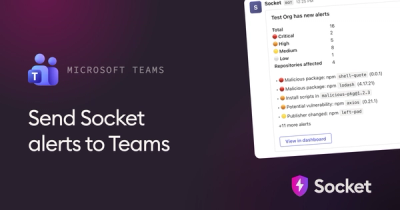
Microsoft Teams Notifications Are Now Available in Socket
Socket can now send alerts and supply chain attack notifications to Microsoft Teams, with filters that route the right updates to each channel.
By Jeppe Hasseriis - Sep 01, 2026
universal-agent-memory
Advanced tools
Universal AI agent memory system - CLAUDE.md templates, memory, worktrees for Claude Code, Factory.AI, VSCode, OpenCode, Forge


Every lesson learned. Every bug fixed. Every architectural decision.
Not just in one conversation—but forever.
UAM transforms stateless AI coding assistants into persistent, coordinated agents that learn from every interaction and never make the same mistake twice.
npm install -g universal-agent-memory && cd your-project && uam init
30 seconds to superhuman AI.
Every time you start a new conversation with your AI assistant:
You're constantly re-teaching the same lessons.
UAM fixes this by giving AI agents:
| Capability | What It Means |
|---|---|
| 4-Layer Memory | Recall decisions from months ago |
| Hierarchical Memory | Hot/warm/cold tiering with auto-promotion |
| 58 Optimizations | Battle-tested from Terminal-Bench 2.0 benchmarking |
| Pattern Router | Auto-selects optimal patterns per task |
| Adaptive Context | Selectively loads context based on task type and history |
| Multi-Agent Coordination | Multiple AIs work without conflicts |
| Worktree Isolation | No accidental commits to main |
| Code Field | 89% bug detection vs 39% baseline |
| Completion Gates | 3 mandatory checks before "done" |
| MCP Router | 98%+ token reduction for multi-tool contexts |
| Pre-execution Hooks | Domain-specific setup before agent runs |
# Agent A starts work
$ uam task create --title "Fix auth vulnerability" --type bug --priority 0
✓ Task created: UAM-042

$ uam worktree create fix-auth
✓ Created worktree: 001-fix-auth
  Branch: feature/001-fix-auth
  Path: .worktrees/001-fix-auth

$ uam agent announce --resource src/auth/* --intent editing
✓ Work announced. No conflicts detected.

# Meanwhile, Agent B checks for conflicts
$ uam agent overlaps --resource src/auth/*
⚠ Agent A (fix-auth) is editing src/auth/*
  Suggestion: Wait for completion or coordinate merge order

# Agent A completes and the lesson is preserved
$ uam memory store "CSRF vulnerability in auth: always validate origin header"
✓ Stored in memory (importance: 8/10)

# Weeks later, ANY agent on this project will know:
$ uam memory query "auth security"
  [2024-03-15] CSRF vulnerability in auth: always validate origin header
  [2024-02-28] Session tokens must be httpOnly and secure
  [2024-01-10] Auth refresh flow: use rotating tokens
The AI never forgets. The team never re-learns.
"After 3 months of using UAM, my Claude instance knows more about our architecture than most junior devs. It remembers that we chose Redux over MobX because of time-travel debugging, that our API uses snake_case because of the Python backend, that the auth flow was refactored twice. It's like pair programming with someone who has perfect recall."
"We run 5 agents in parallel on different features. Before UAM, we had merge conflicts daily. Now? Zero. The agents announce their work, check for overlaps, and coordinate merge order automatically. It's like they're a team."
"UAM's deploy batcher changed everything. Instead of 15 CI runs from rapid commits, we get 1-2. Same work, fraction of the cost. The commit squashing alone paid for the setup time."
Your AI's context is NOT limited to the conversation.
Memory persists with the project in SQLite databases that travel with the code:
agents/data/memory/
├── short_term.db                # L1/L2: Recent actions + session memories (SQLite)
├── long_term_prepopulated.json  # L3: Prepopulated learnings for search
└── historical_context.db        # Adaptive context + semantic cache (SQLite/WAL)
This means:
The AI queries memory before every task - it never starts from zero.
Tasks automatically route to specialized expert droids:
| Task Type | Routed To | Result |
|---|---|---|
| TypeScript/JS | typescript-node-expert | Proper typing, async patterns |
| Security review | security-auditor | OWASP checks, secrets detection |
| Performance | performance-optimizer | Algorithm analysis, caching |
| Documentation | documentation-expert | Complete, accurate docs |
| Code quality | code-quality-guardian | SOLID, complexity checks |
Missing an expert? The AI generates one:
uam droids add rust-expert --capabilities "ownership,lifetimes,async" --triggers "*.rs"
58 optimizations in v2.7.0 from Terminal-Bench 2.0 analysis.
Before ANY task, UAM's Pattern Router auto-selects which patterns apply:
=== PATTERN ROUTER ===
Task: Implement user authentication
Classification: file-creation
PATTERNS: P12:[Y] P17:[Y] P20:[N] P11:[N] P35:[N]
ACTIVE: P3, P12, P17
BLOCKING: [none]
VERIFIER: [read tests first]
=== END ===
Key Patterns:
| Pattern | Name | Impact |
|---|---|---|
| P12 | Output Existence Verification | Fixes 37% of agent failures |
| P17 | Constraint Extraction | Catches "exactly/only/single" requirements |
| P3 | Pre-execution State Protection | Backups before destructive actions |
| P20 | Adversarial Thinking | Attack mindset for security bypass tasks |
| P35 | Decoder-First Analysis | Read decoder BEFORE writing encoder |
| P11 | Pre-Computed Solutions | Use libraries (Stockfish, scipy) not custom code |
Pattern Categories:
Optimization Categories (#40-#58):
Strengths (100% pass rate in category):
| Category | Why It Works |
|---|---|
| ML/Data Processing | Clear data transformation, pandas/numpy operations |
| Graphics/Rendering | Path tracing, POV-Ray - well-defined algorithms |
| Security Tasks | Hash cracking, password recovery - tools available |
| Formal Verification | Coq proofs - step-by-step tactics |
Weaknesses (Common failure modes):
| Failure Mode | Fix |
|---|---|
| "File not created" (37%) | P12 - Verify outputs exist before completing |
| Missed constraints | P17 - Extract "exactly/only/single" keywords |
| First action destroys state | P3 - Backup before agent runs |
| Impossible tasks attempted | P5/P23 - Detect and refuse immediately |
| Complex toolchain setup | Pre-execution hooks for dependencies |
Near-Misses (High-value improvements):
| Task | Tests | Fix Needed |
|---|---|---|
| adaptive-rejection-sampler | 8/9 (89%) | Numerical edge case |
| headless-terminal | 6/7 (86%) | Service startup timing |
| db-wal-recovery | 5/7 (71%) | WAL parsing edge case |
Tasks That Will Never Pass (Without External Tools):
gpt2-codegolf - Requires pre-computed weights (500MB → 5KB impossible)chess-best-move - Requires vision/image parsingbreak-filter-js-from-html - Requires pre-computed XSS bypass patternsThree gates must pass before the AI reports "done":
| Gate | Check | If Fails |
|---|---|---|
| Gate 1 | All output files exist | CREATE immediately |
| Gate 2 | All constraints satisfied | FIX violations |
| Gate 3 | All tests pass | ITERATE until 100% |
# Gate 1: Verify outputs
ls -la /expected/output.json /expected/result.txt
# If missing → CREATE NOW, don't explain

# Gate 2: Check constraints
# Printed checklist with ☐/☑ for each requirement

# Gate 3: Run tests
npm test  # Iterate on failures until 100%
Based on context-field research, UAM includes a 4-line prompt that dramatically improves code quality:
Do not write code before stating assumptions.
Do not claim correctness you haven't verified.
Do not handle only the happy path.
Under what conditions does this work?
Results from 72 tests:
Every code generation task applies Code Field automatically.
The AI never commits directly to main.
All changes use worktrees:
# AI automatically does this for every change
uam worktree create my-feature
# → Creates .worktrees/001-my-feature/
# → Creates branch feature/001-my-feature
# → Works in isolation

uam worktree pr 001
# → Pushes, creates PR, triggers reviews

uam worktree cleanup 001
# → Removes worktree after merge
Work isn't "done" until it's deployed and verified:
MERGE → DEPLOY → MONITOR → FIX (repeat until 100%)
The AI follows this loop automatically:
The AI stores learnings after every completed task for future sessions.
npm install -g universal-agent-memory
# Desktop (includes Docker for semantic search)
bash <(curl -fsSL https://raw.githubusercontent.com/DammianMiller/universal-agent-memory/main/scripts/install-desktop.sh)

# Web browsers (claude.ai, factory.ai)
bash <(curl -fsSL https://raw.githubusercontent.com/DammianMiller/universal-agent-memory/main/scripts/install-web.sh)
| Command | Description |
|---|---|
uam init | Initialize/update UAM (auto-merges, never loses data) |
uam generate | Regenerate CLAUDE.md from project analysis |
uam update | Update templates while preserving customizations |
uam analyze | Analyze project structure and generate metadata |
| Command | Description |
|---|---|
uam memory status | Check memory system status |
uam memory query <search> | Search memories |
uam memory store <content> | Store a learning |
uam memory start | Start Qdrant for semantic search |
uam memory prepopulate | Populate from docs and git history |
| Command | Description |
|---|---|
uam task create | Create tracked task |
uam task list | List all tasks |
uam task claim <id> | Claim task (announces to other agents) |
uam task release <id> | Complete task |
uam task ready | List tasks ready to work on |
uam task stats | Show task statistics |
| Command | Description |
|---|---|
uam worktree create <name> | Create isolated branch |
uam worktree pr <id> | Create PR from worktree |
uam worktree cleanup <id> | Remove worktree |
uam worktree list | List all worktrees |
| Command | Description |
|---|---|
uam droids list | List available expert droids |
uam droids add <name> | Create new expert droid |
uam droids import <path> | Import droids from another platform |
| Command | Description |
|---|---|
uam agent status | View active agents |
uam agent overlaps | Check for file conflicts |
uam agent announce | Announce intent to work on a resource |
uam coord status | Coordination overview |
| Command | Description |
|---|---|
uam deploy queue | Queue a deploy action for batching |
uam deploy batch | Create a batch from pending actions |
uam deploy execute | Execute a deploy batch |
uam deploy flush | Flush all pending deploys |
| Command | Description |
|---|---|
uam model status | Show model router status |
uam model list | List available models |
uam model fingerprint | Show model performance fingerprints |
| Command | Description |
|---|---|
uam mcp-router start | Start hierarchical MCP router |
uam mcp-router stats | Show router statistics and token savings |
uam mcp-router discover | Discover tools matching a query |
uam mcp-router list | List configured MCP servers |
Install & Init: npm i -g universal-agent-memory && uam init
CLAUDE.md Generated: Auto-populated with project structure, commands, patterns, droids, and memory system instructions
AI Reads CLAUDE.md: Follows the embedded workflows automatically
Every Task:
Close-Out: Merge → Deploy → Monitor → Fix loop until 100%
┌─────────────────────────────────────────────────────────────────┐
│  L1: WORKING      │ Recent actions       │ 50 max  │ SQLite    │
│  L2: SESSION      │ Current session      │ Per run │ SQLite    │
│  L3: SEMANTIC     │ Long-term learnings  │ Qdrant  │ Vectors   │
│  L4: KNOWLEDGE    │ Entity relationships │ SQLite  │ Graph     │
└─────────────────────────────────────────────────────────────────┘
On top of the 4-layer system, UAM implements hierarchical memory management:
HOT   (10 entries)  → In-context, always included   → <1ms access
WARM  (50 entries)  → Cached, promoted on access     → <5ms access
COLD  (500 entries) → Archived, semantic search only  → ~50ms access
importance * (0.95 ^ days_since_access)hierarchical_memory tableThe memory system selectively loads context based on task classification:
recordTaskFeedback() captures success/failure to improve future runsData is never deleted. Memory databases persist with the project.
Update with uam init or uam generate always merges - nothing is lost.
Configuration in .uam.json:
{
  "project": {
    "name": "my-project",
    "defaultBranch": "main"
  },
  "memory": {
    "shortTerm": { "enabled": true, "path": "./agents/data/memory/short_term.db" },
    "longTerm": { "enabled": true, "provider": "qdrant" }
  },
  "worktrees": {
    "enabled": true,
    "directory": ".worktrees"
  },
  "template": {
    "sections": {
      "codeField": true
    }
  }
}
| Platform | Context File | Works With |
|---|---|---|
| Claude Code | CLAUDE.md | Desktop app |
| Factory.AI | CLAUDE.md | Desktop/web |
| claude.ai | CLAUDE.md | Web browser |
| VSCode | CLAUDE.md | Extensions |
| Droid | Specialization | When Used |
|---|---|---|
code-quality-guardian | SOLID, complexity, naming | Before every PR |
security-auditor | OWASP, secrets, injection (enhanced with 150+ security sources) | Before every PR |
performance-optimizer | Algorithms, memory, caching | On request |
documentation-expert | JSDoc, README, accuracy | On request |
debug-expert | Dependency conflicts, runtime errors, SWE-bench debugging | Error handling |
sysadmin-expert | Kernel, QEMU, networking, DNS, systemd | Infrastructure tasks |
ml-training-expert | Model training, MTEB, RL, datasets | ML tasks |
terminal-bench-optimizer | Task routing, time budgets, strategy orchestration | Benchmarking |
| Skill | Purpose | Trigger |
|---|---|---|
balls-mode | Decomposed reasoning with confidence scoring | Complex decisions, debugging |
cli-design-expert | CLI/TUI design patterns, UX, help systems | Building CLI tools |
typescript-node-expert | TypeScript best practices, strict typing | TypeScript projects |
terminal-bench-strategies | Proven strategies for Terminal-Bench tasks | Benchmark tasks |
unreal-engine-developer | UE5, Blueprints, C++, Python scripting | Game development |
sec-context-review | Security context review patterns | Security analysis |
Q: Do I need to manage memory manually? A: No. The AI queries and stores memory automatically per CLAUDE.md instructions.
Q: What if I don't have Docker? A: UAM works without Docker. You lose semantic search but SQLite memory still works.
Q: Can multiple AI agents work on the same project? A: Yes. UAM includes coordination protocols to prevent merge conflicts.
Q: How do I update without losing my customizations?
A: Run uam init or uam generate. Updates always merge - nothing is lost.
Q: What's Code Field? A: A prompt technique that makes AI state assumptions before coding. Based on context-field research.
Want to understand how UAM works under the hood?
| Document | Description |
|---|---|
| UAM Complete Analysis | Full system architecture, all features |
| Adaptive UAM Design | Hybrid adaptive context selector design |
| Multi-Model Architecture | Model routing and fingerprints |
| MCP Router Setup | Hierarchical MCP router for token reduction |
| Document | Description |
|---|---|
| Terminal-Bench Learnings | Universal agent patterns discovered |
| Behavioral Patterns | What works vs what doesn't analysis |
| Failing Tasks Solution Plan | Detailed fix strategies for each failure mode |
| Benchmark Results | All Terminal-Bench 2.0 run results |
| Benchmark Evolution | How benchmark performance evolved |
| Domain Strategy Guides | Task-specific strategies |
| Document | Description |
|---|---|
| UAM Performance Analysis | Performance metrics and analysis |
| Optimization Options | Available optimization strategies |
| V110 Pattern Analysis | Pattern effectiveness analysis |
UAM v2.7.0 includes 58 optimizations. Recent additions:
Coming soon:
Star the repo to follow updates. Open an issue to request features.
Code Field prompts based on research from NeoVertex1/context-field.
MIT
Documentation · Issues · npm
Built for developers who want AI that learns.
FAQs
Autonomous AI agent memory system with CLAUDE.md protocol enforcement
The npm package universal-agent-memory receives a total of 13 weekly downloads. As such, universal-agent-memory popularity was classified as not popular.
We found that universal-agent-memory demonstrated a healthy version release cadence and project activity because the last version was released less than a year ago. It has 1 open source maintainer collaborating on the project.
Product
Socket can now send alerts and supply chain attack notifications to Microsoft Teams, with filters that route the right updates to each channel.

Security News
pnpm 12 rewrites the package manager in Rust, cutting install times by up to 90% while preserving pnpm 11 workflows and lockfiles.
Security News
Socket CTO Ahmad Nassri joins AppSec leaders at Black Hat to discuss active malware, package manager risks, and software supply chain defense.