
Research
/Security News
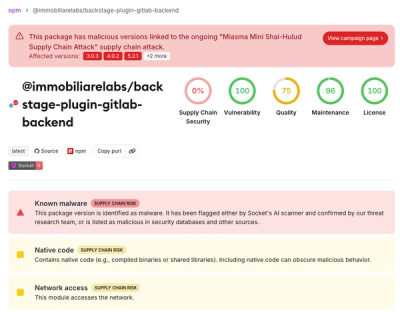
Miasma Mini Shai-Hulud Hits ImmobiliareLabs npm Packages
Miasma Mini Shai-Hulud hits @immobiliarelabs Backstage plugins, targeting GitLab and LDAP auth packages on npm.
By Socket Research Team - Jun 26, 2026



Node.js loader with a Rollup-like interface.
unloader is a Node.js loader framework. Similar to Rollup as a general bundler, unloader provides customization capabilities through a subset of Rollup plugin API.
unloader is designed to be a general-purpose loader, which can be used to develop various loaders, such as Oxc loader, TypeScript loader, etc.
npm i unloader
node --import unloader/register ... # For ESM only, support both sync and async hooks
node --require unloader/register-sync ... # For both ESM and CJS, only support sync hooks
| Hook | Description |
|---|---|
options | Modify the options from userland. |
resolveId | Resolve the module id. |
load | Load the module. |
transform | Transform the module. |
unloader supports both ESM and CJS, however, async hooks are only supported in ESM. To support both ESM and CJS, please make sure all hooks are synchronous, or use quansync.
Here is an example of using sync hooks and quansync:
import { readFileSync } from 'node:fs'
import { readFile } from '@quansync/fs'
import { quansync } from 'quansync'
import type { Plugin } from 'unloader'

// sync usage
const pluginSync: Plugin<true> = {
  name: 'my-plugin',
  resolveId(source, importer, options) {
    const result = this.resolve(`${source}.js`, importer, options)
    if (result) {
      console.log(result)
      return result
    }
  },
  load(id) {
    const contents = readFileSync(id, 'utf8')
    console.log(contents)
    return contents
  },
}

// quansync usage
const pluginQuansync: Plugin = {
  name: 'my-plugin',
  resolveId: quansync(function* (source, importer, options) {
    const result = yield this.resolve(`${source}.js`, importer, options)
    if (result) {
      console.log(result)
      return result
    }
  }),
  load: quansync(function* (id) {
    const contents = yield readFile(id, 'utf8')
    console.log(contents)
    return contents
  }),
}
let context: PluginContext

export function demoPlugin(): Plugin {
  return {
    name: 'demo-plugin',
    options(config) {
      config.sourcemap = true
    },
    buildStart(_context) {
      context = _context
      context.log('hello world')
    },
    async resolveId(source, importer, options) {
      if (source.startsWith('node:')) return

      // Feature: virtual module
      if (source === 'virtual-mod') {
        return '/virtual-mod'
      }

      // Feature: try resolve with different extensions
      const result = await this.resolve(`${source}.js`, importer, options)
      if (result) return result
    },

    load(id) {
      if (id === '/virtual-mod') {
        return { code: 'export const count = 42' }
      }
    },
    transform(code, id) {
      if (typeof code === 'string') {
        // Feature: source map
        const s = new MagicString(code)
        s.prepend('// header\n')
        const map = s.generateMap({
          file: id,
          hires: 'boundary',
          includeContent: true,
        })
        return {
          code: s.toString(),
          map,
        }
      }
    },
  }
}
See demo plugin and unloader.config.ts for more details.
unloader is supported as a framework in unplugin.
// unloader.config.ts
import Oxc from 'unplugin-oxc/unloader'

export default {
  plugins: [
    Oxc({
      // options
    }),
  ],
}

MIT License © 2025-PRESENT Kevin Deng
FAQs
Node.js loader with a Rollup-like interface.
The npm package unloader receives a total of 953 weekly downloads. As such, unloader popularity was classified as not popular.
We found that unloader demonstrated a healthy version release cadence and project activity because the last version was released less than a year ago. It has 1 open source maintainer collaborating on the project.
Did you know?

Socket for GitHub automatically highlights issues in each pull request and monitors the health of all your open source dependencies. Discover the contents of your packages and block harmful activity before you install or update your dependencies.
Research
/Security News
Miasma Mini Shai-Hulud hits @immobiliarelabs Backstage plugins, targeting GitLab and LDAP auth packages on npm.

Security News
Rolldown paused Rust React Compiler integration after a 5MB binary size increase raised concerns about shipping React-specific code to all Vite users.

Security News
/Research
Mini Shai-Hulud expands into the Go ecosystem after hitting LeoPlatform npm packages and targeting GitHub Actions workflows.