

Research
/Security News
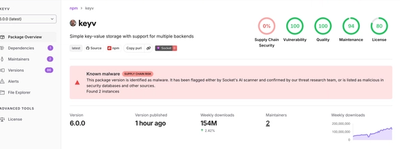
Popular npm Packages in the keyv and Cacheable Namespaces Compromised in Active Supply Chain Attack
Popular npm packages keyv and cacheable compromised.
By Socket Research Team - Aug 04, 2026
unreal-engine-mcp-server
Advanced tools
A comprehensive Model Context Protocol (MCP) server that enables AI assistants to control Unreal Engine via native automation bridge. Built with TypeScript and designed for game development automation.






A comprehensive Model Context Protocol (MCP) server that enables AI assistants to control Unreal Engine through a native C++ Automation Bridge plugin. Built with TypeScript and C++.
| Category | Capabilities |
|---|---|
| Asset Management | Browse, import, duplicate, rename, delete assets; create materials |
| Actor Control | Spawn, delete, transform, physics, tags, components |
| Editor Control | PIE sessions, camera, viewport, screenshots, bookmarks |
| Level Management | Load/save levels, streaming, lighting |
| Animation & Physics | Animation BPs, state machines, ragdolls, vehicles, constraints |
| Visual Effects | Niagara particles, GPU simulations, procedural effects, debug shapes |
| Sequencer | Cinematics, timeline control, camera animations, keyframes |
| Graph Editing | Blueprint, Niagara, Material, and Behavior Tree graph manipulation |
| Audio | Sound cues, audio components, sound mixes, ambient sounds |
| System | Console commands, UBT, tests, logs, project settings, CVars |
Choose your transport:
Skip this step if using Option A: Native MCP Transport (Step 4A below).
NPX (Recommended):
npx unreal-engine-mcp-server
Clone & Build:
git clone https://github.com/ChiR24/Unreal_mcp.git
cd Unreal_mcp
npm install
npm run build
node dist/cli.js
The MCP Automation Bridge plugin is included at Unreal_mcp/plugins/McpAutomationBridge.
Your project must have a code target (.sln or .xcworkspace).
Blueprint-only projects cannot compile native plugins — to convert, add any class via Tools > New C++ Class in the editor.
Method 1: Copy Folder
Copy:  Unreal_mcp/plugins/McpAutomationBridge/
To:    YourUnrealProject/Plugins/McpAutomationBridge/
Method 2: External Plugin Directory (no copy needed)
Unreal_mcp/plugins/This saves the path in your .uproject file so the plugin stays linked without copying.
The plugin compiles automatically when you open the project — UE detects the .uplugin + Source/ and runs UnrealBuildTool.
Video Guide:
https://github.com/user-attachments/assets/d8b86ebc-4364-48c9-9781-de854bf3ef7d
⚠️ First-Time Project Open: UE may prompt "Would you like to rebuild them now?" — click Yes. If instead you see "Missing Modules — McpAutomationBridge. Engine modules cannot be compiled at runtime. Please build through your IDE." — open your project in Visual Studio (Win) or Xcode (Mac) and build from there. After that, the editor will open normally with the plugin loaded.
Build the plugin once, then distribute the compiled binaries — no IDE or compilation needed on the target machine.
1. Build:
# macOS / Linux
./scripts/package-plugin.sh /path/to/UE_5.6

# Windows
scripts\package-plugin.bat C:\Path\To\UE_5.6
This produces a zip like McpAutomationBridge-v0.5.30-UE5.6-Mac.zip.
2. Install: unzip into YourProject/Plugins/ and open the project. That's it — no compilation step.
Note: pre-built binaries are tied to a specific UE version. A build for 5.6 won't work with 5.5, 5.7, or 5.8.
Enable via Edit → Plugins, then restart the editor.
| Plugin | Required For |
|---|---|
| MCP Automation Bridge | All automation operations |
| Editor Scripting Utilities | Asset/Actor subsystem operations |
| Niagara | Visual effects and particle systems |
| Plugin | Required For |
|---|---|
| Level Sequence Editor | manage_sequence operations |
| Control Rig | animation_physics operations |
| GeometryScripting | manage_geometry operations |
| Behavior Tree Editor | manage_ai Behavior Tree operations |
| Niagara Editor | Niagara authoring |
| Environment Query Editor | AI/EQS operations |
| Gameplay Abilities | manage_gas operations |
| MetaSound | manage_audio MetaSound authoring |
| StateTree | manage_ai State Tree operations |
| Smart Objects | AI smart object operations |
| Enhanced Input | manage_networking input mapping operations |
| Chaos Cloth | Cloth simulation |
| Interchange | Asset import/export |
| Data Validation | Data validation |
| PCG | manage_pcg graph authoring and execution |
| Procedural Mesh Component | Procedural geometry |
| OnlineSubsystem | Session/networking operations |
| OnlineSubsystemUtils | Session/networking operations |
💡 Optional plugins are auto-enabled by the MCP Automation Bridge plugin when needed.
The plugin includes a built-in MCP Streamable HTTP server. AI clients connect directly to the plugin over HTTP — no TypeScript bridge, no Node.js, no npm.
Enable in Unreal:
3000)Configure your MCP client to use Streamable HTTP transport at:
http://localhost:3000/mcp
Claude Code:
claude mcp add unreal-engine --transport http http://localhost:3000/mcp
Or manually in ~/.claude/settings.json or project .mcp.json:
{
  "mcpServers": {
    "unreal-engine": {
      "type": "url",
      "url": "http://localhost:3000/mcp"
    }
  }
}
Cursor (.cursor/mcp.json):
{
  "mcpServers": {
    "unreal-engine": {
      "url": "http://localhost:3000/mcp"
    }
  }
}
Verify it works:
● MCP :3000 (2) in the bottom-right of the editor. Green dot = server running, number in parens = active sessions. Click it to open settings.LogMcpNativeTransport to see connections, tool calls, and session activity:
LogMcpNativeTransport: Native MCP server started on http://localhost:3000/mcp
LogMcpNativeTransport: MCP session initialized: ... (client: claude-code 2.1.92, active sessions: 1)
LogMcpNativeTransport: tools/call: inspect (RequestId=...)
LogMcpNativeTransport: tools/call completed: ... (tool=inspect, success=true)
Features:
manage_toolsexecute_python action (inline code or .py files)Add to your Claude Desktop / Cursor config file:
Using Clone/Build:
{
  "mcpServers": {
    "unreal-engine": {
      "command": "node",
      "args": ["path/to/Unreal_mcp/dist/cli.js"],
      "env": {
        "UE_PROJECT_PATH": "C:/Path/To/YourProject",
        "MCP_AUTOMATION_PORT": "8091"
      }
    }
  }
}
Using NPX:
{
  "mcpServers": {
    "unreal-engine": {
      "command": "npx",
      "args": ["unreal-engine-mcp-server"],
      "env": {
        "UE_PROJECT_PATH": "C:/Path/To/YourProject"
      }
    }
  }
}
# Required
UE_PROJECT_PATH="C:/Path/To/YourProject"

# Automation Bridge
MCP_AUTOMATION_HOST=127.0.0.1
MCP_AUTOMATION_PORT=8091

# LAN Access (optional)
# SECURITY: Set to true to allow binding to non-loopback addresses (e.g., 0.0.0.0)
# Only enable if you understand the security implications.
MCP_AUTOMATION_ALLOW_NON_LOOPBACK=false

# Logging
LOG_LEVEL=info  # debug | info | warn | error

# Optional
MCP_CONNECTION_TIMEOUT_MS=5000
MCP_REQUEST_TIMEOUT_MS=120000
ASSET_LIST_TTL_MS=10000

# Optional Prometheus metrics endpoint
# Loopback-only by default. Non-loopback metrics requires both explicit opt-in and a token.
# MCP_METRICS_PORT=9100
# MCP_METRICS_HOST=127.0.0.1
# MCP_METRICS_ALLOW_NON_LOOPBACK=false
# MCP_METRICS_TOKEN=change-me

# Custom content mount points (comma-separated)
# Plugins with CanContainContent register mount points beyond /Game/.
# MCP_ADDITIONAL_PATH_PREFIXES=/ProjectObject/,/ProjectAnimation/
By default, the automation bridge only binds to loopback addresses (127.0.0.1) for security. To enable access from other machines on your network:
TypeScript (MCP Server):
MCP_AUTOMATION_ALLOW_NON_LOOPBACK=true
MCP_AUTOMATION_HOST=0.0.0.0
Unreal Engine Plugin:
0.0.0.0⚠️ Security Warning: Enabling LAN access exposes the automation bridge to your local network. Only use on trusted networks with appropriate firewall rules. Enable capability token authentication (Require Capability Token in project settings) to prevent unauthorized access when using LAN mode.
23 exposed MCP tools in broad all-tools mode. Related actions live directly on their parent tools so clients load less context without losing capabilities.
| Tool | Description |
|---|---|
manage_asset | Assets, Materials, Render Targets, Behavior Trees |
manage_blueprint | Blueprints, SCS components, graph editing, UMG widgets, layout, bindings, animations |
control_actor | Spawn, delete, transform, physics, tags |
control_editor | PIE, Camera, viewport, screenshots |
manage_level | Load/save, streaming, lighting |
system_control | UBT, Tests, Logs, Project Settings, CVars, Python Execution |
inspect | Object Introspection |
manage_tools | Dynamic tool management (enable/disable at runtime) |
| Tool | Description |
|---|---|
build_environment | Landscapes, foliage, procedural terrain, lighting, spline roads/rivers/fences |
manage_level_structure | Levels, sublevels, World Partition, streaming, data layers, HLOD, volumes |
manage_geometry | Procedural mesh creation and editing with Geometry Script |
manage_pcg | PCG graph assets, subgraphs, input/sampler/filter/spawner nodes, pin connections, execution, partition grid size, and node settings |
| Tool | Description |
|---|---|
animation_physics | Animation BPs, skeletons, sockets, physics assets, cloth, vehicles, ragdolls, Control Rig, IK |
manage_effect | Niagara, particles, debug shapes, GPU simulations |
manage_gas | Gameplay Ability System: abilities, effects, attributes |
manage_character | Character creation, movement, advanced locomotion |
manage_combat | Weapons, projectiles, damage, melee combat |
manage_ai | AI controllers, Behavior Trees, EQS, perception, State Trees, Smart Objects, NavMesh/pathfinding |
manage_inventory | Items, equipment, loot tables, crafting |
manage_interaction | Interactables, destructibles, triggers |
| Tool | Description |
|---|---|
manage_audio | Audio Assets, Components, Sound Cues, MetaSounds, Attenuation |
manage_sequence | Sequencer, cinematics, bindings, tracks, playback, keyframes |
manage_networking | Replication, RPCs, network prediction, sessions, split-screen, LAN/voice, game framework, input mappings |
Blueprints • Materials • Textures • Static Meshes • Skeletal Meshes • Levels • Sounds • Particles • Niagara Systems • Behavior Trees
docker build -t unreal-mcp .
docker run -it --rm -e UE_PROJECT_PATH=/project unreal-mcp
| Document | Description |
|---|---|
| Handler Mappings | TypeScript to C++ routing |
| Plugin Extension | C++ plugin architecture |
| Testing Guide | How to run and write tests |
| Roadmap | Development phases |
npm run build       # Build TypeScript
npm run lint        # Run ESLint
npm run test:unit   # Run unit tests
npm run test:all    # Run all tests
| Resource | Description |
|---|---|
| Project Roadmap | Track development progress across 48 phases |
| Discussions | Ask questions, share ideas, get help |
| Issues | Report bugs and request features |
Contributions welcome! Please:
MIT — See LICENSE
FAQs
A comprehensive Model Context Protocol (MCP) server that enables AI assistants to control Unreal Engine via native automation bridge. Built with TypeScript and designed for game development automation.
The npm package unreal-engine-mcp-server receives a total of 324 weekly downloads. As such, unreal-engine-mcp-server popularity was classified as not popular.
We found that unreal-engine-mcp-server demonstrated a healthy version release cadence and project activity because the last version was released less than a year ago. It has 1 open source maintainer collaborating on the project.
Did you know?

Socket for GitHub automatically highlights issues in each pull request and monitors the health of all your open source dependencies. Discover the contents of your packages and block harmful activity before you install or update your dependencies.
Research
/Security News
Popular npm packages keyv and cacheable compromised.

Security News
A misconfiguration gave three Anthropic models internet access, and one, believing it was in a simulation, shipped a credential-stealing package to PyPI.

Security News
/Company News
Socket has joined the new Composer and Packagist sponsorship program as a launch sponsor, supporting the team that keeps PHP's package ecosystem secure.