
Product
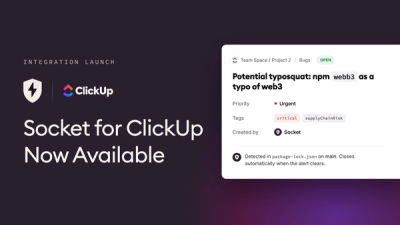
Socket for ClickUp Is Now Available
Create ClickUp tasks from Socket alerts, automate ticketing with custom rules, and keep alert and task status synchronized.
By Jeppe Hasseriis - Aug 26, 2026
The safety layer for vibe coding and AI coding agents: flag risky changes and restore project files, including uncommitted work, to their pre-session state.
The safety layer for vibe coding and AI coding agents: flag risky changes and restore project files, including uncommitted work, to their pre-session state.
VibeRevert records an AI coding session, flags risky changes with deterministic rules, and can restore your project files to exactly how they were before it started, including work you hadn't committed.
No AI judges the AI: risk findings are reproducible, explainable, and based on rules you can inspect.
npm install -g viberevert@beta
viberevert init                # one-time setup in your project
viberevert run <your-agent>    # records the session and saves your files' starting state
viberevert check               # see what changed and what looks risky
viberevert rollback <session>  # preview putting your files back; add --apply to restore
Read what rollback can and can't restore before you rely on it. Full documentation is in the project README.
Status: Beta. Public API may change before v1.0.
This page documents the CLI surface: init, checkpoint, run, shell, check, report, prompt-fix, rollback, hook install, hook uninstall, install, uninstall, and mcp serve.
viberevert run <command> [args...] runs a single command inside a VibeRevert session: it takes a checkpoint, starts a session, spawns the command with stdio: "inherit" (no shell, no PTY), ends the session when the command exits, and prints a two-line summary pointing you at viberevert check --since <session>. Use --task "..." to label the session.
It is deliberately boring -- not a shell, not a terminal emulator, not an agent runtime. shell: false is locked, so there is no shell interpretation or injection surface; guarding applies to the top-level invocation only (commands the wrapped program runs internally are never intercepted); and sessions capture FILE changes, not terminal output.
commands.guard and commands.require_confirm in .viberevert.yml gate the top-level command: a guarded match refuses (exit 2) before any session is created; a confirm-required match prompts for the exact phrase run anyway on a TTY (and refuses on a non-TTY). Guard wins when both match. The framework init profiles ship live, framework-tailored defaults; the generic profile ships a commented example. These rules take effect under both run and shell: run applies them once to the wrapped command and exits on refusal/decline, while shell applies the same matching per submitted line and then continues the loop after a refusal or declined confirmation.
The child's exit code is propagated verbatim (127 for not-found, 126 for not-executable, 128+N for POSIX signal death). All wrapper text goes to stderr; the child owns stdout. Each run appends one JSONL audit line to the session's commands.log -- recorded verbatim, with no secret redaction, so do not pass secrets as command-line arguments.
See docs/run-contract.md for the full contract: argument-boundary rules, guard-matching semantics with worked examples, the exit-code table, confirmation flow, stderr stream lock, signal/cleanup story, Windows .bat/.cmd note, and the commands.log privacy boundary (D102.A-J).
viberevert shell [--task "..."] opens a guarded command loop inside a single VibeRevert session: it takes a checkpoint, starts one session, then prompts (viberevert> ) for one command at a time, guard-checks each command against .viberevert.yml before running it, and -- when you type exit or press Ctrl-D -- ends the session and prints the two-line viberevert check --since <session> summary. It is the interactive companion to viberevert run.
It is a guarded command loop, not a transparent shell. Each line is tokenized by a small v1 parser that does no shell expansion (globs, variables, pipes, and redirection are literal), and each accepted command spawns with stdio: "inherit", shell: false at the directory where you launched the shell (there is no cd). Use sh -c "..." / cmd /c "..." for shell features; the guard then sees that literal command. This path has no node-pty and no native dependency; the transparent terminal bridge is the separate, experimental --pty mode below.
Guard/confirm matching is shared with run, but a refusal or declined confirmation SKIPS that one command and CONTINUES the loop (a non-TTY confirm is refused without consuming a line). Each accepted command appends one JSONL entry to the session's commands.log BEFORE the spawn -- so an ENOENT / failed-spawn command is still logged -- while per-command child exit codes are displayed ([exit: N] / [signal: SIG]) and swallowed, never propagated to the shell's own exit code. If a command ends or replaces the active session, the shell stops and never touches a session it does not own (scoped teardown).
See docs/shell-contract.md for the full contract: the Node-24 readline note (why the interface is not paused around children), tokenizing rules, per-command guard/confirm loop behavior, the commands.log audit + privacy boundary, active-session integrity + scoped teardown, the exit-code table, signals, and what stays out of scope for the REPL (D103.A-G, D103.M).
shell --pty (experimental)viberevert shell --pty is an opt-in experimental transparent PTY bridge with best-effort prompt-level guard interception: it runs a real interactive Bash session inside node-pty, bridges your keystrokes raw, and checks the command text Bash reports at that prompt boundary against the same configured guard rules, using PTY mode's single-element command-text representation. Plain viberevert shell (no flag) remains the stable, native-dependency-free baseline on Linux, macOS, and Windows.
Read the caveat before using it: interception coverage is best effort, and PTY mode is not a sandbox. Its coverage is limited to command events that traverse the installed Bash prompt hook -- not commands run inside an already-running program, in nested processes or alternate shells, or by anything that bypasses the hook. What it does intercept is fail-closed: such a command is never released unless policy allows it and its audit succeeds. It is a prompt-level safety net, never security enforcement or complete command interception. In PTY v1, require_confirm matches are blocked rather than prompted.
--pty needs a real TTY, the optional node-pty dependency, and an interactive shell where Bash 4.1 or newer can be resolved; it is unavailable via MCP. It never silently falls back: if any prerequisite is missing -- including on a stock Windows box, which resolves PowerShell -- it refuses non-zero; plain viberevert shell remains available. Unlike the REPL, PTY mode is not fixed-cwd: you can cd, and each auditable interception is recorded at its prompt-time directory. If an audit prerequisite cannot be satisfied persistently, every intercepted, auditable command stays blocked -- including exit; leave with Ctrl-D.
See docs/pty-contract.md for the full contract: the coverage/disposition distinction, bypass categories, the [rawLine] audit shape + hygiene, the two cwds and which one is stored (including cwd format limits, which make some legal POSIX directory names unauditable), lifecycle and terminal restoration, exit codes, and what is proven live vs. by unit tests (D104.A-O).
viberevert rollback <session-id> restores the working tree, index, and untracked files to the state captured at the start of the named session.
Default is dry-run: it produces a structured receipt describing what --apply would do, without mutating the repo. Pass --apply to actually restore. --force only bypasses the force-overridable dirty-tree safety checks documented in the contract. Receipts are persisted at .viberevert/sessions/<sess>/rollback-receipt.json for apply and .viberevert/sessions/<sess>/rollback-dry-run-receipt.json for dry-run; render via --json, --markdown, or default terminal output.
Every --apply auto-creates an emergency pre-rollback checkpoint of the current state before restore, and records its id in the receipt as pre_rollback_checkpoint_id.
Scope: filesystem + git state only. Does NOT restore database schemas, deployed artifacts, package-registry publishes, external API state, or any other process-side effects.
See docs/rollback-contract.md for the full contract: refusal-order policy, --force override table, receipt schema, and recovery path via the emergency checkpoint.
viberevert prompt-fix loads the persisted ReportFile produced by viberevert check and renders a deterministic, template-based prompt you paste into your coding agent. By default it resolves the active session's report if present, else the latest report across both session-bound and ad-hoc stores; pass --session <sess-id> or --report <rpt-id> to load an explicit source.
Output is text-only and goes to two sinks byte-identically: stdout AND a sibling fix-prompt.txt written next to the source report (.viberevert/sessions/<sess>/fix-prompt.txt for session-bound, .viberevert/reports/<rpt>/fix-prompt.txt for ad-hoc). The single render call drives both sinks; the file is written first via atomic temp+rename, so a failed persist leaves stdout empty and exit 1 — never the "I see a prompt but the command failed" bad state.
The prompt template is injection-defended (three-paragraph preamble framing report contents as data, never instructions), normalized (dynamic fields rendered block-form so a finding message starting with ## can never become a section header), and capped at 20 highest-risk findings with an explicit omitted-count line on truncation. Findings sort critical > high > medium > low. Empty-findings reports refuse with exit 1 AND remove any stale sibling fix-prompt.txt (drift-guarded read-read-compare).
Out of scope in v0.7.0: no LLM API calls (--llm is a hidden reserved seam that exits 1), no repository source-file reads (renderer trusts the M C redactor's already-redacted evidence), no --json / --markdown flags, no FixPromptFileSchema sidecar. fix-prompt.txt is the v0.7.0 compatibility contract; structured wrappers are deferred until a real consumer (MCP generate_fix_prompt) needs them.
See docs/prompt-fix-contract.md for the full contract: refusal table, template section details, dynamic-field normalization rules, drift guard, byte-identity write order, and architectural invariants (D90.1-8).
viberevert hook install writes a deterministic POSIX #!/bin/sh pre-commit hook to .git/hooks/pre-commit that runs viberevert check --staged on every commit. The hook respects your .viberevert.yml risk.block_on threshold (default: critical); on exit 2 it prints a viberevert prompt-fix tip on stderr and translates to git-hook exit 1 so blocked commits abort uniformly. Use git commit --no-verify for a single-commit bypass; vibe-revert documents it but does not hide it.
Refuses cleanly on husky / lefthook detection (those ecosystems own their own hook lifecycle — invoke viberevert check --staged from your manager's pre-commit instead), on git worktree / submodule layouts (.git-as-pointer-file is not yet supported), on shared-hooks-directory setups (.git/hooks as symlink), and on malformed package.json. --force overrides ONLY the existing-non-viberevert-hook case (backing it up to .git/hooks/pre-commit.viberevert-backup-<UTC>); it does NOT override hook-manager / layout / malformed-JSON refusals — those are absolute.
viberevert hook uninstall removes the viberevert-managed hook (identified by an exact line-2 marker check with CRLF tolerance) and refuses to touch hooks it did not write. No --force flag: refusing to remove unknown hooks IS the safety belt. With --restore, it renames the most recent pre-commit.viberevert-backup-<UTC> file back to .git/hooks/pre-commit (validate-before-mutate per D98.P: the managed hook is NEVER deleted before backup existence is proven; metadata-fingerprint guard — dev + ino + size + mtimeMs + ctimeMs — catches in-place modification between the first and final stat). The safety posture is best-effort validate-before-mutate, not a cross-process lock.
Re-installing an existing managed hook is byte-compare idempotent (D98.A11): byte-identical + executable → no-op; byte-identical + non-executable (Unix only) → chmod-only repair; bytes differ → atomic refresh to the current template via writeFileAtomic.
Out of scope in v0.7.0-beta: husky / lefthook adapter integration (deferred to M G1's installers package — refusal-on-detection is intentional), worktree / submodule support (.git-as-pointer-file), git core.hooksPath redirect detection (install succeeds but the hook won't fire if core.hooksPath points elsewhere; a future viberevert doctor diagnostic will flag this), Windows-native git without sh.exe (git itself does not execute the hook on that platform — not a vibe-revert limitation), and any second severity threshold beyond what check --staged already enforces (risk.block_on is the single knob).
See docs/hook-contract.md for the full contract: refusal copy table, exit-code policy (D98.K + D98.F translation), hook script verbatim text, --force scope lock, --restore validate-before-mutate semantics, metadata-fingerprint guard, and architectural invariants (D98.M.1-14).
viberevert install writes VibeRevert integration configuration for one or more adapters, driven through @viberevert/installers. Each per-adapter flag targets one integration:
viberevert install --cursor — merge the VibeRevert MCP server into .cursor/mcp.json.viberevert install --claude — merge into .mcp.json.viberevert install --direct — write .git/hooks/pre-commit directly.viberevert install --husky — insert a VibeRevert block into .husky/pre-commit.viberevert install --lefthook — insert a VibeRevert block into the detected Lefthook config.viberevert install --github-action — write the pinned CI workflow at .github/workflows/viberevert.yml.viberevert install --all — iterate the five safe adapters (cursor, direct-hook, husky, lefthook, claude). GitHub Action is explicit-only.--dry-run prints per-file diffs instead of writing. --force-reinstall narrowly overrides recorded-SHA drift refusals, and the GitHub Action adapter's user-authored-workflow refusal. It does not bypass locks, journals, symlink refusals, parent-escape refusals, target-shape refusals, target-size refusals, or other adapter-layer structural refusals. --migrate-from-hook-install orchestrates a two-step Husky migration when a VibeRevert direct hook is already present.
CLI output uses a locked bracket vocabulary, one line per selected adapter:
[applied: <adapter>: <humanSummary>] — install succeeded.[noop: <adapter>: <reason>] — record already matches desired state.[skipped: <adapter>: <reason>] — adapter detect returned false for the selected intent.[refused: <adapter>: <code>: <message>] — adapter or engine refusal.[applicable: <adapter>: <humanSummary>] + indented diff — --dry-run only.viberevert uninstall mirrors the flag surface (except no --dry-run, and --force instead of --force-reinstall). Output uses [uninstalled], [noop], or [refused].
viberevert install writes the durable record at .viberevert/integrations.json; viberevert uninstall reads and removes records from that file. That file should be committed. Transient paths under .viberevert/ — integration-backups/, integration-journal/, integrations.lock/ — should be gitignored.
See docs/installers-contract.md for the full contract: per-adapter conflict behavior, drift semantics, migration choreography, error taxonomy, and locked-copy reason codes.
viberevert mcp serve boots a local Model Context Protocol server over stdio that exposes VibeRevert's read-only and local-write tools to AI coding agents. The server is config-blind (no .viberevert.yml required) and binds to the repository it was launched in — one server, one repository, one audit log at .viberevert/mcp-audit.log.
Eight tools are exposed in v0.7.0-beta: check_repo, explain_diff, classify_risk, list_risky_files, get_policy (read-only); start_session, create_checkpoint, generate_fix_prompt (local-write). Two names are reserved and intentionally hidden from tools/list: rollback and request_human_approval — both return a generic Tool not found envelope identical to any other unknown name, with no leak of "exists but blocked".
Raw tool arguments are NEVER logged to the audit; records contain call metadata such as tool name, timestamp, ok/exit-code, and duration. Stdin EOF triggers graceful shutdown, with in-flight tool calls allowed to complete before the process exits.
Out of scope in v0.7.0-beta: HTTP / SSE transport (stdio only), per-tool cwd parameter (confused-deputy risk), execution tools beyond the three local-write tools above, and cross-repository operation.
See docs/mcp-contract.md for the full contract: tool input/output shapes, dispatcher matrix, audit record shapes, output caps, timeout policy, library discipline, and architectural invariants (D99.M.1-22).
FAQs
The safety layer for vibe coding and AI coding agents: flag risky changes and restore project files, including uncommitted work, to their pre-session state.
We found that viberevert demonstrated a healthy version release cadence and project activity because the last version was released less than a year ago. It has 1 open source maintainer collaborating on the project.
Product
Create ClickUp tasks from Socket alerts, automate ticketing with custom rules, and keep alert and task status synchronized.
Product
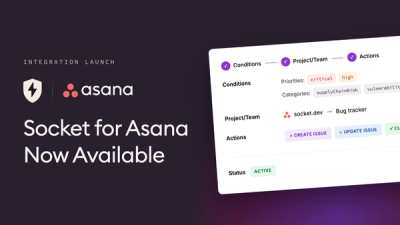
Create and manage Asana tasks directly from Socket alerts, with manual task creation, automated ticketing rules, and two-way sync.

Security News
Open VSX has removed three extension IDs from its malicious-extension list as the legitimate publishers they impersonated move to claim the names for themselves.