Product
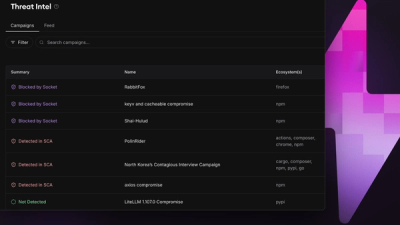
Socket Threat Intel Now Shows Which Malware Campaigns Were Blocked or Detected
Socket Threat Intel now shows which malware campaigns were blocked or detected in your organization, with links to scans and Firewall events.
TypeScript Interface for Ethereum
... and a lot more.
// 1. Import modules.
import { createPublicClient, http } from 'viem';
import { mainnet } from 'viem/chains';
// 2. Set up your client with desired chain & transport.
const client = createPublicClient({
chain: mainnet,
transport: http(),
});
// 3. Consume an action!
const blockNumber = await client.getBlockNumber();
Head to the documentation to read and learn more about viem.
Check out the following places for more viem-related content:
If you're interested in contributing, please read the contributing docs before submitting a pull request.
MIT License
The 'web3' package is a popular library for interacting with the Ethereum blockchain. It provides similar functionalities to 'viem' such as connecting to nodes, sending transactions, and interacting with smart contracts. However, 'web3' is more established and widely used in the Ethereum developer community.
The 'ethers' package is another widely-used library for Ethereum development. It offers a clean and simple API for interacting with the Ethereum blockchain, including functionalities for connecting to nodes, sending transactions, and interacting with smart contracts. 'ethers' is known for its ease of use and comprehensive documentation.
FAQs
TypeScript Interface for Ethereum
The npm package viem receives a total of 5,021,867 weekly downloads. As such, viem popularity was classified as popular.
We found that viem demonstrated a healthy version release cadence and project activity because the last version was released less than a year ago. It has 2 open source maintainers collaborating on the project.

Product
Socket Threat Intel now shows which malware campaigns were blocked or detected in your organization, with links to scans and Firewall events.

Security News
Fixes for eMudhra and Brotli are out. Getting them everywhere they’re needed means tracking down bundled libraries, runtimes, and certificate stores.

Threat Research
/Security News
Socket uncovered secret-stealing workflows that ran in LiteLLM’s GitHub repository 11 days before the supply chain attack on PyPI and Docker.