

Product
PHP and Composer Support Is Now in Beta
Socket’s PHP and Composer support is now in Beta for all customers, with PHP reachability analysis generally available.
By Trevor Norris, Benjamin Barslev - Aug 21, 2026
Native repository intelligence for coding agents: 39 read-only MCP operations backed by typed evidence graphs, impact, architecture, APIs, Git, search, semantics, and memory.


Give your coding agent repository evidence before it starts guessing.
Weavatrix is the native MCP product for repository intelligence. It gives Codex, Claude Code, and other coding agents 39 read-only operations over one revision-bound evidence graph: impact, architecture, APIs, Git history, duplicates, dead code, search, semantic links, and temporal memory.
It does not answer from a larger grep or an invented confidence score. Every bounded result can carry the repository revision, file, line, extractor, evidence kind, and confidence that produced it.
This npm package is the convenient prebuilt distribution of the same native
product published on crates.io as weavatrix. It is not a separate
JavaScript engine; both registry packages run the same Rust adapter and engine.
npx -y weavatrix mcp .
Or install the same native MCP product through Cargo:
cargo install weavatrix
weavatrix mcp .
[mcp_servers.weavatrix]
command = "npx"
args = ["-y", "weavatrix", "mcp", "."]
claude mcp add weavatrix -- npx -y weavatrix mcp .
Profiles expose bounded views of the same engine:
npx -y weavatrix mcp . --profile=all
npx -y weavatrix mcp . --profile=code
npx -y weavatrix mcp . --profile=seo
The package contains native binaries for Windows x64/arm64, macOS x64/arm64, and glibc Linux x64/arm64. It has no install script and performs no runtime download.
What breaks if I change src/auth/middleware.ts?
Trace POST /api/orders through this backend and its clients.
Which production symbols are dead, and what evidence proves it?
Show duplicate implementations but suppress router boilerplate.
Which dependency violates .weavatrix/architecture.json?
Find every GraphQL, gRPC, Kafka, RabbitMQ, NATS, JMS, SQS, or SNS
contract affected by this branch.
Build the smallest source bundle needed to edit this symbol safely.
| Workflow | Operations |
|---|---|
| Graph orientation | graph_stats, get_node, get_neighbors, query_graph, god_nodes, shortest_path, get_community, list_communities, module_map |
| Change impact | get_dependents, change_impact, verified_change, prepare_change, graph_diff |
| Exact source context | search_code, read_source, inspect_symbol, context_bundle |
| Health and quality | find_duplicates, find_dead_code, run_audit, coverage_map, hot_path_review |
| APIs and transports | list_endpoints, trace_endpoint, trace_api_contract |
| Architecture | get_architecture_contract, verify_architecture, explain_architecture_violation, propose_architecture_exception |
| Git and repositories | git_history, cross_repo_git, open_repo, list_known_repos, rebuild_graph |
| Native extensions | vector_search, semantic_link, seo_link_suggestions, memory_context |
Every operation is read-only with respect to the analyzed repository. Pagination and explicit limits bound large neighborhoods, histories, searches, and contract inventories.
| Group | Surfaces |
|---|---|
| Code | Rust; JavaScript/JSX; TypeScript/TSX; Python; Go; Java; C#; C; C++; SQL; Bash/Zsh; Swift; Solidity |
| Contracts and configuration | GraphQL; Protobuf/gRPC; JSON/JSONC; YAML/Kubernetes; Terraform/HCL; XML |
| Documents and UI | HTML/Vue/Svelte; CSS/SCSS/Sass/Less; Markdown/MDX; reStructuredText; AsciiDoc |
Cross-surface analysis connects HTTP, GraphQL, gRPC, Kafka, RabbitMQ/AMQP, JMS, NATS, SQS, and SNS evidence. Dynamic dispatch that cannot be proved stays unresolved; static reachability is never presented as measured coverage.
coding agent
    |
    | MCP over stdio
    v
weavatrix 1.1.2
    profile catalog · refresh · watcher · MCP framing
    |
    v
weavatrix-rust 2.0.2
    typed graph · analysis · 39 read-only operations
This npm product owns MCP transport and native distribution. The
weavatrix-rust crate is
the reusable protocol-independent engine; it is not an MCP server.
Its standalone diagnostic therefore reports weavatrix-rust <engine-version>,
while this MCP product reports both its product and embedded-engine identities.
Engine 2.0.2 keeps find_duplicates families internally consistent after
test/classified/low-signal filters and top_n truncation. Families are rebuilt
from the surviving pairs, so excluded members and dangling pair identifiers
cannot remain in the result.
The installed-package benchmark packs both products, installs them into isolated npm roots, starts fresh MCP processes with empty caches, and validates identity, advertised operations, results, and cleanup.
The packaged 1.1.2 product (weavatrix-rust 2.0.2) passed the bounded native
gate on 2026-07-30: 39 tools; cold initialize 405.770 ms; tools/list
0.790 ms; first graph_stats 54.880 ms; and 1,000 hot graph_stats
calls at 136.83 calls/s with 0 failures, p50 7.610 ms, p95
10.180 ms, and p99 12.230 ms.
The last published baseline (weavatrix 1.0.0 versus weavatrix-js 0.3.15)
measured a 30.34x median cold-boundary ratio and 156.10x warm-call
ratio. Those comparison numbers remain historical and are not presented as a
fresh competitor benchmark; the current 1.1.2 gate is bounded and does not
relabel them.
Full evidence and methodology: benchmarks.
unsafe Rust forbidden in first-party engine crates;MIT.
FAQs
Native repository intelligence for coding agents: 43 read-only MCP operations backed by typed evidence graphs, impact, architecture, APIs, Git, search, semantics, and memory.
The npm package weavatrix receives a total of 207 weekly downloads. As such, weavatrix popularity was classified as not popular.
We found that weavatrix demonstrated a healthy version release cadence and project activity because the last version was released less than a year ago. It has 1 open source maintainer collaborating on the project.
Product
Socket’s PHP and Composer support is now in Beta for all customers, with PHP reachability analysis generally available.
Product
Socket is bringing experimental protection to Firefox, scanning 97,000+ extensions in Mozilla's official directory for malware and risky updates.
Research
/Security News
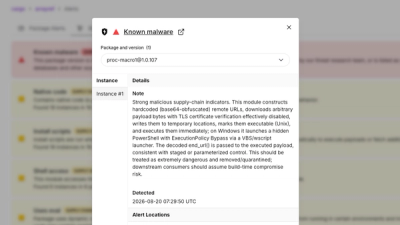
Three compromised Rust crates pulled in a malicious dependency that downloaded and executed cross-platform malware during Cargo builds.