Security News
6 AppSec CTOs Debate Open Source Supply Chain Security at Black Hat
Socket CTO Ahmad Nassri joins AppSec leaders at Black Hat to discuss active malware, package manager risks, and software supply chain defense.
webdriverio
Advanced tools
Next-gen browser and mobile automation test framework for Node.js
This package provides an easy-to-manage API and a lot of syntactical sugar on top of the WebDriver specification. You can use WebdriverIO as a standalone package or via a test runner using @wdio/cli. WebdriverIO allows you to run tests locally using the WebDriver as well as remote user agents using cloud providers like Sauce Labs.
You can install WebdriverIO via NPM:
npm install webdriverio
WebdriverIO by default uses Puppeteer to automate a browser like Chrome, Firefox or Chromium Edge. So if you have Chrome installed, the following script should start a browser for you and get the title of the page:
import { remote } from 'webdriverio'
const browser = await remote({
capabilities: { browserName: 'chrome' }
})
await browser.navigateTo('https://www.google.com/ncr')
const searchInput = await browser.$('#lst-ib')
await searchInput.setValue('WebdriverIO')
const searchBtn = await browser.$('input[value="Google Search"]')
await searchBtn.click()
console.log(await browser.getTitle()) // outputs "WebdriverIO - Google Search"
await browser.deleteSession()
See the raw protocol example using the webdriver package to get a glance at the differences.
For more information on options, multiremote usage or integration into cloud services please check out the docs.
Package Sponsors:Selenium WebDriver is one of the most popular browser automation tools. It requires setting up a standalone server and writing more boilerplate code compared to WebdriverIO, which provides a more concise API and integrated test runner support.
Puppeteer is a Node library developed by the Chrome DevTools team. It provides a high-level API to control Chrome or Chromium over the DevTools Protocol. Puppeteer is typically faster and more stable for Chrome/Chromium automation because it uses the DevTools protocol, but it does not support multiple browsers out of the box like WebdriverIO does.
Cypress is a front-end testing tool built for the modern web. It is both a library for writing tests as well as a test runner. It offers a rich interactive interface for running tests but is limited to running tests within its own browser-based test runner, which can be a limitation compared to WebdriverIO's support for various browsers and mobile platforms.
Nightwatch.js is an automated testing framework for web applications and websites, written in Node.js and using the W3C WebDriver API. It is similar to WebdriverIO but has its own test runner and asserts library, which can make it easier to set up and start writing tests. However, it might not be as feature-rich as WebdriverIO in terms of community plugins and integrations.
FAQs
Next-gen browser and mobile automation test framework for Node.js
The npm package webdriverio receives a total of 2,485,035 weekly downloads. As such, webdriverio popularity was classified as popular.
We found that webdriverio demonstrated a healthy version release cadence and project activity because the last version was released less than a year ago. It has 3 open source maintainers collaborating on the project.

Security News
Socket CTO Ahmad Nassri joins AppSec leaders at Black Hat to discuss active malware, package manager risks, and software supply chain defense.

Research
/Security News
Thirteen malicious Packagist themes expose visitors on unpatched iPhones to a WebKit-to-kernel exploit chain that steals device data and wallet seeds.

Research
/Security News
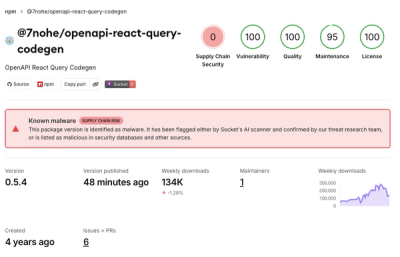
Ten malicious OpenAPI React Query Codegen versions were published to npm in the Mini Shai-Hulud attack, all with valid provenance.