

Company News
AWS Security Hub Adds Socket for Supply Chain Security
Socket is now in the AWS Security Hub Extended plan. Adopt it through AWS, apply committed spend, and block malicious open source packages.
By Feross Aboukhadijeh - Aug 04, 2026
Give your AI coding assistant ears — capture, analyze, and describe live audio from any web app. Works with Windsurf, Cursor, Claude Code, and any MCP-compatible IDE.




Give your AI coding assistant ears.
An MCP server that lets AI coding assistants capture, analyze, and describe live audio from a running web application — not a file on disk, not the physical microphone. The actual AudioContext output your app is rendering right now.
"The beat sounds muddy" → your AI captures 3 seconds, measures the spectral centroid at 580 Hz with 45% energy below 250 Hz, and tells you exactly why.
| Tool | Description |
|---|---|
capture_audio | Record a short clip (500ms–30s) of what your web app is outputting right now |
analyze_audio | Signal analysis: RMS, peak dB, clipping, spectral centroid, frequency bands, BPM, timing jitter |
describe_audio | Plain-English AI description — "the kick is boomy with heavy sub buildup around 80 Hz" |
diff_audio | Compare two captures and flag what changed — loudness, tone, timing, clipping |
Browser (Web Audio API)
    ↓ MediaRecorder taps the AudioContext output node
    ↓ Uploads WebM blob via HTTP POST
Express Middleware (your dev server)
    ↓ Stores captures in memory, dispatches commands via SSE
MCP Server (stdio — runs inside your IDE)
    ↓ Retrieves captures, sends to CodedSwitch analysis API
AI Coding Assistant
    → "Your bass band is 42% of the mix (high), spectral centroid
       is 580 Hz (muddy), and timing jitter is 23ms — the scheduler
       is drifting under load."
The key difference from every other audio MCP: this taps the Web Audio graph directly, bypassing room acoustics, microphone hardware, and the need to export files.
npm install webear
import express from 'express'
import { webearMiddleware } from 'webear/middleware'

const app = express()
app.use(express.json())

// Mount the audio debug bridge (automatically disabled in production)
app.use('/api/webear', webearMiddleware())

app.listen(5000)
Option A — auto-detect everything (Tone.js or raw Web Audio)
import WebEar from 'webear/client'
WebEar.init()
Option B — explicit AudioContext
const ctx = new AudioContext()
const masterGain = ctx.createGain()
masterGain.connect(ctx.destination)

WebEar.init({ audioContext: ctx, outputNode: masterGain })
Option C — Tone.js project
import * as Tone from 'tone'
WebEar.init({ toneJs: true })
Option D — Three.js WebGL Game
import * as THREE from 'three'
const listener = new THREE.AudioListener()
camera.add(listener)
WebEar.init({ tapNode: listener.getInput() })
Option E — plain script tag
<script src="node_modules/webear/client-snippet.js"></script>
<script>WebEar.init()</script>
Claude Code (.mcp.json in project root):
{
  "mcpServers": {
    "webear": {
      "command": "npx",
      "args": ["webear"],
      "env": {
        "WEBEAR_BASE_URL": "http://localhost:5000",
        "CODEDSWITCH_API_KEY": "your-key-here"
      }
    }
  }
}
Cursor (.cursor/mcp.json):
{
  "mcpServers": {
    "webear": {
      "command": "npx",
      "args": ["webear"],
      "env": {
        "WEBEAR_BASE_URL": "http://localhost:5000",
        "CODEDSWITCH_API_KEY": "your-key-here"
      }
    }
  }
}
Windsurf (mcp_config.json):
{
  "webear": {
    "command": "npx",
    "args": ["webear"],
    "disabled": false,
    "env": {
      "WEBEAR_BASE_URL": "http://localhost:5000",
      "CODEDSWITCH_API_KEY": "your-key-here"
    }
  }
}
Get your free CODEDSWITCH_API_KEY at codedswitch.com.
Free tier: 50 analyses/day. No credit card required.
"Capture 3 seconds and tell me why the bass sounds muddy."
"Compare the audio before and after my last commit."
"Is there any clipping in the high-frequency range?"
analyze_audio── Audio Analysis Report ──────────────────────────────
Duration: 3.02s
── Loudness ─────────────────────────────────────────
RMS: -12.4 dBFS
Peak: -1.2 dBFS
Dynamic range: 11.2 dB
Crest factor: 3.63
Clipping: none
── Tone ──────────────────────────────────────────────
Spectral centroid: 2847 Hz
DC offset: 0.00012 (ok)
── Frequency Bands ───────────────────────────────────
Sub (20-80 Hz): 8.2%
Bass (80-250 Hz): 22.1%
Mid (250-2k Hz): 38.4%
Hi-mid (2-6k Hz): 21.8%
High (6k+ Hz): 9.5%
── Rhythm ────────────────────────────────────────────
Estimated BPM: 92
Onset count: 12
Timing jitter: 4.2 ms std dev
── Summary ───────────────────────────────────────────
Loudness: -12.4 dBFS RMS, peak -1.2 dBFS. Tone: balanced (centroid 2847 Hz).
Band mix — sub: 8% | bass: 22% | mid: 38% | hi-mid: 22% | high: 10%.
Rhythm: estimated 92 BPM, 12 onsets detected. Timing: very tight (< 5 ms jitter).
diff_audio── Audio Diff: a1b2c3d4… → e5f6g7h8… ──
── Loudness ──────────────────────────────────────────
RMS: -14.2 dBFS → -12.4 dBFS (+1.8 dBFS)
⚠ Peak: -3.1 dBFS → -0.2 dBFS (+2.9 dBFS)
⚠ CLIPPING INTRODUCED — gain staging regression
── Tone ──────────────────────────────────────────────
⚠ Spectral centroid: 2847.0 Hz → 1920.0 Hz (-927.0 Hz)
── Interpretation ────────────────────────────────────
A gain bug was introduced that causes clipping.
Tonal character changed noticeably — EQ or filter behaviour may have shifted.
| Variable | Default | Description |
|---|---|---|
WEBEAR_BASE_URL | http://localhost:4000 | URL of your dev server (where middleware is mounted) |
CODEDSWITCH_API_KEY | — | API key from codedswitch.com — required for analyze_audio and describe_audio |
MCP_API_URL | https://www.codedswitch.com | Override the analysis API base (advanced / self-hosted) |
webearMiddleware({
  maxCaptures: 50,       // Max captures in memory (default: 50)
  maxAgeMins: 10,        // Auto-evict after N minutes (default: 10)
  maxUploadBytes: 50e6,  // Max upload size (default: 50MB)
  devOnly: true,         // Disable in production (default: true)
})
WebEar.init({
  audioContext: myCtx,             // Your AudioContext instance
  outputNode: myGainNode,          // The node to tap (defaults to destination)
  toneJs: true,                    // Auto-detect Tone.js context
  bridgeBase: '/api/webear',  // Override API path
  devOnly: true,                   // Only init outside of production (default: true)
})
MediaRecorder (Chrome, Firefox, Edge, Safari 14+)CODEDSWITCH_API_KEY for analysis (free at codedswitch.com)diff_audioMicrophone MCPs capture room sound — your fan noise, chair creaks, and room reverb are all in the recording. webear taps the Web Audio API before it hits the DAC, giving you a clean digital signal with no room artifacts.
See CONTRIBUTING.md.
MIT — see LICENSE
Built by @asume21 — CodedSwitch
FAQs
Give your AI real senses — hear, see, and feel any web app in real time. Audio, visuals, performance, network, security, and console capture via MCP. Works with Windsurf, Cursor, Claude Code, and any MCP-compatible IDE.
The npm package webear receives a total of 66 weekly downloads. As such, webear popularity was classified as not popular.
We found that webear demonstrated a healthy version release cadence and project activity because the last version was released less than a year ago. It has 1 open source maintainer collaborating on the project.
Did you know?

Socket for GitHub automatically highlights issues in each pull request and monitors the health of all your open source dependencies. Discover the contents of your packages and block harmful activity before you install or update your dependencies.
Company News
Socket is now in the AWS Security Hub Extended plan. Adopt it through AWS, apply committed spend, and block malicious open source packages.
Research
/Security News
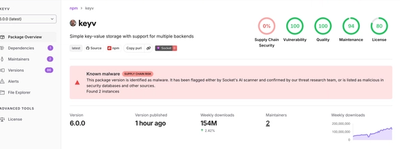
Popular npm packages keyv and cacheable compromised.

Security News
A misconfiguration gave three Anthropic models internet access, and one, believing it was in a simulation, shipped a credential-stealing package to PyPI.