Research
lightning PyPI Package Compromised in Supply Chain Attack
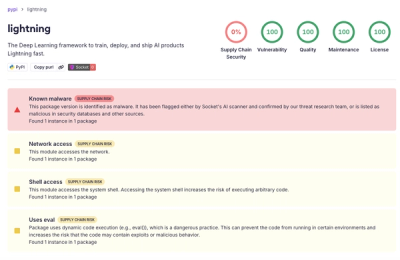
Socket detected a malicious supply chain attack on PyPI package lightning versions 2.6.2 and 2.6.3, which execute credential-stealing malware on import.
which-boxed-primitive
Advanced tools
Which kind of boxed JS primitive is this? This module works cross-realm/iframe, does not depend on instanceof or mutable properties, and works despite ES6 Symbol.toStringTag.
var whichBoxedPrimitive = require('which-boxed-primitive');
var assert = require('assert');
// unboxed primitives return `null`
// boxed primitives return the builtin constructor name
assert.equal(whichBoxedPrimitive(undefined), null);
assert.equal(whichBoxedPrimitive(null), null);
assert.equal(whichBoxedPrimitive(false), null);
assert.equal(whichBoxedPrimitive(true), null);
assert.equal(whichBoxedPrimitive(new Boolean(false)), 'Boolean');
assert.equal(whichBoxedPrimitive(new Boolean(true)), 'Boolean');
assert.equal(whichBoxedPrimitive(42), null);
assert.equal(whichBoxedPrimitive(NaN), null);
assert.equal(whichBoxedPrimitive(Infinity), null);
assert.equal(whichBoxedPrimitive(new Number(42)), 'Number');
assert.equal(whichBoxedPrimitive(new Number(NaN)), 'Number');
assert.equal(whichBoxedPrimitive(new Number(Infinity)), 'Number');
assert.equal(whichBoxedPrimitive(''), null);
assert.equal(whichBoxedPrimitive('foo'), null);
assert.equal(whichBoxedPrimitive(new String('')), 'String');
assert.equal(whichBoxedPrimitive(new String('foo')), 'String');
assert.equal(whichBoxedPrimitive(Symbol()), null);
assert.equal(whichBoxedPrimitive(Object(Symbol()), 'Symbol');
assert.equal(whichBoxedPrimitive(42n), null);
assert.equal(whichBoxedPrimitive(Object(42n), 'BigInt');
// non-boxed-primitive objects return `undefined`
assert.equal(whichBoxedPrimitive([]), undefined);
assert.equal(whichBoxedPrimitive({}), undefined);
assert.equal(whichBoxedPrimitive(/a/g), undefined);
assert.equal(whichBoxedPrimitive(new RegExp('a', 'g')), undefined);
assert.equal(whichBoxedPrimitive(new Date()), undefined);
assert.equal(whichBoxedPrimitive(function () {}), undefined);
assert.equal(whichBoxedPrimitive(function* () {}), undefined);
assert.equal(whichBoxedPrimitive(x => x * x), undefined);
assert.equal(whichBoxedPrimitive([]), undefined);
Simply clone the repo, npm install, and run npm test
The `kind-of` package is similar to `which-boxed-primitive` in that it provides a way to check the type of a value in JavaScript. However, `kind-of` goes beyond just boxed primitives and can identify many other types, including arrays, regular expressions, dates, and more. This makes `kind-of` more versatile for general type checking, but potentially less focused if the specific need is to identify boxed primitives.
The `is` package offers a collection of type-check functions, such as `is.string`, `is.number`, and so on, which can be used to determine the type of a given value. While it includes functions for checking boxed types (e.g., `is.object` and specific checks for boxed types), it is broader in scope and includes checks for many other types of values. Compared to `which-boxed-primitive`, `is` provides a more granular approach to type checking at the cost of requiring more specific function calls for each type.
FAQs
Which kind of boxed JS primitive is this?
The npm package which-boxed-primitive receives a total of 54,707,655 weekly downloads. As such, which-boxed-primitive popularity was classified as popular.
We found that which-boxed-primitive demonstrated a not healthy version release cadence and project activity because the last version was released a year ago. It has 1 open source maintainer collaborating on the project.
Did you know?

Socket for GitHub automatically highlights issues in each pull request and monitors the health of all your open source dependencies. Discover the contents of your packages and block harmful activity before you install or update your dependencies.

Research
Socket detected a malicious supply chain attack on PyPI package lightning versions 2.6.2 and 2.6.3, which execute credential-stealing malware on import.

Research
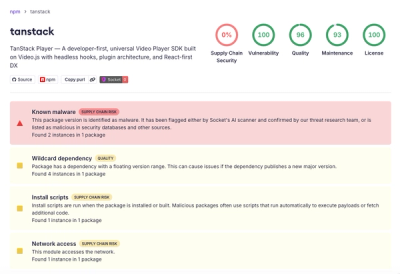
A brand-squatted TanStack npm package used postinstall scripts to steal .env files and exfiltrate developer secrets to an attacker-controlled endpoint.

Research
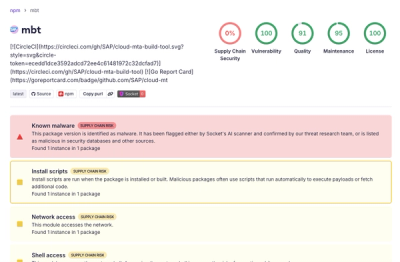
Compromised SAP CAP npm packages download and execute unverified binaries, creating urgent supply chain risk for affected developers and CI/CD environments.