

Security News
The Code You Didn't Write Is Still Yours to Defend
AI agents are pulling packages into environments no scanner is watching, creating exposure before security teams can see it.
By Brad Arkin - Jun 23, 2026
Simple to use, blazing fast and thoroughly tested websocket client and server for Node.js



ws is a simple to use, blazing fast, and thoroughly tested WebSocket client and server implementation.
Passes the quite extensive Autobahn test suite: server, client.
Note: This module does not work in the browser. The client in the docs is a
reference to a back end with the role of a client in the WebSocket
communication. Browser clients must use the native
WebSocket object.
To make the same code work seamlessly on Node.js and the browser, you can use
one of the many wrappers available on npm, like
isomorphic-ws.
protocolVersion: 8)protocolVersion: 13)npm install --save ws
There are 2 optional modules that can be installed along side with the ws module. These modules are binary addons which improve certain operations. Prebuilt binaries are available for the most popular platforms so you don't necessarily need to have a C++ compiler installed on your machine.
npm install --save-optional bufferutil: Allows to efficiently perform
operations such as masking and unmasking the data payload of the WebSocket
frames.npm install --save-optional utf-8-validate: Allows to efficiently check
if a message contains valid UTF-8 as required by the spec.See /doc/ws.md for Node.js-like docs for the ws classes.
ws supports the permessage-deflate extension which enables the client and server to negotiate a compression algorithm and its parameters, and then selectively apply it to the data payloads of each WebSocket message.
The extension is disabled by default on the server and enabled by default on the client. It adds a significant overhead in terms of performance and memory consumption so we suggest to enable it only if it is really needed.
Note that Node.js has a variety of issues with high-performance compression, where increased concurrency, especially on Linux, can lead to catastrophic memory fragmentation and slow performance. If you intend to use permessage-deflate in production, it is worthwhile to set up a test representative of your workload and ensure Node.js/zlib will handle it with acceptable performance and memory usage.
Tuning of permessage-deflate can be done via the options defined below. You can
also use zlibDeflateOptions and zlibInflateOptions, which is passed directly
into the creation of raw deflate/inflate streams.
See the docs for more options.
const WebSocket = require('ws');

const wss = new WebSocket.Server({
  port: 8080,
  perMessageDeflate: {
    zlibDeflateOptions: { // See zlib defaults.
      chunkSize: 1024,
      memLevel: 7,
      level: 3,
    },
    zlibInflateOptions: {
      chunkSize: 10 * 1024
    },
    // Other options settable:
    clientNoContextTakeover: true, // Defaults to negotiated value.
    serverNoContextTakeover: true, // Defaults to negotiated value.
    clientMaxWindowBits: 10,       // Defaults to negotiated value.
    serverMaxWindowBits: 10,       // Defaults to negotiated value.
    // Below options specified as default values.
    concurrencyLimit: 10,          // Limits zlib concurrency for perf.
    threshold: 1024,               // Size (in bytes) below which messages
                                   // should not be compressed.
  }
});
The client will only use the extension if it is supported and enabled on the
server. To always disable the extension on the client set the
perMessageDeflate option to false.
const WebSocket = require('ws');

const ws = new WebSocket('ws://www.host.com/path', {
  perMessageDeflate: false
});
const WebSocket = require('ws');

const ws = new WebSocket('ws://www.host.com/path');

ws.on('open', function open() {
  ws.send('something');
});

ws.on('message', function incoming(data) {
  console.log(data);
});
const WebSocket = require('ws');

const ws = new WebSocket('ws://www.host.com/path');

ws.on('open', function open() {
  const array = new Float32Array(5);

  for (var i = 0; i < array.length; ++i) {
    array[i] = i / 2;
  }

  ws.send(array);
});
const WebSocket = require('ws');

const wss = new WebSocket.Server({ port: 8080 });

wss.on('connection', function connection(ws) {
  ws.on('message', function incoming(message) {
    console.log('received: %s', message);
  });

  ws.send('something');
});
const fs = require('fs');
const https = require('https');
const WebSocket = require('ws');

const server = new https.createServer({
  cert: fs.readFileSync('/path/to/cert.pem'),
  key: fs.readFileSync('/path/to/key.pem')
});
const wss = new WebSocket.Server({ server });

wss.on('connection', function connection(ws) {
  ws.on('message', function incoming(message) {
    console.log('received: %s', message);
  });

  ws.send('something');
});

server.listen(8080);
const http = require('http');
const WebSocket = require('ws');

const server = http.createServer();
const wss1 = new WebSocket.Server({ noServer: true });
const wss2 = new WebSocket.Server({ noServer: true });

wss1.on('connection', function connection(ws) {
  // ...
});

wss2.on('connection', function connection(ws) {
  // ...
});

server.on('upgrade', function upgrade(request, socket, head) {
  const pathname = url.parse(request.url).pathname;

  if (pathname === '/foo') {
    wss1.handleUpgrade(request, socket, head, function done(ws) {
      wss1.emit('connection', ws, request);
    });
  } else if (pathname === '/bar') {
    wss2.handleUpgrade(request, socket, head, function done(ws) {
      wss2.emit('connection', ws, request);
    });
  } else {
    socket.destroy();
  }
});

server.listen(8080);
const WebSocket = require('ws');

const wss = new WebSocket.Server({ port: 8080 });

// Broadcast to all.
wss.broadcast = function broadcast(data) {
  wss.clients.forEach(function each(client) {
    if (client.readyState === WebSocket.OPEN) {
      client.send(data);
    }
  });
};

wss.on('connection', function connection(ws) {
  ws.on('message', function incoming(data) {
    // Broadcast to everyone else.
    wss.clients.forEach(function each(client) {
      if (client !== ws && client.readyState === WebSocket.OPEN) {
        client.send(data);
      }
    });
  });
});
const WebSocket = require('ws');

const ws = new WebSocket('wss://echo.websocket.org/', {
  origin: 'https://websocket.org'
});

ws.on('open', function open() {
  console.log('connected');
  ws.send(Date.now());
});

ws.on('close', function close() {
  console.log('disconnected');
});

ws.on('message', function incoming(data) {
  console.log(`Roundtrip time: ${Date.now() - data} ms`);

  setTimeout(function timeout() {
    ws.send(Date.now());
  }, 500);
});
For a full example with a browser client communicating with a ws server, see the examples folder.
Otherwise, see the test cases.
// If the WebSocket is closed before the following send is attempted
ws.send('something');

// Errors (both immediate and async write errors) can be detected in an optional
// callback. The callback is also the only way of being notified that data has
// actually been sent.
ws.send('something', function ack(error) {
  // If error is not defined, the send has been completed, otherwise the error
  // object will indicate what failed.
});

// Immediate errors can also be handled with `try...catch`, but **note** that
// since sends are inherently asynchronous, socket write failures will *not* be
// captured when this technique is used.
try { ws.send('something'); }
catch (e) { /* handle error */ }
The remote IP address can be obtained from the raw socket.
const WebSocket = require('ws');

const wss = new WebSocket.Server({ port: 8080 });

wss.on('connection', function connection(ws, req) {
  const ip = req.connection.remoteAddress;
});
When the server runs behind a proxy like NGINX, the de-facto standard is to use
the X-Forwarded-For header.
wss.on('connection', function connection(ws, req) {
  const ip = req.headers['x-forwarded-for'].split(/\s*,\s*/)[0];
});
Sometimes the link between the server and the client can be interrupted in a way that keeps both the server and the client unaware of the broken state of the connection (e.g. when pulling the cord).
In these cases ping messages can be used as a means to verify that the remote endpoint is still responsive.
const WebSocket = require('ws');

const wss = new WebSocket.Server({ port: 8080 });

function noop() {}

function heartbeat() {
  this.isAlive = true;
}

wss.on('connection', function connection(ws) {
  ws.isAlive = true;
  ws.on('pong', heartbeat);
});

const interval = setInterval(function ping() {
  wss.clients.forEach(function each(ws) {
    if (ws.isAlive === false) return ws.terminate();

    ws.isAlive = false;
    ws.ping(noop);
  });
}, 30000);
Pong messages are automatically sent in response to ping messages as required by the spec.
Use a custom http.Agent implementation like https-proxy-agent or
socks-proxy-agent.
We're using the GitHub releases for changelog entries.
Socket.IO is a library that enables real-time, bidirectional and event-based communication between web clients and servers. It's more feature-rich than 'ws', providing built-in support for broadcasting to multiple sockets, handling reconnection, and other high-level features. However, it's also heavier and less minimalistic than 'ws'.
Faye is a WebSocket (and EventSource) implementation that is designed for ease of use and compatibility across a wide range of browsers. It's similar to 'ws' but also works in client-side JavaScript, unlike 'ws' which is Node.js only.
The 'websocket' package provides both client and server implementations of the WebSocket protocol. It offers a similar API to 'ws' but also includes a fallback option for older browsers that do not support WebSockets, using Flash sockets or other transport protocols.
FAQs
Simple to use, blazing fast and thoroughly tested websocket client and server for Node.js
The npm package ws receives a total of 148,270,960 weekly downloads. As such, ws popularity was classified as popular.
We found that ws demonstrated a healthy version release cadence and project activity because the last version was released less than a year ago. It has 4 open source maintainers collaborating on the project.
Did you know?

Socket for GitHub automatically highlights issues in each pull request and monitors the health of all your open source dependencies. Discover the contents of your packages and block harmful activity before you install or update your dependencies.
Security News
AI agents are pulling packages into environments no scanner is watching, creating exposure before security teams can see it.

Security News
GitHub Actions checkout now blocks risky pull_request_target checkouts by default to help prevent pwn request supply chain attacks.
Product
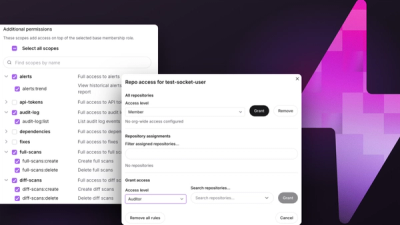
Socket now supports Custom Roles and Repository Access Permissions so organizations can control who can access specific repositories and actions.