
Research
/Security News
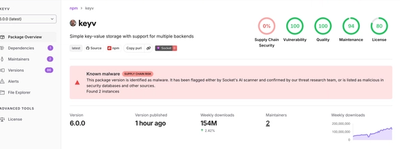
Popular npm Packages in the keyv and Cacheable Namespaces Compromised in Active Supply Chain Attack
Popular npm packages keyv and cacheable compromised.
By Socket Research Team - Aug 04, 2026
Local-first persistent memory for AI agents over MCP. Ground truths, negative learning (recorded failures block repeats), decision causality, hybrid recall, live memory streams, run-attributed fleet memory — a structured SQLite memory on your machine, no






Persistent memory for AI agents, over MCP.
Ground truths, recorded failures that block repeats, decision causality, and hybrid recall.
A structured SQLite memory on your machine. No cloud, no separate LLM.
Website · Quickstart · Discussions · Changelog
Most AI coding sessions start from zero. Wyrm gives the agent a memory that persists across them. It keeps your project's decisions, conventions, open work, and dead-ends in a structured database on your own machine, and hands them back to the model at the start of the next session. An agent connected to Wyrm recalls what was decided last week instead of re-deriving it, and can be stopped from repeating an approach that already failed.
It speaks the Model Context Protocol, so it drops into Claude, Cursor, Copilot, Windsurf, and Codex without glue code.
npm install -g wyrm-mcp # install
wyrm-setup # wire it into your AI clients, then restart them
On npm v12+, npm denies dependency install scripts by default, which skips
better-sqlite3's native build — the install succeeds butwyrmthen fails with "Could not locate the bindings file". Install with the build allow-listed instead:npm install -g wyrm-mcp --allow-scripts=wyrm-mcp,better-sqlite3(wyrm updatealready does this for you). See TROUBLESHOOTING.md.
Then, from inside your client, ask it to call wyrm_capabilities to confirm the connection. The everyday loop is four steps the agent runs on its own once the habit sets in:
prime    →  load the project's truths, quests, and dead-ends at session start
recall   →  retrieve what you know before re-deriving it
check    →  before retrying an approach, ask if it already failed
capture  →  store durable facts, lessons, and tasks as you go
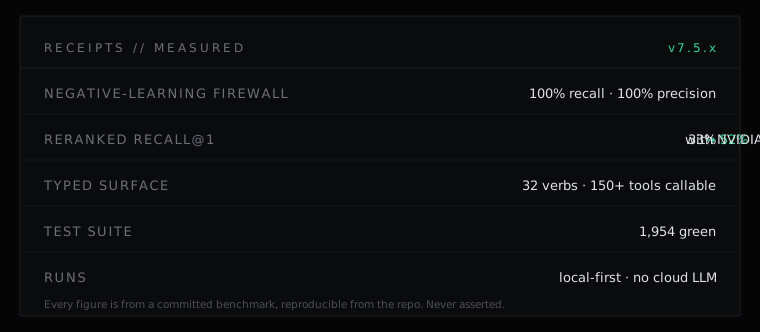
Every number Wyrm publishes comes from a benchmark committed to the source, reproducible on your own data. The negative-learning firewall and the recall lift are the two that matter most, and both are covered below.
Most memory tools store successes. Wyrm also records dead-ends and blocks the repeat. You record a failed approach with wyrm_failure_record, and a later wyrm_failure_check surfaces it before the agent walks back into it. Across a session that stops re-litigating solved problems; across a fleet of agents, one worker's dead-end warns the rest, once.
wyrm_recall runs keyword search (FTS5) and semantic search over a vector index, fuses them, and reranks. It is hybrid by default, no configuration required. It also weighs recency, temporal cues, and confirmed reuse, so the memory that fits the moment ranks first. On a real-set LoCoMo benchmark committed in the repo, the deterministic no-LLM floor reaches recall@10 59.9%, and local hybrid recall lifts it to 72.6%. For higher accuracy you can opt into NVIDIA NIM retrieval (below).
By default nothing leaves your machine. The database is a single SQLite file at ~/.wyrm/wyrm.db. When you do opt into a hosted embedding path, Wyrm reports exactly what left and where, in a determinism receipt and on its health endpoint. The privacy claim is one you can verify from the runtime, not just the docs.
Every memory write returns a structured receipt that says what happened to it: stored, queued for review, merged, aliased, or dropped, and why. The receipts are ledgered too, so wyrm digest --writes reconstructs a day's writes offline and wyrm_stats shows the outcomes and the review-queue depth. You can audit what the agent actually committed to memory, not just trust that it did.
Every memory is attributed to the agent and run that produced it, so a swarm of agents can share one accountable memory bus, with failures kept private to your account by default. A live event stream keeps devices in sync.
Every artifact is tagged with where it came from: you, an agent, an import, or an untrusted source. Content on the untrusted lane is categorically withheld from the context briefs the model reads, whatever it contains, and imported content is detector-gated and marked. The brief-surface quarantine was hardened against a full garak red-team of 622 real jailbreak payloads: zero escapes from the untrusted lane by construction, and the detector flagged 80.7% of the rest with zero false positives on benign prose. That red-team runs as a CI gate.
Wyrm can use NVIDIA NIM for embeddings and reranking when accuracy is worth a hosted call. On a retrieval benchmark committed in the repo, recall@1 moved from 33% on the local baseline to 47% with NIM embeddings and 52% with NIM reranking added. It is an explicit opt-in, off by default, and the egress is disclosed on every call.
export WYRM_VECTOR_PROVIDER=nim
export WYRM_RERANK_PROVIDER=nim
export NIM_API_KEY=nvapi-...
Ghost Protocol (Pvt) Ltd is a member of NVIDIA Inception.
Claude (Code, desktop, web) · Cursor · GitHub Copilot · Windsurf · Codex, and any MCP-capable client.
Node.js 22 or newer. Optional: a local Ollama with nomic-embed-text for semantic recall without any hosted call.
Wyrm sends no telemetry, so the way we learn what is working is you telling us.
wyrm feedback from your terminal opens a prefilled report. Add --bug, --idea, or --question.If Wyrm earned a place in your workflow, a star helps other people find it.
Wyrm is proprietary software, free to use under the Wyrm license and Terms of Service. This repository is the public home for the docs, the changelog, and the community. The source is not published here. For a commercial license (embedding Wyrm in a closed product, or running it as a managed service), contact ryan@ghosts.lk.
Built by Ghost Protocol · Colombo, Sri Lanka
NVIDIA, the NVIDIA logo, and NVIDIA Inception are trademarks and/or registered trademarks of NVIDIA Corporation.
FAQs
Local-first persistent memory for AI agents over MCP. Ground truths, negative learning (recorded failures block repeats), decision causality, hybrid recall, live memory streams, run-attributed fleet memory — a structured SQLite memory on your machine, no
The npm package wyrm-mcp receives a total of 380 weekly downloads. As such, wyrm-mcp popularity was classified as not popular.
We found that wyrm-mcp demonstrated a healthy version release cadence and project activity because the last version was released less than a year ago. It has 1 open source maintainer collaborating on the project.
Did you know?

Socket for GitHub automatically highlights issues in each pull request and monitors the health of all your open source dependencies. Discover the contents of your packages and block harmful activity before you install or update your dependencies.
Research
/Security News
Popular npm packages keyv and cacheable compromised.

Security News
A misconfiguration gave three Anthropic models internet access, and one, believing it was in a simulation, shipped a credential-stealing package to PyPI.

Security News
/Company News
Socket has joined the new Composer and Packagist sponsorship program as a launch sponsor, supporting the team that keeps PHP's package ecosystem secure.