
Research
/Security News
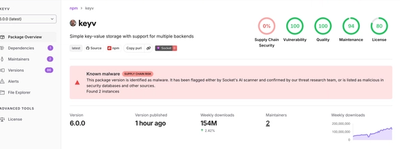
Popular npm Packages in the keyv and Cacheable Namespaces Compromised in Active Supply Chain Attack
Popular npm packages keyv and cacheable compromised.
By Socket Research Team - Aug 04, 2026
Local compiler-backed verification and typed .NET wiring for AI coding agents. Typecheck proposed edits, compute change impact, run covering tests, and stage verified refactors. Persistent scoped context supports these outcomes.

The MCP server that collapses an AI coding agent's explore phase on .NET into one scoped call.
Website . Documentation . Connect your agent . Benchmarks



Fuse is a Model Context Protocol server for AI-assisted development on .NET. It hands your coding agent (Claude Code, Cursor, GitHub Copilot) the right code, scoped and reduced, in a single call, instead of letting it burn its context window opening thousands of files during the explore phase. It cuts input tokens while keeping the public API intact, scopes to the files a task needs, and trims the round-trips an agent makes. The same engine is also a fuse CLI.
Unlike generic repo packers (Repomix, Code2Prompt, Gitingest), Fuse understands C# structure: dependency graphs, skeleton extraction, BM25 query scoping, git change detection, and convention patterns. An opt-in Roslyn precision tier and a hybrid-retrieval reranker raise accuracy further. The MCP server exposes eight tools; see Connect your agent.
Full documentation lives at fuse.codes.
Measured over a pinned corpus of four real .NET libraries (MediatR, FluentValidation, AutoMapper, Newtonsoft.Json), counted with the o200k_base tokenizer. Reduction ratios transfer across models even though absolute token counts do not. Every figure is reproducible with one command and reported in full, including the arms where Fuse ties or loses, on the benchmarks page.

fuse --query call delivers the files a change needs in about 40,000 tokens at 51 percent recall, against a generic-packer dump of about 512,000 tokens (about 13 times more) at the same single call, and about 494,000 tokens to read the repository blind. Fuse ties a packer at one call and wins on tokens; with a git base the change-scoping mode reaches 88 percent recall. Read the token number with its recall.--all removes 21 to 40 percent of tokens while keeping 99 to 100 percent of public types and methods. --skeleton removes 66 to 93 percent for an architecture map.Reproduce every number with pwsh -File tests/benchmarks/harness/run-all.ps1.
Fuse is a developer tool for .NET developers, so the recommended install is the .NET global tool (.NET SDK 10.0 or later):
dotnet tool install -g Fuse
Or run it on demand without installing: dnx Fuse -- serve.
If you do not have the .NET SDK, install a self-contained binary (Native AOT, no runtime required) with the script for your platform:
# Linux
curl -fsSL https://fuse.codes/install.sh | sh
# Windows
irm https://fuse.codes/install.ps1 | iex
On Windows you can also use winget install Litenova.Fuse, or download a binary
from Releases. Verify with
fuse --help. Full notes: fuse.codes/docs/start/install.
Register Fuse once; your AI client launches fuse mcp serve automatically when MCP is enabled:
fuse mcp install
That writes MCP config for Claude Code, Cursor, and GitHub Copilot in the current project.
Use fuse mcp install --scope user to register Fuse for every project on this machine.
Use fuse mcp install --client cursor to configure one client only.
Manual registration is also supported. For Claude Code, add .mcp.json to your project root:
{
  "mcpServers": {
    "fuse": {
      "type": "stdio",
      "command": "fuse",
      "args": ["mcp", "serve"]
    }
  }
}
Or register with the Claude CLI: claude mcp add fuse --scope project -- fuse mcp serve
(use --scope user for all projects). Cursor uses .cursor/mcp.json and GitHub Copilot
uses .vscode/mcp.json; see Connect to your AI for both.
A recommended agent flow on a large codebase: survey with fuse_toc or fuse_skeleton, drill in with fuse_focus or fuse_search, then review a branch with fuse_changes. Or call fuse_ask with a task and a token budget and let Fuse pick the strategy. See Context for an agent.
Tool catalog and parameters: MCP Tools and MCP Resources. MCP Registry manifest: mcp-registry/server.json.
The same engine runs as a CLI:
# fuse a .NET project with the DotNet template
fuse dotnet --directory ./src

# maximum C# reduction, public API intact
fuse dotnet --directory ./src --all

# architecture overview, signatures only
fuse dotnet --directory ./src --all --skeleton

# cheap survey before fetching files (tree, symbol outline, token costs)
fuse dotnet --directory ./src --toc

# accurate skeletons and dependency edges with the Roslyn precision tier
fuse dotnet --directory ./src --skeleton --semantic

# PR-scoped fusion with diff hunks and the callers of each changed file
fuse dotnet --directory ./src --changed-since main --review

# query-scoped fusion
fuse dotnet --directory ./src --query "payment gateway" --query-top 10
Output defaults to Documents/Fuse; use --output and --name to control the destination. Walkthrough: fuse.codes/docs/start/quickstart.
| Command | Purpose |
|---|---|
fuse | Generic fusion. All extensions unless you set --only-extensions. |
fuse dotnet | .NET projects: C# reduction, structural maps, dependency-aware scoping. |
fuse wiki | Azure DevOps wikis: Markdown only. |
fuse init | Create fuse.json in the current directory. |
fuse mcp install | Register Fuse with MCP clients (Claude Code, Cursor, Copilot). |
fuse mcp serve | MCP server entry point on stdio (launched by your client, not run manually). |
Full option lists: Commands and Options.
A fusion is a four-stage pipeline:
.gitignore, binary detection, test projects, globs).The concept in plain terms is at How Fuse works; the internals are at The pipeline.
src/
  Core/                               Pipeline libraries
    Fuse.Collection/                  File discovery, filters, templates
    Fuse.Reduction/                   Content pipeline, caching, redaction
    Fuse.Emission/                    Output writers, token budget, manifest
    Fuse.Fusion/                      Orchestration, scoping, analysis, enrichment, DI
  Host/
    Fuse.Cli/                         CLI and MCP server
  Plugins/                            Extension-keyed capability providers
    Fuse.Plugins.Abstractions/        Capability interfaces (shared contract)
    Fuse.Plugins.Languages.CSharp/    C# language plugin (regex, AOT-clean default)
    Fuse.Plugins.Languages.CSharp.Roslyn/  Opt-in Roslyn precision tier (excluded from the AOT build)
    Fuse.Plugins.Formats.Web/         Format reducers (HTML, JSON, YAML, SQL, TS/JS, etc.)
tests/                                Unit, golden-output, and integration tests; benchmarks
site/                                 The fuse.codes website and documentation (Next.js + Fumadocs)
assets/                               Benchmark figure and the chart-generating script
mcp-registry/                         MCP Registry server manifest
dotnet build Fuse.slnx --configuration Release
dotnet test Fuse.slnx --configuration Release --no-build
dotnet format Fuse.slnx --verify-no-changes
Contribution workflow: Contributing. Agent instructions: AGENTS.md. The documentation site is in site/; see site/README.md to run it locally.
MIT. Copyright (c) 2026 Litenova Solutions. See LICENSE.
FAQs
Local compiler-backed verification and typed .NET wiring for AI coding agents. Typecheck proposed edits, compute change impact, run covering tests, and stage verified refactors. Persistent scoped context supports these outcomes.
We found that Fuse demonstrated a healthy version release cadence and project activity because the last version was released less than a year ago. It has 1 open source maintainer collaborating on the project.
Did you know?

Socket for GitHub automatically highlights issues in each pull request and monitors the health of all your open source dependencies. Discover the contents of your packages and block harmful activity before you install or update your dependencies.
Research
/Security News
Popular npm packages keyv and cacheable compromised.

Security News
A misconfiguration gave three Anthropic models internet access, and one, believing it was in a simulation, shipped a credential-stealing package to PyPI.

Security News
/Company News
Socket has joined the new Composer and Packagist sponsorship program as a launch sponsor, supporting the team that keeps PHP's package ecosystem secure.