
Research
/Security News
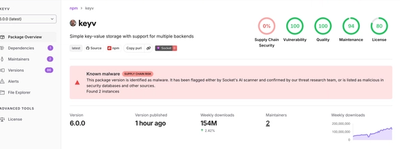
Popular npm Packages in the keyv and Cacheable Namespaces Compromised in Active Supply Chain Attack
Popular npm packages keyv and cacheable compromised.
By Socket Research Team - Aug 04, 2026
Local compiler-backed verification and typed .NET wiring for AI coding agents. Typecheck proposed edits, compute change impact, run covering tests, and stage verified refactors. Persistent scoped context supports these outcomes.

A faster, cheaper, more accurate AI coding assistant on your .NET codebase.
Website . Documentation . Connect your agent . Benchmarks



Fuse is a Model Context Protocol server that makes your AI coding assistant (Claude Code, Cursor, GitHub Copilot) faster, cheaper, and more accurate on .NET code. Its one concrete edge: it understands how your code is actually wired (which service implements an interface, which handler runs a request, which action a route hits) by reading the code with Roslyn, so the assistant answers from the real graph instead of guessing from file names and grep. Context for a task arrives scoped and reduced in one call, so the agent spends fewer tokens and fewer round-trips. The same engine is also a fuse CLI.
Full documentation: fuse.codes.
Fuse is a .NET developer tool, so the recommended install is the .NET global tool (.NET SDK 10.0 or later):
dotnet tool install -g Fuse
Or run it on demand without installing: dnx Fuse -- serve. No SDK? Install a self-contained binary (the .NET runtime is bundled):
curl -fsSL https://fuse.codes/install.sh | sh      # Linux / macOS
irm https://fuse.codes/install.ps1 | iex           # Windows PowerShell
On Windows: winget install Litenova.Fuse, or grab a binary from Releases. Verify with fuse --help. Full notes: fuse.codes/docs/start/install.
Register Fuse once; your client launches fuse mcp serve automatically when MCP is enabled:
fuse mcp install --rules
That writes MCP config for Claude Code, Cursor, and GitHub Copilot in the current project, and --rules adds a short instruction so the agent reaches for the fuse_* tools instead of grepping blindly. Use --scope user for every project on the machine, or --client cursor for one client.
Prefer to wire it by hand? The MCP server config is the same shape everywhere:
{
  "mcpServers": {
    "fuse": {
      "command": "fuse",
      "args": ["mcp", "serve"]
    }
  }
}
Put it in .mcp.json (Claude Code), .cursor/mcp.json (Cursor), or .vscode/mcp.json (Copilot); any MCP client uses the same command and args. The Claude CLI shortcut is claude mcp add fuse --scope project -- fuse mcp serve. Both surfaces are covered in Connect your agent.
Fuse exposes verbs an agent uses while it works. Two carry most of the value:
# Resolve .NET wiring: which implementation does the container give for IBasketService?
fuse_resolve  service="IBasketService"
  -> BasketService  (src/ApplicationCore/Services/BasketService.cs)
     edge: di_resolves_to  (registered services.AddScoped<IBasketService, BasketService>())

# Scope a change: the blast radius of a branch, packed under a token budget
fuse_review  changedSince="main"
  -> changed files + support files (the interface a changed type implements, its consumers)
     100% of changed files kept, ~958 tokens median, with provenance for each file
The rest of the surface, by what an agent does with it:
| Verb | What it does |
|---|---|
fuse_map | Workspace map (symbols, routes, counts). The cheap first call. |
fuse_localize | Rank candidate files for a task. Refuses and hands back a map when the task names no code. |
fuse_resolve | Resolve wiring: service to implementation, request to handler, route to action, config to options. |
fuse_context | Emit scoped, reduced source (with provenance) for selected seeds. |
fuse_review | Diff-first semantic impact and packed context for a change. |
fuse_neighbors | Graph neighborhood of a file, callers and implementers of a symbol, central files of an area. |
fuse_find | Exact symbol, path, or text lookup. |
fuse_index | Build or refresh the persistent semantic index (the read tools build it on first use). |
Tool parameters and the full catalog: MCP Tools.
Fuse is judged as a semantic engine, not a token compressor: can it resolve .NET wiring, scope a change precisely, help an agent, and stay honest on a vague query. Every figure below is recorded under tests/benchmarks/results and reproduced with fuse eval <suite>; the full methodology, the corpus, and the modes where Fuse is weak are on the benchmarks page. Numbers are counted with the o200k_base tokenizer over a commit-pinned corpus (Scrutor, Ardalis.Specification, NodaTime, and the eShopOnWeb application).
fuse review keeps 100 percent of the changed files at 79.8 percent precision in a median 958 returned tokens, adding the semantic blast radius (callers, DI consumers, handlers) on top. A grep baseline reaches 53 percent recall at 14 percent precision.fuse localize recalls about 15 percent of the changed files: the weakest mode, reported straight. Rather than return a low-precision guess on a no-signal title, Fuse refuses and hands back a navigation map (correct-refusal rate 100 percent on no-signal titles).No head-to-head ranking against other tools is claimed here; the measured peer comparison (with the exact reproduction command and every caveat) lives on the benchmarks page.
The same engine runs as a CLI for one-shot context outside an agent:
fuse index ./src                                   # build the semantic index
fuse localize ./src --task "discount rounding at checkout"
fuse dotnet --directory ./src --level skeleton     # architecture overview, signatures only
Output and option lists: Commands and Quickstart.
The planned direction is the Roadmap; shipped work is the Changelog.
src/
  Core/        Pipeline and engine: Fuse.Collection, Fuse.Reduction, Fuse.Emission,
               Fuse.Fusion, plus the V3 semantic stack (Fuse.Indexing, Fuse.Semantics,
               Fuse.Retrieval, Fuse.Context).
  Host/        Fuse.Cli: the CLI commands and the MCP server.
  Plugins/     Extension-keyed providers: Abstractions, Languages.CSharp,
               Languages.CSharp.Roslyn, Formats.Web.
tests/         Unit, golden-output, and integration tests; benchmarks under tests/benchmarks.
site/          The fuse.codes website and documentation (Next.js + Fumadocs).
assets/        The benchmark figure and its chart-generating script.
mcp-registry/  MCP Registry server manifest.
dotnet build Fuse.slnx --configuration Release
dotnet test Fuse.slnx --configuration Release --no-build
dotnet format Fuse.slnx --verify-no-changes
Contribution workflow: Contributing. Durable project context for contributors and agents: AGENTS.md. The docs site is in site/.
MIT. Copyright (c) 2026 Litenova Solutions. See LICENSE.
FAQs
Local compiler-backed verification and typed .NET wiring for AI coding agents. Typecheck proposed edits, compute change impact, run covering tests, and stage verified refactors. Persistent scoped context supports these outcomes.
We found that Fuse demonstrated a healthy version release cadence and project activity because the last version was released less than a year ago. It has 1 open source maintainer collaborating on the project.
Did you know?

Socket for GitHub automatically highlights issues in each pull request and monitors the health of all your open source dependencies. Discover the contents of your packages and block harmful activity before you install or update your dependencies.
Research
/Security News
Popular npm packages keyv and cacheable compromised.

Security News
A misconfiguration gave three Anthropic models internet access, and one, believing it was in a simulation, shipped a credential-stealing package to PyPI.

Security News
/Company News
Socket has joined the new Composer and Packagist sponsorship program as a launch sponsor, supporting the team that keeps PHP's package ecosystem secure.